Sādhana of Vajrayoginī
Sādhana of Vajrayoginī
by Nāropa
In the language of India: Vajrayoginīsādhanam
In the language of Tibet: Dorjé Nenjormé Druptap (rdo rje rnal ’byor ma’i sgrub thabs)
In the English language: A Sādhana of Vajrayoginī
Homage to Mahākāruṇika!
First, the yogin should actualize the Yoga of the Immeasurables, thinking: “I will liberate all sentient beings from the ocean of saṃsāra and establish them in the bliss of perfect awakening.”
Then, one should meditate upon the guru at one’s head.[1]
After that, visualize that within one’s heart-center, there is moon mandala arisen from the syllable aṃ. Upon that, visualize the mantra garland: oṁ oṁ oṁ sarvabuddhāḍākinīye vajra varṇanīye vajra vairocanīye hūṁ hūṁ hūṁ phaṭ phaṭ phaṭ svāhā. It is red in color, radiating multicolored light rays, and arranged in reverse order.[2] In its center is the syllable vaṁ.[3]
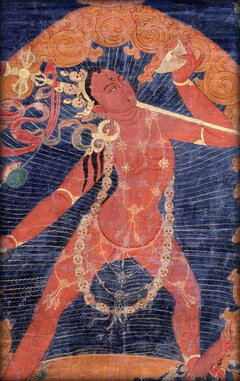
The light rays pervade one’s own body, completely purifying it. Then imagine: I arise as the Bhagavatī Vajravārāhī with one face, two arms, and a red-colored body. She is as brilliant as the fire at the end of an aeon. She is adorned with the five seals.[4] She stands upon a variegated lotus and sun disk, with her feet suppressing Bhairava and Kālarātri. Her right hand holds a vajra-flay knife and her left holds a skull cup and a khaṭvāṅga.
Then, once again, multicolored light rays radiate from the assembly of syllables, inviting all the hosts of vīras and ḍākinīs to enter into me.
These light rays radiate again, purify sentient beings, and return. With the mantra garland as before, recite the mantra, differentiating between mental and verbal recitations.
Then, by means of the light rays emanating from the syllable vaṁ, the three realms, one’s body, and the syllables gradually recede into the inconceivable, and one meditates on suchness.
This concludes the Brief Meditation for Beginners, an oral transmission of the glorious Nāropa. It was translated by the Indian scholar Sumatikīrti[5] and the Tibetan translator, the bhikṣu Prajñākīrti. Sarva maṅgalam!
| Translated by Jake Nagasawa, 2026
Bibliography
Tibetan Source
Nāropa. "rdo rje rnal 'byor ma'i sgrub thabs" in bstan 'gyur dpe bsdur ma, Q 2290, rgyud, vol. 12, pp. 791–793.
Secondary Sources
Almogi, Orna. "The Translation Endeavours of Shes rab grags Revisited: An Investigation of Translations Done by Pu rang lo chung Shes rab grags and 'Bro lo tsā ba Shes rab grags." Revue d'Etudes Tibétaines 63 (April 2022): 289–400.
Pabongkha Dechen Nyingpo. The Extremely Secret Dakini of Naropa: Vajrayogini Practice and Commentary. Translated by David Gonzalez. Ithaca: Snow Lion Publications, 2011.
Version: 1.0–20260320
Notes
-
In what has come to be known as the Nāroḍākinī (nā ro mkha' spyod) tradition of the practice of Vajrayoginī, the guru is imagined in the form of Vajradharma (rdo rje chos). ↩
-
The phrase here is lugs las bzlog pa, which I have rendered as “arranged in reverse order.” There is debate between different traditions about the interpretation of this phrase and how the mantra garland should be visualized. See Pabongkha Dechen Nyingpo, The Extremely Secret Dakini of Naropa: Vajrayogini Practice and Commentary, trans. David Gonzalez (Ithaca: Snow Lion Publications, 2011), 118–120. ↩
-
Often rendered as bam in Tibetan. ↩
-
These are: 1) a diadem, 2) earrings, 3) a necklace, 4) a chest ornament, and 5) bangles and anklets. ↩
-
Sumatikīrti was a Nepali master who was involved with translating several works with Tibetan scholars in the second half the eleventh century to the first half of the twelfth century. He is thought to have been a direct disciple of Nāropa. See Orna Almogi’s “The Translation Endeavours of Shes rab grags Revisited: An Investigation of Translations Done by Pu rang lo chung Shes rab grags and ’Bro lo tsā ba Shes rab grags,” Revue d’Etudes Tibétaines 63, April 2022: 289–400. ↩