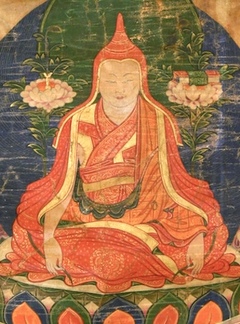
Zabmo Yangtik History
The Garland of Precious Light
A History of the Zabmo Yangtik Teachings
by Longchen Rabjam
Homage to glorious Samantabhadra!
At the outset, I pay homage
To the Teacher, protector of the triple world,
Who is worshipped by the gods themselves,
The bringer of auspiciousness, happiness and excellence.
Here I shall set out the Garland of Light history,
So amazing, wondrous and propitious,
Telling how the sublime beings came into the world
And how they turned the Wheel of Dharma.
1. Wisdom-Mind Transmission of the Victorious Ones
Countless aeons ago, in the realm known as Natural Array, the fully awakening great Vajradhara was someone who offered a golden vajra to the Buddha Great Exquisite Flower and first set his mind on supreme awakening. Then, in his second rebirth thereafter, in a northern realm called Windswept Array he was one named Jewelled Rosary who received Dharma teachings in the presence of the Buddha Wheel of Excellent Conduct. After he died, he took birth in the land known as Blissful Intoxication as one called Well Given, who received teachings for five years from the Buddha Virtuous Intelligence and then spent seven years absorbed in samādhi. Through this, he attained complete and perfect awakening on the summit of the mountain Heap of Precious Gem Array. He remained for one great aeon without falling into any extreme basis of phenomenal elaboration, and the great naturally emergent wisdom of compassion stirred out of the great spontaneity of the internal space and the precious visions of spontaneous presence naturally arose to the kāya of dharmatā. The radiance of fivefold wisdom became manifest externally, and the emanation and absorption of light rays naturally appeared as the cause of the thirty-six actions. Out of the domain of the luminous sphere, sixty perfect locations spontaneously arranged themselves, and through the blessings of this natural occurrence, countless hundreds of thousands of buddha forms manifested spontaneously. By means of the six naturally occurring wisdoms all sentient beings were established in unsurpassable awakening. This happened three times, whereby the naturally emergent syllable spontaneously arose in the form of a face and hands as Samantabhadra himself, king of natural cognizance and awareness. Inexhaustible compassion radiated throughout the ten directions. Out of that very state, the buddhas of the five families naturally appeared as the enjoyment of Samantabhadrī, the dharmatā, and blazed with light as the kāyas of great perfection.
At that time, within a pure luminous dome, a tiered house of light, the pure teacher was the king of natural cognizance and awareness called Vairocana Glacial Ocean. He arose spontaneously as the sovereign of all the maṇḍalas, immovable within an experience of the precious teachings, his enlightened body, speech and mind self-arisen and unfabricated. He abided in the realization in which kāyas and wisdoms are inseparably united with the pure realm of Ghanavyūha together with an immense retinue of self-arisen gatherings.
Then, naturally occurring wisdom stirred and manifested as the compassionate nirmāṇakāya. Through the power of recalling aspirations from the past, Vajradhara complete with all the signs arose and manifested in precious, wish-fulfilling forms for the purpose of guiding disciples. How do such forms appear? They appear in twelve domains as twelve different buddhas and act for beings’ benefit.
That is to say, at the dharmakāya stage, the teacher Samantabhadra has assumed a form with face and hands. His enlightened body, speech and mind have outer, inner, secret and unsurpassable aspects, and his thirty-six forms of activity, based on sets of four, unfold spontaneously. He appears together with the token of enlightened mind, a dharmatā vajra that is not created by anyone. Through blessings, the vajra arises naturally from 101 precious substances and appears in a size to match the hands of the beings for whom it is destined.
At the sambhogakāya stage, there is manifestation as the buddhas of the five families. Their thirty-six forms of activity related to the outer, inner, secret and unsurpassable aspects of enlightened body, speech and mind unfold spontaneously. They appear together with the token of enlightened speech, the great, spontaneously arisen text of The Single Child of the Teachings, the natural resonance of dharmatā. Through blessings, the text appears naturally from 101 precious substances and resounds spontaneously in language that is intelligible to the beings for whom it is destined.
At the nirmāṇakāya stage, there is manifestation as Vajradhara complete with all the signs. His thirty-six forms of activity related to enlightened body, speech and mind unfold spontaneously. He appears together with the token of enlightened body, which appears spontaneously through the blessings of all the buddhas. Through such blessing, the statue materialises automatically from 101 precious substances in a size that matches the physical bodies of the beings for whom it is destined.
While the actual tokens of enlightened body, speech and mind remain in Akaniṣṭha together with the three kāyas, three representative tokens are present in Jambudvīpa, where, through their varied manifestations, they naturally bring benefit to beings.
The Twelve Dzogchen Teachers
As to how the nirmāṇakāya Vajradhara complete with all the signs brings about such benefit, at first Vajradhara himself manifested in the realm of Joyous Multitude[1] as the perfect teacher Youth of Inconceivably Sublime Light.[2] In the perfect location, a thousand-petalled lotus flower, the emanation appeared before the perfect retinue of a thousand and one buddhas, and taught the perfect Dharma, the great Word-Transcending Tantra that is the precursor of all other tantras. This happened during the perfect time, when the lifespan of beings was immeasurable.
Then, in the Sahā world, the perfect teacher Unwavering Light took birth perfectly via a pure oviform orb of light, and gave the perfect teaching, the five tantras of enlightened body, speech, mind, qualities and activity, to the perfect retinue of two hundred thousand ḍākinīs at the perfect time, when the lifespan was ten million years.
Similarly, in the perfect location Mass of Light Containing Heat and Moisture, the teacher Mind of Protection from Fear taught the tantras known as Emptying Saṃsāra from Its Depths, Entwined Peacocks, and Exhaustion of the Four Elements to a retinue of six hundred thousand bodhisattvas at a time when the lifespan was one hundred thousand years.
Then, in the location Appearance in the Womb of Conception, the teacher Youthful Disportment taught the eleven tantras—the five root tantras and six auxiliary tantras of the Mind Series—to a retinue of a hundred thousand yakṣas and rock demons at a time when the lifespan was eighty thousand years.
Then, in the Garden of Life-Sustaining Youth, the teacher Vajradhara taught the six transcendent perfections and more to a retinue including the seven successive buddhas at a time when the lifespan was seventy thousand years.
Then, in the charnel ground Blazing Volcano on the north side of Mount Meru, the teacher Youthful Mighty Great Warrior taught the father and mother tantras to a retinue of seven bodhisattvas, including Bālāhaka, at a time when the lifespan was sixty thousand years.
Then, in the location Possessed of the ‘Rulu’ Sound of the Rākṣasas, the teacher Wrathful Kingly Sage taught the ten tantras on subduing coarse defilements to a retinue of ten million rākṣasas at a time when the lifespan was ten thousand years.
Then, at the location Vulture Peak Mountain, the arhat teacher Sublime Golden Light taught unfathomable myriads of Vinaya instructions to a retinue of countless śrāvakas with miraculous abilities at a time when the lifespan was five thousand years.
Then, before the Tree of Victory in the place Turquoise-Browed Sokpo, the teacher Playful Intelligence taught the seven subtle tantras[3] to a retinue of eighth-bhūmi bodhisattvas at a time when the lifespan was a thousand years.
Then, at Vulture Peak, the teacher Kāśyapa the Elder taught the sūtras, Kriyā tantras and eighty thousand Anuyoga instructions to a retinue of seven long-lived ones[4] at a time when the lifespan was five hundred years.
Then, before the bodhi tree at the Vajra Seat, the teacher Truly Perfected King taught the Dharma of exclusively definitive meaning to a retinue of the Lords of the Three Families at a time when the lifespan was three hundred years.
Then, in such locations as Anāthapiṇḍada’s pleasure grove,[5] the teacher Śākyamuni taught the Dharma such as the Four Truths to the fourfold retinue[6] at a time when the lifespan was a hundred years.
This is known as the wisdom-mind transmission of the victorious ones, because each of these teachers, who appear in different locations as described, transmits the actual realization of the Vajradhara alone and because the sambhogakāya and dharmakāya teachers transmit a single realization. The teachers who act in these ways in these realms are known as transcendent conquerors who are masters of the teachings. The thousand buddhas maintain a lineage of one wisdom mind, whereas those buddhas who appear in the intervals between them, and who do not act in such ways are known as intermediate buddhas, while their teachings are called partial.[7]
This concludes the wisdom-mind transmission of the victorious ones.
2. Symbolic Transmission of the Vidyādharas
Garab Dorje
Three hundred and sixty years after the Buddha’s parinirvāṇa, in the western land of Uḍḍiyāna, King Uparāja and Queen Ālokabhāsvatī (Radiant Light) had a daughter named Sudharmā,[8] who took ordination as a nun. She constructed a grass hut on a western island covered by golden sands. There, while she was perfectly absorbed in meditative concentration, she had a dream in which a white figure bestowed empowerment upon her using a precious vase. Ten months later, a child complete with the signs and marks was born from her right side. The mother was alarmed and said aloud, “Who could such a fatherless child be but a worldly demon? He will bring accusations of misconduct from misguided folk. How wrong this is!” With this, she abandoned the child in a pit of ashes. After three days, she witnessed various signs such as an earthquake and rays of light, and she saw that the child, who was unharmed, was being honoured by kingly devas and sages. Amazed, she retrieved him.
Seven years later, when the child had demonstrated a spontaneous mastery of all the teachings, he went to Uḍḍiyāna where he debated with paṇḍitas and won. He was recognised as an emanation of a buddha. The king, in his delight named him Prahevajra (Garab Dorje, Supremely Joyful Vajra). His mother named him Ashen Resurrected.[9] The local population called him Happily Resurrected and the paṇḍitas named him Prajñābhava (Source of Intelligence). These four different names derive from intentions he formed during four previous lifetimes when he was listening to the Dharma before the twelve nirmāṇakāya buddhas.
Garab Dorje travelled northwards to Mount Sūryaprakāśa where he remained in samādhi for thirty-two years. Then, he went to the peak of Mount Malaya, which abounds in precious jewels, where he committed to writing the collections of teachings he had heard from buddhas in the past, including the precious tantras and especially the six million four hundred thousand teachings of the natural Great Perfection that were stored in his memory. Having deposited these teachings in the Cave from Which Ḍākinīs Emerge, he went to the charnel ground of Śītavana to the north east of the Vajra Seat, where he taught the Dharma to ḍākinīs.
Mañjuśrīmitra
At that time, there was a master called Mañjuśrīmitra, who had been born in a town called Dvikrama to the west of the Vajra Seat. His father was the brahmin Sādhuśāstri and his mother was Pradīpālokā, and he was learned in the five sciences. Ārya Mañjuśrī gave him a prophetic instruction: “Son of noble family, if you wish to attain buddhahood in a single lifetime, go the charnel ground of Śītavana.” He went as soon as he heard this, and there met the master [Garab Dorje], with whom he studied the Dharma for the next seventy-five years. Eventually, when the nirmāṇakāya Garab Dorje displayed the signs of passing into parinirvāṇa at the source of the River Danatika, to the north east of the charnel ground, Mañjuśrīmitra cried out in anguish: “Kyema kyihü! Kyema long! If the light of the teacher’s lamp should fade, who will dispel the darkness of the world?” When he said this, the master’s right forearm emerged from a circle of light in the sky, letting fall a precious golden casket the size of a fingernail, which descended into Mañjuśrīmitra’s hand. Mañjuśrīmitra opened it and discovered the testament Striking the Vital Point in Three Statements, a mere glance at which caused him to gain the same level of realization as his teacher.
Then, the master Mañjuśrīmitra divided the six million four hundred thousand teachings of the Natural Great Perfection into three series: mind, space and pith instructions. He further divided the pith instruction series into the explanatory transmission and the oral transmission. He set down notes on the oral transmission. As he could not find a suitable recipient for the explanatory transmission, he hid the texts beneath a boulder marked with a crossed vajra to the north east of the Vajra Seat. Then he went to remain in meditation at the charnel ground of Sosadvīpa.
Śrī Siṃha
At that time, in the town called Black Shakhyam[10] in China, there was a great master called Śrī Siṃha, the son of a householder called Possessor of a Virtuous Mind and a mother called Wise Radiance. He possessed all the qualities of training. Having previously been told by the Great Compassionate One that he should go to Sosadvīpa, he met Mañjuśrīmitra there and studied the Dharma with him for twenty-five years. Eventually, when Mañjuśrīmitra dissolved without remainder at the pinnacle of a stūpa within the charnel ground, Śrī Siṃha expressed his anguish as Mañjuśrīmitra himself had done in the past. As before, a testament—this time, Six Meditative Experiences—descended from a circle of light in the sky, the mere sight of which caused Śrī Siṃha to gain the same level of realization as his teacher.
Śrī Siṃha then retrieved the texts from the north east of the Vajra Seat and went to the residence[11] associated with the Tree of Awakening in China, where he divided the texts of the essential Great Perfection into four cycles: (1) the outer cycle, (2) the inner cycle, (3) the secret cycle, and (4) the unsurpassed secret cycle. He concealed the texts of the first three cycles as treasure for the sake of those who are suited to elaboration. He retained the final cycle but then, following a ḍākinī’s prophecy, concealed it in the temple Gateway to Myriad Auspiciousness.[12] Then he went to remain in meditation at the great charnel ground of Siljin.
Vimalamitra & Jñānasūtra
At that time, there were two masters: the great master Vimalamitra, who had been born in the town called Elephant Ridge in western India to a householder father called Deden Khorlo and mother called Salrikma, and Jñānasūtra, who had been born in the town of Kamala in eastern India to a low-caste father called Śāntihasta and mother called Virtuous Minded.
On one occasion, when the two masters went for recreation to a marshy thicket to west of the Vajra Seat, Vajrasattva issued a prophecy, saying, “Hey, two sons of noble family! You have each taken birth as paṇḍitas for five hundred lifetimes, yet still you have not attained fruition. If you wish to be liberated in a single lifetime, go to the great charnel ground of Siljin.”
Vimalamitra went as instructed and met the great master Śrī Siṃha, with whom he studied the first three cycles before returning to India, where he rejoined Jñānasūtra on the outskirts of the town of Gaché. Recalling the earlier prophecy, Jñānasūtra asked if the guru was there. “He was,” replied Vimalamitra, who then left for the charnel ground of Tachung.
Jñānasūtra himself then went to the Siljin charnel ground, where he met Śrī Siṃha and received empowerments, transmissions and instructions. He then put these into practice. When Śrī Siṃha departed in a body of light, Jñānasūtra called out in anguish as the previous masters had done. Through this, the testament of the Seven Nails descended from a circle of light, and the mere sight of it caused Jñānasūtra to gain the same level of realization as his teacher.
Jñānasūtra then retrieved the texts [from the Gateway to Myriad Auspiciousness temple] and went to stay in the great Indian charnel ground of Bhasing.
At that time, Vimalamitra received prophetic guidance from the ḍākinī Śrīmatī, who said, “Hey, fortunate one! If you wish to receive an instruction even more profound than those you have already received, go to the great charnel ground of Bhasing.” He left immediately upon hearing this. When he met Jñānasūtra, he performed prostrations and circumambulations and requested transmission. The master granted him the entire instruction and then demonstrated passing into nirvāṇa. At this, Vimalamitra cried out in anguish. From a circle of light in the sky, the testament The Four Means of Leaving Things As They Are descended, and the sight of it caused Vimalamitra to gain the same level of realization as his teacher.
Vimalamitra then travelled to Kamaru in eastern India, where for twenty years he served as a royal priest to King Siṃhabhadra. Then he served as a royal priest to King Dharmapala in Bhirya in western India. At night, he stayed in the great charnel ground called Prabhāskara more than five hundred leagues to the north of the kingdom, where he copied the texts of the supremely secret tradition three times. He then hid one set of texts on an island covered in golden sand in a great lake in Uḍḍiyāna. He hid another set in a place called Golden Isle in the border region of Kashmir. The final set was placed in a bamboo pavilion, where it served as a field of merit. Then, the great master Vimalamitra spent six years as royal priest to King Indrabodhi in the Indian city of Kapala.
This concludes the symbolic transmission of the vidyādharas.
3. Oral Transmission of Individuals
At this time, the Tibetan king Tri Songdeutsen conferred with Nyang Tingdzin Zangpo. Following their discussion, they despatched three messengers bearing gold dust and several gold bricks as gifts for King Indrabodhi, in return for which they would request a learned and accomplished paṇḍita.
The king sent the great paṇḍita Vimalamitra to Tibet. The master departed together with Ma Rinchen Chok, Kawa Paltsek and Chokro Lüi Gyaltsen. At this time, the Indians experienced bad dreams, including one in which three Tibetans took away the Indian sun. They despatched swift-footed messengers to post malicious rumours at crossroads. Meanwhile, the translators and the paṇḍita arrived and requested a meeting with the king. The king said he would meet the paṇḍita the next day and that he should spend the night in the Golden Buddha temple. All the ministers then came to the king and said that an Indian mendicant who would bring ruin through his evil sorcery had arrived and that he must be sent back to India. When the translators came before the king, he said that he must consider the matter. This made the translators uneasy. They then recounted how they had witnessed Vimalamitra bowing before the deity statues, which thereby dissolved into dust, and then when he had snapped his fingers, the statues had become even more wondrous and splendid than they were before. This reassured the king and his ministers, who offered the master a grand welcome. The master sat on a three-tiered golden lion-throne, and the king and all his ministers requested him to translate the Dharma.
With Nyak Jñānakumāra, Kawa Paltsek and Chokro Lüi Gyaltsen and others, he translated many teachings on cause and effect. With Vairotsana, who was invited back from Gyalmo Tsawé Rong, he translated multiple texts from the Mind Series and Space Series. He taught the outer, inner, secret and unsurpassed secret cycles of the Essence to King Tri Songdeutsen, Prince Muné Tsenpo, Nyang Tingdzin Zangpo, Kawa Paltsek, and Chokro Lüi Gyaltsen. Then Vimalamitra concealed four volumes of profound teachings at Gengong in Chimphu and departed for Wutai Shan, the Five-Peaked Mountain, in China.
Nyang Tingdzin Zangpo
The great Nyangben [Tingdzin Zangpo] concealed the texts of the explanatory transmission in the Zha Lhakhang in Uru, a temple he had founded using funds gained after Dorje Lekpa brought hailstorms to Eastern Tibet.[13] He taught the oral transmission to Bé Lodrö Wangchuk, then placed the texts in Draklha Cave near Lhasa, and passed into nirvāṇa in a body of light without leaving any physical remains. Bé then taught Drom Rinchen Barwa.
Dangma Lhungyal
When one hundred years had passed since the concealment of the texts of the explanatory transmission, the elder Dangma Lhungyal, son of Dangma Gechok, retrieved them according to a prophecy issued by Dorje Lekpa.
Chetsün Senge Wangchuk
Fifteen years later, in Nyangtso[14] in the region of Nyangro, Dangma Lhungyal met Chetsün Sengé Wangchuk, who was the son of Ché Tubpé Wangpo and Khyungmo Za Lekma, and transmitted to him the whole of the oral transmission that he had received from Drom [Rinchen Barwa].
Dangma Lhungyal had searched for a suitable vessel for the explanatory transmission for three years. He met Chetsün in the valley of Rizar Göpo before spending time in Kharak and entrusting Chetsün with the texts. Chetsün concealed the three sets of scriptures related to the first three cycles of the teaching near Takdra spring in Langdro Chepa. Then, while he was staying at Shuksep in Oyuk, he had a dream in which Vimalamitra issued a prophecy:
I am the learned Vimalamitra.
Fortunate one, if you seek the most distilled heart-essence,
In the upper recesses of Gegong at Drakmar in Chimphu
Lie the secret Nyingtik teachings, analogous to the heart.
Retrieve them and meditate upon them in a rocky enclosure[15]
For seven years without being seen by anyone.
Your defiled aggregates will no longer appear.
Accordingly, he went to Chimpu, where he met a woman who retrieved the texts and gave them to him. He then took the texts to Oyuk, where Vimalamitra appeared to him directly and stayed for a fortnight, bestowing all the empowerments, transmissions and instructions, before returning to China.
Chetsün concealed the four volumes of the profound unsurpassable cycle as treasure in the lion-like rock in the Char uplands. Chetsün meditated for seven years, through which he purified his own being. During this time Chegom Nakpo of Nangda[16] in Rong[17] requested the outer, inner and secret cycles, and they unearthed the hidden texts as treasure.
Zhangtön Tashi Dorje
At around this time, one called Tashi Dorje, who had been born in a place called Lado, at Lungtso Linggu in Yardrok Gang to a father named Zhang Dorje Ngödrub and mother named Zhumo Nyirecham, awakened a karmic connection from previous training. The Great Compassionate One appeared to him in a dream and issued a prophecy:
Kyé! A collection of secret unsurpassed Great Perfection instructions, which bring enlightenment within a single lifetime, lies within a cliff that resembles a lion. Extract it and bring immeasurable benefit to beings!
The moment he heard this, he awoke. Then a man in white appeared and said, “I will grant you a siddhi. Proceed!” They departed and they eventually reached a lion-shaped rock, where the man disappeared. Tashi Dorje discovered the treasure texts within a cave, and the glorious Mantra Protectress issued a prophecy, based on which he copied the texts and put the originals back in their hiding place. Then he went to Tanak Zamkha, where he met Chetsün Senge Wangchuk, who granted him all the empowerments, transmissions and instructions. Then, Chetsün, who was 125 years old, passed into the immaculate sphere. As is well known, the master’s final testament, The Three Secret Crucial Points, was taken by a ḍākinī to Uḍḍiyāna. Then Gyalwa Zhangtön went to Kyergang and Gomkhang, where he remained, turning the wheel of unsurpassable secret Dharma.
Khepa Nyima Bum
At around this time, the great tulku [Tashi Dorje] himself and his wife Gyamo Yang had a son known as Khepa Nyima Bum, in whom the lotus of intelligence blossomed so that he was able to master the various fields of knowledge. While Khepa Nyima Bum was studying, contemplating and meditating on the secret unsurpassable teachings that he had received, the great Gyalwa Zhang passed into parinirvāṇa. As this happened, there were lights, earthquakes and several rains of flowers. The appearance of countless relics and ringsel inspired a sense of wonder in all those present.
Guru Jober
At around this time, while Khepa Nyibum was benefitting countless disciples and in his wisdom mind never straying from realization of dharmatā, Guru Jober, who was an emanation of Vajrapāṇi and the son of Khepa Nyibum’s younger brother and Gyamo Alu, received the teachings of the unsurpassed secret cycle. Then when Khepa Nyibum passed into parinirvāṇa the appearance of lights, relics and ringsel inspired a sense of wonder in all who were present.
Trulzhik Sangye Önpo
Then, one called Trulzhik Sangye Önpo, who had been born in the village of Sogetreng in the Dra highlands in Yoru to a father called Tashi Dorje and a mother named Salé, received the teachings and was fully entrusted with the ultimate essence. At around this time, as Guru Jober passed into the primordial sphere, rains of flowers fell and a canopy of rainbow light appeared, inspiring a sense of awe.
Melong Dorje
Then the adept Melong Dorje, who had been born in Drak Darpuk to a father who was a yogin called Samyé and a mother called Majo Barma, received the teachings from Sangye Önpo. He received the instructions in their entirety and gained accomplishment. Then the great Trulzhik passed into the primordial sphere, and, when this happened, countless signs such as rainbow lights and ringsel inspired a sense of wonder.
Kumārādza
Then, in Barsang Dzingkha in Ön in Uru, a son called Tarpa Gyal was born to a father called José Sönam Pal and a mother named Khyeza Bummé. He took monastic ordination and received the name Kumārādza.[18] He received the teachings from the great adept [Melong Dorje] who was residing in the crystal cave at Drak Yangdzong. When he had put the entire cycle of the unsurpassed secret teachings into practice, he brought benefit to an ocean-like number of disciples.
Longchenpa
At around this time, in the vicinity of Khamsum Metokdrol to the south of Samyé,[19] Dorje Gyaltsen, who had been born as the son of the vidyādhara master Tensung and Sonam Gyen of the Dro family, took ordination and became known as Tsultrim Lodrö. In the splendid hermitage known as Tashi Geding (Plateau of Auspiciousness and Virtue) in highlands of Kyom, he went before the great vidyādhara [Kumārādza], and received all the empowerments, transmissions and instructions of the unsurpassed teachings. Then, practising these instructions in places of great accomplishment, such as glorious Chimpu, he became a worthy successor of the masters of the past, at least ensuring that there was no weakening of benefit for self and others. Acting for the sake of fortunate ones and with devotion towards the site of Uḍḍiyāna,[20] he continues to uphold the special gatherings for restoration and observation of the tenth day and to make excellent aspirations and create beneficial circumstances for the region.
At dawn on the eighth day of the final month of autumn in the female Water Sheep year [i.e., 1343], in a hermitage in the Dang valley in Dakpo, [Kumārādza] displayed the signs of passing into parinirvāṇa. The great earth shook, five-coloured lights appeared, and there was a sound of cymbals playing. In the cremation ashes, the maṇḍalas of the five families spontaneously appeared in the remains of his skull, instilling a sense of wonder in those present.
Thus, since the stream of empowerment and blessings in this precious lineage of the unsurpassed secret teachings flows without interruption, the transmission of profound secret mantra has been continuous. On the basis of pure samaya, whatever noble beings have wished for has been accomplished. Introduction here is through direct seeing and thus unspoilt by the ordinary language of intellectual speculation. Attested by scriptural authority and pith instructions, this tradition commands the utmost confidence. Since the lineage of siddhi attainment is unbroken, and the transmission of blessings so prodigious, the most diligent practitioners who observe the samaya will attain awakening without the remainder of the physical aggregates in this lifetime; those of intermediate capacity will awaken during the bardos; and those of lesser capacity will awaken within a naturally emanated pure realm. This lineage thus resembles a garland of light from a rosary of wish-fulfilling jewels.
Thus, through bringing forth this Garland of Precious Light,
A history of the mind-direct, symbolic and aural transmissions
Of the pinnacle of the supremely secret Great Perfection,
May all beings without exception attain perfect awakening!
This history entitled The Garland of Precious Light, composed by Natsok Rangdrol, a yogin of the sovereign vehicle, in the grove of floral clouds on the slopes of Gangri Tökar, is hereby complete. May it prove virtuous! Virtuous! Virtuous!
| Translated by Adam Pearcey with the generous support of the Tsadra Foundation, 2026.
Bibliography
Tibetan Editions
klong chen rab 'byams. "lo rgyus rin po che 'od kyi phreng ba" In snying thig ya bzhi. 13 vols. Delhi: Sherab Gyaltsen Lama, 1975. Vol. 12: 1–30 (15 folios)
klong chen rab 'byams. "lo rgyus rin po che ʼod kyi phreng ba". In o rgyan chos gling du bzhugs paʼi shing par dpe rnying phyogs bsgrigs (n.d.). Vol. 36, pp. 11–30. (BDRC MW2PD20323_097064)
Secondary Sources
Akester, Matthew. Jamyang Khyentsé Wangpo's Guide to Central Tibet. Chicago: Serindia Publications, 2016
Dudjom Rinpoche. The Nyingma School of Tibetan Buddhism. Translated by Gyurme Dorje and Matthew Kapstein. Boston: Wisdom, 1991.
Khenpo Yeshi. "The Origins of the Dzogchen Eleven Words and Meanings: Comparing Nyima Bum, Longchenpa, and Rikzin Gödemchen" in Journal of Tibetan Literature. Vol. 2.2 (2023): 39–82
Longchenpa. Yoga of the Natural State: The Dzogchen Aural Lineage. Translated by Ācārya Malcolm Smith. New York: Wisdom Publications, 2025.
Nyoshul Khenpo. A Marvelous Garland of Rare Gems. Translated by Richard Barron. Junction City, California: Padma Publication, 2005.
Tulku Thondup. Masters of Meditation and Miracles: The Longchen Nyingthig Lineage of Tibetan Buddhism. Boston: Shambhala, 1996.
Valby, Jim. The Great History of Garab Dorje, Manjushrimitra, Shrisingha, Jñanasutra and Vimalamitra. Arcidosso: Shang Shung Edizioni, 2002.
Version: 1.0–20260922
Notes
-
dga’ ldan brtsegs pa. Gyurme Dorje and Matthew Kapstein translate this as Pagoda of Tuṣita. ↩
-
Acintyaprabhāsa ↩
-
Reading pha rgyud bdun as phra rgyud bdun here, following the Vima Nyingtik’s Great History (rdzogs pa chen po snying tig gi lo rgyus chen mo), which was likely Longchenpa’s source. ↩
-
The Great History specifies that they were long-lived arhats. ↩
-
i.e., Jetavana ↩
-
The retinue of monks, nuns, laymen and laywomen. ↩
-
Reading kol bu’i as khol bu’i. Both the Great History and Nyoshul Khen Rinpoche’s Dzogchen History have khol bu’i, which Richard Barron translates as “fragmentary”. ↩
-
Jim Valby gives her name as Kudharma, but it is unclear why, since he was working from the Great History. ↩
-
Although the term ro langs is sometimes translated as zombie in this context, that is not quite correct. In modern usage, that term suggests a creature that remains lifeless even after being brought back from the dead, but here the sense is of being fully restored to life. ↩
-
shwa khyams. The spelling of this toponym is not consistent across the Nyingtik Yabzhi corpus. Longchenpa’s Lama Yangtik history has Shokhyam (sho khyams). ↩
-
Reading brag khang as brang khang, following the Great History. ↩
-
bkra shis khri sgo, which is said to be in China. The term translates literally as Gateway to Ten Thousandfold Auspiciousness and is possibly a translation of 吉祥萬門 (Jíxiáng Wànmén). “Ten thousand” here is not to be taken literally but indicates an abundance. ↩
-
On this legend see Akester, Jamyang Khyentsé Wangpo’s Guide to Central Tibet, p. 168 ↩
-
This toponym is usually given as Nyentso. ↩
-
The Lama Yangtik history and most other texts have Oyuk Chigong in place of “a rocky enclosure” (rza yi ra ba). ↩
-
Elsewhere this appears as Narda (mnar mda’). ↩
-
Reading rang as rong. ↩
-
In the longer biography within the Lama Yangtik history, Longchenpa specified that Kumārādza was given the Tibetan name Zhönnu Gyalpo at ordination. He became known by the Sanskritized version of this name, Kumārādza. Although, strictly speaking, the Sanskrit equivalent of Zhönnu Gyalpo (gzhon nu rgyal po) is Kumārarāja, this is shortened and altered in Tibetan pronunciation to give Kumārādza/Kumarādza. ↩
-
According to Nyoshul Khen Rinpoche this was the place to which Longchenpa’s family moved when he was quite young. This biography therefore appears to deviate from the preceding ones, which all provide the place of birth as well as the parents’ names. Such deviation is perhaps unsurprising given the fact that Longchenpa is here writing about himself. ↩
-
u rgyan gyi gnas. The precise significance of this phrase in this context is unclear. ↩