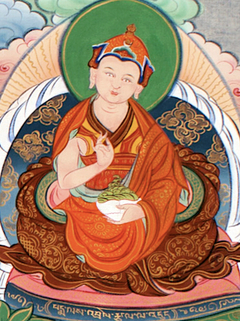
Heart-Essence Guru Yoga
Heart-Essence Guru Yoga
from the Khandro Nyingtik
Homage to the gurus, yidams and ḍākinīs!
As you visualize yourself as the yidam deity, at your crown on a precious throne and lotus, sun and moon is your own root guru and Padma of Oḍḍiyāna, indivisible in essence, in the form of the great Vajradhara, sky-blue in colour and holding a vajra and bell. He is adorned with silk, bone and jewelled ornaments. His consort, the ḍākinī Tsogyal, is red and wears bone ornaments. She embraces her male partner with her right hand while using her left hand to offer him a skull-cup filled with nectar.
To the couple’s right are Pema Ledrel Tsal and Rangjung Dorje in forms resembling Mañjughoṣa, with a sword in the right hand and the left hand holding an utpala upon which there lies a volume of the Heart-Essence teachings.
To their left are Gyalsé Lekpa and Śākya Zhönnu in forms resembling Avalokiteśvara, white in colour with one face and four arms, the first two joined at the heart, the lower right telling a mālā of pearls and the lower left holding a white lotus.
At their front are Rolpé Dorje and Darma Dorje in forms resembling Vajrapāṇi, dark blue in colour with one face and two hands holding a vajra and bell.
Behind them are Namkha Dorje and Tsultrim Bum in forms resembling the Great Compassionate One Who Empties Saṃsāra from Its Depths, holding a vase of nectar in the right hand and telling a ruby mālā at the heart with the left.
Above the guru’s head, upon seats of lotus, sun and moon, is the vidyādhara Śrī Siṃha, with ordinary coloured skin and two hands that display the mudrā of Vairocana. He is dressed in saffron-coloured robes of silk and a paṇḍita’s attire and is seated in the vajra posture.
Above his head is the vidyādhara Garab Dorje, white in colour, with one face and two hands. His right hand makes the threatening gesture and his left is in the mudrā of granting protection. His hair is in a topknot, and he wears the six bone ornaments. His legs are in the sattva posture.
Above his head is the great Vajradhara, sky-blue in colour, holding vajra and bell, and wearing the six bone ornaments.
Above his head are the male and female buddhas of the five families with the hand implements that match their respective families.
Above their heads is the dharmakāya couple Samantabhadra and Samantabhadrā, dark blue in colour with one face and two hands, holding vajra and bell. They are embracing, adorned with various ornaments and seated in vajra posture.
These figures are surrounded by all those with a Dharma connection, the gurus of the lineage, buddhas and bodhisattvas, all poised to confer blessings and guidance.
These masters all have an oṃ at their forehead, āḥ at their throats, and hūṃ at their hearts. Rays of light stream from these syllables and invite the buddhas and bodhisattvas of the ten directions, gurus, hosts of yidam deities, ḍākinīs and dharma protectors, who arrive together with the three types of sacred support and palaces.
As you recite “vajra samāja” and “jaḥ hūṃ baṃ hoḥ” the deities arrive and dissolve. Then perform the seven branches and make outer, inner and secret offerings before them. Then, with devotion recite the following prayer:
oṃ āḥ hūṃ hrīḥ
The dharmakāya of primordial purity, free from the extremes of real and unreal,
The sambhogakāya of self-knowing awareness, radiantly clear and spontaneously present,
And the nirmāṇakāya of the all-encompassing liberation of whatever arises, in all its variety—
To the gurus of my own awareness throughout the three times, I bow.
To Samantabhadra and Samantabhadrī, Father and Mother,
In the pure palace of the referenceless dharmadhātu, I pray:
Bless me to realize the essence as pure from the beginning.
To the assembly of the peaceful and wrathful saṃbhogakāya deities
In the pure palace of the spontaneously present dharmadhātu, I pray:
Bless me so that pure awareness ripens as the kāyas.
To the nirmāṇakāya Vajradhara
In the palace of compassion free from partiality or bias, I pray:
Grant your blessings so that clinging to appearances and mind may be avoided.
To Garab Dorje
In the palace of the Blazing Fire Mountain charnel ground, I pray
Grant your blessings so that I may encounter the ultimate meaning of dharmatā!
To Śrī Siṃha
In the palace of the charnel ground Sosadvīpa, I pray:
Grant your blessings so that great bliss may be forever beyond union and separation!
To Padma of Oḍḍiyāna and consort
In the Palace of Lotus Light on the Mountain of Glory, I pray:[1]
Grant your blessings so that I may realize co-emergent wisdom!
To the Ḍākinīs’ Heart-Essence itself
In the palace of Tramo Drak, the treasure site, I pray:
Grant your blessings so that I may accomplish the state in which no trace of the ordinary aggregates remains!
To Ledrel Tsal and Rangjung Dorje
In the palace of pure twofold accumulation, I pray:
Grant your blessings so that I may accomplish the twofold aims of self and other!
To Lekdenpa and Śākya Zhönnu
In the palace of generation and perfection as a unity, I pray:
Grant your blessings so that I may become a source of impartial benefit for beings!
To Gyalwa Lungtön and Rolpé Dorje
In the dharma palace of wherever-one-stays-is-supreme, I pray:
Grant your blessings so that I may gain stability in generation and perfection!
To Darma Badzra and Namkha Dorje
In the palace of appearance and existence arising as dharmakāya, I pray:
Grant your blessings so that I may bring disciples to maturity without partiality!
To Tsultrim Bum and Dharma Lakṣa
In the palace of clarity and emptiness free of grasping, I pray:
Grant your blessings so that experience and realization may develop further!
To the gracious root guru
In the palace of avadhūti within the centre of my heart, I pray:
Grant your blessings so that I may spontaneously actualize the five kāyas!
To the hosts of peaceful and wrathful ones and ḍākinīs
In the palace of my own utterly pure body, I pray:
Grant your blessings so that I may reach the full extent of my practice!
To the guardians of the teachings and treasure-keepers
In the palace of utterly pure samaya, I pray:
Grant your blessings so that there may be no adversity or obstacles!
I take refuge in the precious buddha guru.
Grant your blessings, that I might abandon self-grasping!
Grant your blessings, that I might develop renunciation in my being!
Grant your blessings, that I might suddenly realize the unborn nature of my own mind!
Grant your blessings, that I might purify delusion in its own place!
Grant your blessings, that appearance and existence may arise as dharmakāya!
Recite the collection of names as many times as possible.
oṃ āḥ hūṃ—Mahāguru Samantabhadra Samantabhadrā—namo hūṃ
oṃ āḥ hūṃ—five families, male and female—namo hūṃ
oṃ āḥ hūṃ—Garab Dorje—namo hūṃ
oṃ āḥ hūṃ—Śrī Siṃha—namo hūṃ
oṃ āḥ hūṃ—Padmākara—namo hūṃ
oṃ āḥ hūṃ—Yeshe Tsogyal—namo hūṃ
oṃ āḥ hūṃ—Pema Ledrel Tsal—namo hūṃ
oṃ āḥ hūṃ—Rangjung Dorje—namo hūṃ
oṃ āḥ hūṃ—Gyalsé Lekpa—namo hūṃ
oṃ āḥ hūṃ—Śākya Zhönnu—namo hūṃ
oṃ āḥ hūṃ—Rolpé Dorje—namo hūṃ
oṃ āḥ hūṃ—Darma Dorje—namo hūṃ
oṃ āḥ hūṃ—Gaga Vajra[2]—namo hūṃ
oṃ āḥ hūṃ—Tsultrim Bum—namo hūṃ
oṃ āḥ hūṃ—Dharma Lakṣa—namo hūṃ
oṃ āḥ hūṃ—Puṇye Lakṣa[3]—namo hūṃ
As you pray, nectar emerges from the bodies of the masters of the lineage and flows into the top of your head. It purifies all the misdeeds and obscurations related to your three doors, which are expelled through the soles of your feet and your nails. Then your whole body, inside and outside, is filled with the nectar of wisdom.
Then the gurus, yidams, ḍākinīs, dharma protectors and guardians all dissolve into Padma of Oḍḍiyāna and consort. From the three centres of the guru, the three syllables oṃ, āḥ and hūṃ emerge together with rays of light, which dissolve into your own three centres. Consider that this purifies obscurations of the three doors and confers the siddhis of enlightened body, speech and mind. Then the guru and consort descend and dissolve into the root guru upon the eight-petalled lotus in your heart.
The prayer, method of focusing the mind, session of breathing, and hūṃ practice for this occasion should be learned directly from the guru.
Let it be virtuous!
| Translated by Adam Pearcey with the generous support of the Tsadra Foundation, 2026.
Bibliography
Tibetan Edition
"snying tig gi bla ma’i rnal 'byor" In snying thig ya bzhi. 13 vols. Delhi: Sherab Gyaltsen Lama, 1975. Vol. 11: 238–246 (4.5 folios)
Version: 1.0–20260624
Notes
-
Up to this line, the prayer follows the Prayer of the Profound and Secret Heart-Essence of the Ḍākinīs but differs from this point on. ↩
-
Sanskrit for Namkha Dorje ↩
-
Sanskrit for Sonam Bum ↩