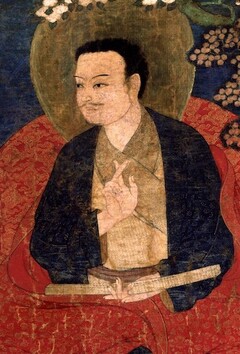
Establishing Appearances as Divine
Establishing Appearances as Divine
by Rongzom Chökyi Zangpo
In the system of the vajra vehicle of secret mantra, it is said that all worldly and transcendent phenomena without distinction are primordially perfected[1] as the maṇḍala of vajra-like buddha-body, -speech, and -mind and, as such, not something to be achieved, as it were, in the here and now.
To this, one might object: "All these phenomena appearing[2] within the experiential domain of sentient beings are not as they appear.[3] They are fictions and therefore unsuited to being primordially perfected."
In response, we can say that they are only fictions, and, indeed, there are no other phenomena whatsoever that might be set forth or demonstrated other than the confusions of sentient beings. These phenomena, referred to as confusing (or fictive) appearances, are all that there is. Consequently, non-Buddhists imagine a self of persons that exists permanently. Some Vaibhāṣikas assume the existence of the person is characterized by impermanence. Other Vaibhāṣikas, along with the Sautrāntikas, negate the self but insist upon the existence of phenomena such as the empty aggregates. The Yogācāra assert the existence of the characteristics of dependent phenomena that are empty of the imagined, the existence of which is qualified by emptiness. The Mādhyamikas assume that, ultimately, all phenomena are free from extremes of existence, non-existence, and so on, such that conceptual elaborations are eliminated. And in the secret mantra approach, the two types of truth are inseparable, primordially perfected, and so on. Sentient beings thus set forth and debate their individual views on the character of shared perceptions. They do not debate the existence of subject matter other than appearance.
Therefore, all these phenomena that appear are nothing more than confusion. Furthermore, it is not the case that some non-fiction is established when the fictions are eliminated. Fictions are perfected because of being totally pure in their essential nature. Since that is so, all phenomena are primordially manifestly complete and perfect. Thus, phenomena, appearing as various attributes, are in fact the maṇḍala of vajra buddha-body, -speech, and -mind, which, like the omnipresent perfection of awakening, is none other than the essence of total purity. The difference between sentient beings and buddhas is not based on phenomenal essence. Rather, like the perceptible appearance of specific causes and results within a dream, awakened beings and sentient beings merely appear as separate to the intellect through force of imagination.
Here, one might point out: "Although thus explained in scripture, since it is uncertain whether this is intended literally or has some underlying purport, while it is possible to prove the essential purity of phenomena, it is illogical to assume that the nature of this subject, which appears as a phenomenal sign, is itself primordially perfect. If it were, there would be no basis at all for afflicted states of mind or conditioned existence. There is also no reasoning that would establish such a philosophical position."
From time immemorial, sentient beings, have assumed the validity of the objects appearing within their experience and have offered intellectually confused proofs and refutations about them. Indeed, dialectics is incapable of proving what is of deep and profound significance. Still, reality being inconceivable does not mean there is no technique for penetrating that deeper significance by means of discriminating awareness. Indeed, it is entirely unproblematic if the devout, accessing what is of deep and profound significance through faith alone, having accepted the validity of scripture and the teacher's pith instructions, access the deep and profound with confidence.
It might be contested that “unless something is logically established there can be no accessing it.” To such a charge, we respond that it is provable by analogy.[4] The reasoning of reality proves that phenomena are perfected as the maṇḍala of vajra buddha-body, -speech, and -mind. As a sūtra states: "Form is empty of its own nature. Why? Because that is its nature." All phenomena consist in purity by nature. Therefore, the reality of phenomena is devoid of any impure quality. Thus, purity of one's own ordinary body, speech, and mind, is one's own reality, as well; and that purity is perfected.
That is why ordinary body, speech, and mind—distinguished in terms of their ultimate purity—should be identified as the maṇḍala of vajra buddha-body, -speech, and -mind itself. They are inseparable from, without conceptual elaboration with respect to, and completely interpenetrating with, pure buddha-body, buddha-speech, and buddha-mind.[5] When proving something like this by means of the reasoning of reality, the other three types of reasoning are superflous. This is because the reasoning of reality is the basis of the other three and because it is primary.
Others might ask: "Since that reality is unestablished for us, are not other types of reasoning needed?" They may also be employed. For instance, the reasoning of causal activity brings comprehension of a cause by means of a thing's effects (or what it does). Just as we understand that medicine contributes to vitality and poison brings death, we may also observe (via the reasoning of causal activity) that whoever meditates upon body, speech, and mind as the maṇḍala of vajra buddha-body, -speech, and -mind obtains the accomplishment of pure body, speech, and mind. And this proves that all perceptible phenomena have the nature and power of vajra buddha-body, -speech, and -mind. Nor can this be validated by conceptual proof alone without relying upon the force of fact.[6] Imagine someone who has found a precious jewel but has not yet had occasion to use it. He or she might not recognize it for what it truly is and set it aside as insignificant, not having observed its qualities. Later, if an expert in such jewels were to reveal its worth, the owner would clean and honor it, so that its extraordinary qualities emerge and would be evident thereafter. As with this determination of an actual jewel by observation of its function—the value it evinces—the qualities of the ordinary body, speech, and mind will only be observed when they are recognized and revered as divine. Until then, their qualities will not be observed. Yet when they are so recognized and revered, their qualities will be observed within the body as the basis itself.
The reasoning of dependence also applies, whereby the cause of a thing leads to the realization of its effects, establishing production. In dependence upon a seed, there is a sprout. This is also used to validate conventions: the convention "bad" is validated in dependence upon the convention "good." Similarly, all perceptible phenomena are phenomenal appearances of mind as such. All pure and impure dimensions of experience are mental effects generated in dependence upon mental causes. Therefore, all pure and impure dimensions of experience are mental outcomes ("effects") generated via karmic predisposition; both are established as authentic. Designations of which is mistaken and which unmistaken are also established by the reasoning on dependence. Thus, we must be sure to realize that the pure domain of experience is the authentic perceptible appearance.
When there is such proof by means of these three types of reasoning, there is no need to prove anything by means of the reasoning of logical proof. This is because, apart from reasoning on reality, cause, and effect, there is no reasoning pertaining to either direct perception or logical inference.
What then, one may ask, is the purpose of the logical proof? For those of inferior faculties, the reasoning itself must be established beforehand in order to assess the meaning it constructs through the introduction of (i) a logical subject of an inference, (ii) something to prove about that commonly accepted subject[7]—the predicated property to be proved, a comparison via (iii) analogical example; and the determination of (iv) pervasional relations obtained between inferential reasons and property predicated (sādhya), including counter-pervasional relations, all of which are elements that must obtain.
There may still be questions. For instance, "While that is sufficient proof for some, there are those for whom the reasoning of logical proof does not settle the matter decisively, so prove it another way—through scripture!"
First, it ought to be established by scriptural proof for both parties. As the Viṣayāvatāra-jñānālokālaṁkāra Sūtra states:
Eternally unborn phenomena are tathāgata, All phenomena have similarities with sugata; Yet, the intellectually immature fixate on features, Wandering in a world of phenomena that do not exist.
In that context, the logical argument is that "eternally unborn phenomena are tathāgata." The logical subject of the syllogism is "all phenomena." The comparison via analogical example is "like the sugata." "All phenomena are tathāgata" is the proposition.
To the question of whether this logic is undermined by direct sensory perception, the scripture states that "the intellectually immature fixate on features" (i.e., phenomenal characteristics), "wandering in a world of phenomena that do not exist." Just so, children, without mastery of language, grasp at optical illusions such as falling hairs and enjoy the wheel conjured by the spinning of a firebrand. Likewise, ordinary beings who are intellectually immature enjoy fixation on the features of objects in experience that are imagined by means of confused consciousness. This amounts to the enjoyment of non-existent qualities or phenomena. Therefore, the proof is as follows: all phenomena are tathāgata (i.e., consist in suchness), because eternally unborn phenomena are tathāgata[8] (consist in suchness) as in the example of the bliss-gone ones (sugata) of the three times.
If asked "How are sentient beings and buddhas similar?" we say a bliss-gone one is not distinguished in terms of ordinary body, speech, and mind, but in terms of actual reality. As scriptures such as the Vajracchedikā Sūtra state, the noble person (āryapudgala) is distinguished in terms of the uncompounded. Just as a noble one attains nobility by attaining the unconditioned (i.e., nirvāṇa), all phenomena are tathāgata[9] due to attaining the nature of the unconditioned (i.e., śūnyatā). The experiential realm of characteristics is not like that. In that way, those desiring to experience what does not exist end up experiencing phenomena that do not exist.
While one may assume phenomena to be perfect in nature due to their absence of essence, one could question whether there is a rational logical proof that proves the maṇḍala of vajra buddha-body, -speech, and -mind at the level of mere appearance. That, too, is provable. That is, it is provable in an instant or provable in progressive stages. For those with minimal obsessive fixation on their own perceptions, understanding comes about by means of instaneous proof. For them, it is proved primarily through analogy.
Consider how pretas see a stream of water as pus. Some of them will have also heard how humans see the stream as water. Some pretas thus contend[10] that pus is the actual reality while water is a wholly imagined form. For others, the argument is: pus is an impure appearance, and, for that reason, the water seen by humans[11] is itself something authentic. They will therefore say: "Friends, this pus that fills the stream we pretas commonly perceive is seen by humans as water alone. If those empowered to use water, dedicate it and make a gift of it to pretas, it appears as water to us too, and exists as a resource. Thus, it is like the dedicated water we have obtained at various times in the past." When establishing the connection in the context of an instaneous proof, this constitutes a proper pervasional relationship.
Additionally, the statement—"if those empowered with water,[12] dedicate and make a gift of it, all the water that is itself present in experience is just water, like the water we have heard about again and again"—establishes proper definite pervasional relations here. The same applies to the appearances of ordinary physical bodies and environmental resources that people commonly perceive. Some have heard that completely pure beings see them as a divine maṇḍala—buddha-bodies and buddhified resources. They also know that it is taught in the secret mantra approach to the path that apparently ordinary physical bodies and environmental resources are the divine maṇḍala itself. On this basis, some among them assume the ordinary body and resources to be genuine reality while the divine vision is something wholly imagined. Others assume that, since the perception of the ordinary body and resources is impure, then, in accordance with what is seen by pure beings and exalted in the secret mantra approach to the path, divinity is itself the reality of things.[13] Consequently, they will say: "Friends, these objective appearances of ordinary physical bodies and resources that are common perceptions for the likes of us are the divine maṇḍala itself. If those empowered to practice in the pure domain of experience[14] make a gift of their yogic attainment of seeing appearances as divine, then, for people, too, these experiences will be present in perception and experience as divine. Hence, it is like in the past when, some among us—those for whom, from time to time, yogic attainment arose—attained divine realms of experience."
The proof stated here that is the determination of pervasional relations for this tantric pramāṇa is as follows: "If those with control over the pure domain of experience make a gift of their yogic attainment,[15] then everything that is present as a resource within the divine domain of experience is divinity itself, just as it is the divine domain of experience for someone with yogic attainment. And, when those empowered to practice in the completely pure realm of experience make a gift of their yogic attainment, this domain of experience is present as a resource within the divine realm of experience."
The proof, moreover, is not undermined by direct perception, which is tainted by karmic obscuration. For example, in the past, when compassion stirred the gods, they offered gold to a destitute woman, but it became coal. Yet, for those who have a connection of karma and compassion, the appearance of gold will gradually emerge, just as the destitute woman was able to make use of some of the gold offered to her by Agni, the god of fire.
If their own perceptions are not initially established as being true, those who are exceedingly obsessed with their own perceptions will not engage with the basis itself.[16] Therefore, with such people, establish their ideas first, before gradually introducing different philosophical perspectives. The way to do so is exemplified by the two pretas mentioned above. On the basis of a contrary philosophical view, one argued as proof, "This river of pus that we pretas commonly perceive is not simply pus in reality.[17] It is actually water, too, because of being an appearance or mental image—like this pus and water, which are themselves obtained after being dedicated and gifted to us." Also, "Whatever is a mental image is entirely appearance in character, like some pus appearing to the common preta and the water one obtains after it is dedicated. The great river filled with pus, too, is an appearance or mental image. These two images of water and pus, moreover, are not distinct. They correspond to a common appearance of fluidity, like the appearance itself of pus."[18]
The following constitutes the comparable pervasion relation for establishng that logically: for persons who accept water and pus to be mental appearance, then, since these statements are logically established for both parties and that is accepted as a logical subject, this reasoning is established. Just so, after initially affirming them to be comparable, the character of the pus should be refuted thus: while both are comparable insofar as they appear as mental images, since the appearance of pus is impure, it is an error—and the water is not an error since it is a pure appearance. According to this view, what is impure is erroroneous; and what is erroroneous is impure.
Pure and fictive appearances should be regarded in a similar way. In other words, according to this very logic's determined pervasion, pus is fictive appearance, the appearance of error; wheresas water is not erroroneous; it is non-fictive appearance but appearance nonetheless.[19]
Accordingly, what appears to ordinary beings moving through conditioned existence, even from the point of view that all phenomena are nothing but illusory appearance—these apparent bodies and objective resources composing body, speech, and intellect that are naturally dissatisfying—are not only features of a world giving rise to afflictive states. Rather, they are features of awakening embodying the completely pure field and domain composing buddha-body, buddha-speech, and buddha-mind, like what appears for pure beings. Moreover, it is said that apparent divinity for those who have attained sublime yogic accomplishment and as a vase, pillar, and the like for ordinary sentient beings, are mental images. Thus, anything and everything whatsoever—appearing as divine for some and appearing as vases, pillars, and the like, for others—is mental appearance, entirely appearance in character.
Objective appearances of physical bodies, worlds, and resources for ordinary beings are in fact the experience of mental images. The two images are not even separate on account of both being connected to the common experience of the physical bodies, worlds, and domains of experience comprising physical body, speech, and mind—like the experience itself of pilllars and the like. For those accepting mind as appearance, this logic is sound.
First, establish comparable pervasional relations in such a way. Thereafter, the character of suffering should be negated. Though both these appearances are comparable insofar as they are appearances of mental images, since appearances of suffering and worlds of suffering[20] are impure appearances, they are fictions. And since appearances of freedom and worlds of freedom—awakening and maṇḍalas—are pure, they are not fictions. That which is mistaken pertains to that which is impure; and the impure is fiction. This pervasional relation is comparable. The following ought to be realized with cetainty: "The pure and the fictive, too, should be seen this way. According to this very logic of definite pervasional relations,[21] the appearance of the ordinary is fictive, an appearing fiction. Deity is appearance that is unmistaken, an appearance of the unmistaken."
The statement that each mental image is not distinct needs some further explanation. For some, while it is possible that in meditating on imagined vases, pillars, and the like, as divine, such objects may appear divine, possessed of buddha-body, buddha-speech, and buddha-mind. This is because being a pillar and so on is not the objects’ character, just as the land may be filled with bones and the like during meditation on the unpleasant. Likewise, it is said that even appearances associated with meditation, such as the all-encompassing sense fields, are mastered forms, which, being instances of forms in the phenomenological field[22] [i.e., imagined], are not said to pertain to the character of a thing.
Some say: "When appearance is divine, since it is only one's own appearances that become divine, the character of common appearance does not become divine." In response to such an objection, we must point out that common perception is the reason not even the images are different.
Just so, for pretas, appearance as pus derives from comparable individual karma and appearance as water also derives from comparable individual karma.[23] Therefore, it is untenable to declare different bases.[24] For both, the common appearance of fluidity is unmistaken. Thus, it is logically possible for both parties to take the river as the logical subject of a syllogism. If that, too, were to be refuted, because the appearance of pus itself is one's own appearance, there would be no logical subject of a syllogism that is established for both proponent and opponent in a debate.
Likewise, in common perception, in both the appearance of impure aspects of body, speech, and mind and in the pure appearance of vajra buddha-body, buddha-speech, and buddha-mind, a body-speech-mind triad qualifies the field[25] and resources. Both are correct common perceptions, which means that positing appearance as the logical subject is tenable.
If common perception is refuted by stating that "every perception is different because of being one's own perception," then since things such as pillars are appearances of one's own, a logical subject would not be found that is established for both proponents and opponents. Therefore, the problem of different logical subjects in establishing appearances as divine does not apply.
Yet one may still ask whether the divine associated with what is completely pure is described in terms of actual reality and gnosis; and, if so, how could it be the appearance of a mental image?
It might be said that the divine associated with what is completely pure is described in two ways linked with two aspects. Just as the reflection of a face in a mirror relates to the mirror insofar as the appearance is a quality of the mirror, but also to the face since it is a facial reflection. Similarly, perceptible appearance of divine buddha-body, buddha-speech, and buddha-mind are described in terms of gnosis and reality because they appear due to the potency of gnosis penetrating reality and the practice of the path of compassionate aspiration. Those divine appearances are also appearances of mental images qualified by habitual tendencies. Thus, they are included in the mind as such.[26]
One might ask how the divine appears via habitual tendencies? Habitual tendencies associated with the two types of fixation appear as subject and obejct. Positive habitual tendencies appear as extraordinary buddha-attributes, such as major and minor marks of a nirmāṇakāya. What's more, habitual tendencies derived from views of the self[27] cause one's mind-stream to appear distinct from the divine continuum—as if they were objectively separate.
It is the habitual tendency toward linguistic expression[28] that causes characteristic marks to appear differently. The nature of production derives from habitual tendencies associated with the limbs of conditioned existence.[29] The complete exhaustion of all habitual tendencies is not even the appearance of the completely pure domain of experience. The existence or non-existence of an awakened one's pure worldly gnosis should be analyzed in a similar manner, though it is an unimaginable phenomenon.
Again, a question arises: "When describing the nature[30] of the completely pure divine realm, what is it that is described in terms of gnosis and reality? Is it the case that whatever it is does not exist in the nature of the fictions appearing to ordinary people?"
This too is incorrect. Even the consciousness of an ordinary sentient being is an intrinsically pure reality; and gnosis is not merely contingent upon the generation of bodhicitta. The presence of self-occuring gnosis is proclaimed in the sūtra collections acceptable to the likes of both of us. In accordance with this view, a Prajñāpāramitā text states that "even the consciousness of an ordinary being is qualified by inherent purity."[31]
And the "Turning of the Dharma Wheel in the Realm of Suyamadevaputra" chapter of the Gaṇḍavyūha Sūtra states: "Multitudinous world realms will be consumed in unimaginable fire. Space will not be consumed in fire; and so it is with self-arisen gnosis."
Although unnecessary, more citations could be offered to justify what is well known in the secret mantra approach to the path. So, since thoroughly course obscurations are purified, common appearance would be unmistaken, too—appearing as completely pure fields and resources. Therefore, the logical subject is not different.
Summarizing what is established, it is declared: "For as long as everything is separated into appearances such as space and time[32]—perceived in association with completely pure bodies and resources or completely impure bodies and resources that endure in spacio-temporal terms—then, since they pertain to the experience of a single moment in the ground consciousness, there is no primordium that is[33] an attainable quality capable of being attained[34]—just as, for example, the properties of space are not affirmed in space."[35] This syllogism, too, is a flawless proof.
The eightfold assemblage of consciousness, too—everything that grows from or typifies its activities of separation—is encompassed by the ground consciousness, which means these forms of consciousness are not different. Distinction between continuums of self and other, moreover, are divided in and by persons; they are not qualitatively different phenomena.
There is a range of different reasonings, too. Proving fictive experience to be authentic in that way is not without problems under the power of appearance itself. If the intelligent establish the divinity of appearance in this very manner it will not in fact be impossible to prove the proposition.
The Great Establishing Appearances as Divine was composed by Dharmabhadra. May it be virtuous!
| Translated by Dominic Sur, 2024. Revised for and first published on Lotsawa House, 2026.
Bibliography
Tibetan Editions
rong zom. rong zom chos bzang gi gsung ’bum. Vols. 1–2. Chengdu: Si khron mi rigs dpe skrun khang, 1999.
rong zom. "gsang sngags rdo rje theg pa’i tshul las snang ba lhar bsgrub pa rong zom chos bzang gis mdzad pa." In vol. 1 of rong zom chos bzang gi gsung ’bum, 557–568. Chengdu: Si khron mi rigs dpe skrun khang, 1999.
Secondary Sources
Brunnhölzl, Karl. A Compendium of the Mahāyāna: Asaṅga’s Mahāyānasaṃgraha and Its Indian and Tibetan Commentaries. Vol 1. Boulder, CO: Snow Lion, 2018
Dreyfus, Georges. Recognizing Reality: Dharmakīrti’s Philosophy and Its Tibetan Interpretations. Albany: State University of New York Press, 1997.
Eltschinger, Vincent. “Dharmakīrti.” Revue Internationale de Philosophie 64, no. 253 (2010): 397–440. https://www.jstor.org/stable/23961185.
Gentry, James. “What Color Is Your Buddhahood? Vision and Vacuity in Tibetan Old School Accounts of Awakened Cognition.” Journal of the International Association of Buddhist Studies 44 (2021): 119–207.
Köppl, Heidi I. Establishing Appearances as Divine: Rongzom Chözang on Reasoning, Madhyamaka, and Purity. Boston: Snow Lion, 2008.
Lamotte, Etienne. La Somme du grand véhicule d’Asaṅga (Mahāyānasaṃgrāha). 2 vols. Louvain-la-Neuve: Université de Louvain, Institut Orientaliste, 1973.
La Vallée-Poussin, Louis. Mūlamadhyamakakārikās (Mādhyamikasūtras) de Nāgāruna Avec la Prasannapadā Commentaire de Candrakīrti. Biblioteca Buddhica IV. Germany: Froff & Co., 1970.
Ruegg, D. S. Three Studies in the History of Indian and Tibetan Madhyamaka Philosophy: Studies in Indian and Tibetan Madhyamaka Thought, Part 1. Vienna: Arbeitskreis Für Buddhistische Studien, Universität Wien, 2000.
Sur, Dominic D. Z. A Study of Rongzom’s Disclosing the Great Vehicle Approach (theg chen tshul ’jug) in the History of Tibet’s Great Perfection Tradition. PhD diss., University of Virginia, 2015.
________. Entering the Way of the Great Vehicle: Dzogchen as the Culmination of the Mahāyāna. Boulder, CO: Shambhala, 2017.
________. “Constituting Canon and Community in Eleventh-Century Tibet: The Extant Writings of Rongzom and His Charter of Mantrins (sngags pa’i bca’ yig).” Religions 8, no. 3 (2017a): 1–30. https://doi.org/10.3390/rel8030040.
________. “The Dzokchen Apology: On the Limits of Logic, Language, & Epistemology in Early Great Perfection.” Journal of Indian Philosophy 50, no. 1 (2021): 1–46. https://doi.org/10.1007/s10781-021-09492-z.
________. “A Biography of the Translator, Rongzom.” Treasury of Lives, August 2024. https://treasuryoflives.org/biographies/view/Rongzom-Chokyi-Zangpo/6194.
________. "The Art of Imagination at the Intersection of Pramāṇa and Samaya: Normative Epistemology and Tantric Ethics in Early Philosophical Vajrayāna." Journal of Contemplative Studies 4: 30–77.
Version: 1.2–20260410
Notes
-
sangs rgyas pa. This term, the Tibetan equivalent of the nominal derivative Sanskrit, bauddhika, is composed from a nominal form of a strengthened (vṛddhi) verbal stem, √bud ("to awake"), which forms buddha, meaning "awakened one," a term composed in Tibetan vis-á-vis two preterite verbal elements: √sangs ("purified") and √rgya ("expanded"). Thus, when we say, "awakened one" or "buddha," sangyé in Tibetan, we say "purified-expanded" (sangs rgyas), a term whose meaning is typically unpacked as purification of the two types of obscuration and the visionary expansion of the two types of exalted knowers. Combined with "primordially" (yas nas), then, yas nas sangs rgyas pa [ādi-bauddhika] may be "primordially buddhic," "always awakened," "perfect from the beginning," and the like. Thus, just as lauikika ("worldly"), vaudika ("Vedic"), and nyayāyika ("logician"), so bauddhika ("buddhic"/"buddhified"). ↩
-
Just as nangwa (snang ba) renders in a subjective register in terms of "perception," "perceptible appearance," "experience," "vision," and the like, and it's semantic range includes an objective register in the sense of "appearance" (Sur 2017, 35; Gentry 2021, 133), trülpa ('khrul pa) renders as subjective "confusion" and objective "error." These ambiguities provide enormous philosophical profit (Sur 2015, 171 n. 370). In describing appearances as "confusing" and "fiction," I attempt at capturing both, with some useful ambiguity. Throughout, 'khrul ba is mostly rendered as "error," etc., though it is also given as "fictive" and the like when the register tends toward the role of imagination vis-á-vis "perceptible appearance" (snang ba). ↩
-
This could be rephrased in a modern vernacular with "things are not what they seem" (cf. seems, semblance, resemblance), which would be an accurate but not literal translation insofar as both locutions verbalize descriptions of phenomena—i.e., stuff in our experience—the stuff we "see in our minds," which is part and parcel of the rather global mind as a physical (a container) metaphorical structure. ↩
-
That is, the analogy between what the sūtra teaches and his claim that reality is pure and therefore the purity is sangs rgyas pa. ↩
-
rdzogs par khyab pa. Literally, "fully penetrating," "perfectly pervading," or " completely entailing." ↩
-
See Westerhoff 2018, 243–4; Eltschinger 2010, 420. Rongzom's phrasing gestures toward three analytic criteria (dpyad pa gsum) used to determine whether a scripture forms a sound basis for infering the truth of the matter. Tillemans writes that, according to the three analytic criteria, "a scripture must be (i) unrefuted by direct perception, (ii) unrefuted by vastubalapravṛttānumāna, and (iii) free from contradiction with other propositions whose truth is scripturally inferred. Put in this way it might seem that what is being said is simply that the scripture cannot be refuted by any pramāṇa, or that it cannot come into conflict with any of the other three kinds of objects. However, the point at stake, as we find it elaborated in PV I, k.216, Dharmakirti s Svavṛtti or Svopajñavṛtti (PVSV) and Karnakagomin’s Ṭīkā, is more subtle, and is essentially an inductive argument: the scripture’s assertions concerning pratyakṣa and parokṣa are seen to be trustworthy, and so, similarly, its assertions about atyantaparokṣa, if not internally inconsistent, should also be judged trustworthy" (Tillemans 1999, 30). Śākya Chokden, for his part, rejects the idea that scriptural inference derives from force of fact (Dreyfus 1997, 529–30 n. 47). ↩
-
Note to emphasize the concept of acceptance (abhyupagama, khas len [pa]), which connotes "in a general and weaker sense, to accept/ acceptance (in regard to a view, doctrine etc.) and, in a strong sense, to assert/tenet" (Ruegg 2000, 106–7, n. 3). ↩
-
The Sanskrit abstract suffix, -gata, has the sense here of consisting in. Thus, to say stuff is tathāgata is a meatphorical way of gesturing toward its ultimate nature of emptiness. It is not a literal description, such as stating that a rock is an awakened being (buddha). ↩
-
That is, since phenomena consist in suchness, it is acceptable to call them "tathāgata." A similar view is documented in the Ratnakuṭa collection, which Rongzom cites elsewhere, e.g., dkon mchog brtsegs pa las kyang// sangs rgyas gzugs su mi blta mtshan dang ni// rigs dang rgyud du mi brtag sgra dang ni// 'chad par 'gyur ba ma yin sems dang ni// rnam shes yid kyis rab tu phe ma yin// chos nyid gang yin de ni bcom ldan das// (RZSB 2.75.16–8); cf. Kangyur, Vol. 43, 68.8–10. ↩
-
Note: pretas philosophize; or at least have time and leisure to speculate. ↩
-
mi rnams kyis mthong ba bzhin du. Here, the bzhin immediately after a verbal stem, √mthong, is construed in terms of the durative/continuative, and not as the adverb, "as," or the adjective, "like," which applies in some contexts below. ↩
-
Cf. chab srid. ↩
-
This is not unlike an inferenced that turns on recognition of a yāna. ↩
-
The phrase dag pa'i spyod yul la spyod par dbang ba rnams puns on the Tibetan term for empowerment (dbang, abhiṣeka), Buddhist tantra's ritual initiation ceremony, in which there is a commitment (samaya) exhorting the exercitant to always maintain the view of purity. Notably, in KCG, in the context of explicating the tantric commitments that require no maintenance (bsrung ba med pa'i dam tshig), the explanation correlates the characteristics of afflictive states of mind and the five buddha families by explaining samaya in terms of not forsaking [the presumption] that both are inseparable in essence (bsrung ba med pa'i dam tshig bshad pa'i skabs nas | nyon mongs pa lnga'i mtshan nyid dang | rigs lnga'i mtshan nyid mthun par bshad nas | de gnyis dbyer med par ngo bo nyid kyis mi 'da'a ba'i dam tshig tu bshad de/ RZSB 1.109.1–4). Rongzom sets the distinction in terms of one's view: "for example, when the afflicted mind is explained as transforming into the gnosis of equality, insofar as one is qualified by a view of the self and one sees the absence of self, they are incongruous. Yet the purification of views of the self is the consumation ('grub pa) of the exalted vision of selflessness. For Rongzom, the gnosis of equality corresponds to realizing selflessness. ↩
-
Again, this may be punning on being initiated, i.e., if those em-powered in the experience of the pure domain of experience... ↩
-
Literally, "basis" (gzhi), here, refers to "basis of dispute" (rtsod gzhi) – i.e., a commonly accepted nangwa (experiences/ideas/representations), whose nature and scope permit a wide horizon of possibilities, none of which is, for all, obviously the correct determination. ↩
-
rnag gi mtshan nyid. Literally, "character of pus," indicating the character of the appearance. ↩
-
Both water and pus, as perceptions, correspond to a common perception of fluidity. This is key. ↩
-
Variation between "error" and "fiction" here attempts to reflet the polysemy of 'khrul ba, as the register slips between objective and subjective suggestions. ↩
-
bsdug bsngal gyi gnas. Literally, "sources of discontent," instances of the second noble truth. ↩
-
That is, according to Rongzom's some appearances are better than others logic, the purer the appearance the more correct, the more impure the appearance, the more incorrect. ↩
-
chos kyi skye mched kyi gzugs. This is one of the forms appearing to mental awareness, which is typically listed along with aggregated forms (bsdu ba las gyur ba, abhisaṃkṣepika), open space (mngon par skabs yod pa, abhyavakaṣika), proper committments (yang dag par blangs pa la, samadanika), the imagined (kun btags pa, parikalpita) and the "empowered" or "mastered" (dbang 'byor ba, vaibhūtvika/vaibhūtika). ↩
-
Such existential extremes are difficult to imagine. Ironically, it becomes clearer in a subtler context. For example, "spicy." The same basis may be spicy for one, but not another. ↩
-
That is, the appearances of water and pus are not each reflective of some different given, in Willfred Sellers's sense of the term. Moreover, except as a momentary convention of use, our author posits no given – has no need to. As far as Buddhist debates go, it's the turtles of appearance all the way down. ↩
-
zhing i.e., "buddhified environment" ↩
-
That is, the perception of purity is conventional. ↩
-
That is, those views obectifying/reifying what is imagined about the self. ↩
-
mngon par brjod pa'i bag chags. This refers most generally to karmic habitual tendencies within the ground consciousness that constitute latent predispositions toward linguistic expression. We note, here, the close connection between langauge and the types of conceptual proliferation that structures the experience of samsara; following, inter alia, Candrakīrti, prapañca is intimately related with language vis-á-vis abhilāpa, abhidhāna, and abhidheya: cf. his commentary on MMK 18,9 s.v., prapañco hi vāk prapañcayaty arthān iti kṛtvā (de la Valleé Poussin 1970, 373.9). ↩
-
srid pa yan lag gi bag chags. Note Asaṅga's Mahāyānasaṃgrāha, chapter two, the dependent nature (gzhan dbang gi mtshan nyid) is delineated in terms of a group of eleven "cognizances" or "cognitions consisting in false imaginations seeded in the ground consciousnes" (gang kun gzhi rnam par shes pa'i sa bon can yang dag ma yin pa kun rtog pas bsdus pa'i rnam par rig pa)." Karl Brunnhölzl translates the relevant passage in Msg: "these cognizances appear to beings as: “(1) the body, (2) the body-possessor, and (3) the experiencer, (4) the cognizances that [appear as] what is experienced by these [three], (5) the cognizances that [appear as] the experiencers of that [which is experienced], and the cognizances that [appear as] (6) time, (7) numbers, (8) locations, and (9) conventions arise from the seeds that are the latent tendencies of expression. For (10) the cognizances that [appear as] the distinctions between a self and others arise from the seeds that are the latent tendencies of the views about a self. For (11) the cognizances that [appear as] the pleasant realms, the miserable realms, and the deaths, transitions, and births [in those realms] arise from the seeds that are the latent tendencies of the limbs of existence” (2018, 429–30); cf. Tengyur: de la lus dang lus can dang za ba po'i rnam par rig pa gang yin pa dang/ des nye bar spyad par bya ba'i rnam par rig pa gang yin pa dang/ de la nye bar spyod pa'i rnam par rig pa gang yin pa dang/ dus dang/ grangs dang/ yul dang/ tha snyad kyi rnam par rig pa gang yin pa de ni mngon par brjod pa'i bag chags kyi sa bon las byung ba'i phyiri ro// bdag dang gzhan gyi bye brag gi rnam par rig pa gang yin pa de ni bdag tu lta ba'i bag chags kyi sa bon las byung ba'i phyir ro// bde 'gro dang ngan 'gro dang 'chi 'pho dang skye ba'i rnam par rig pa gang yin pa de ni/ srid pa'i yan lag gi bag chags kyi sa bon las byung ba'i phyir ro// (Vol. 76, 30.17–31.10). BiB Lamotte's (1973) La Somme du grand véhicule d’Asaṅga (Mahāyānasaṃgrāha) Université de Louvain, Institut Orientaliste: Louvain-la-Neuve, 24–5). The lattermost refers to the habitual tendencies associated with the so-called twelve limbs of conditioned existence (srid pa’i yan lag bcu gnyis, dvādaśa bhavāṅgāni), ignorance, formations, consciousness, name and form, six entrances, contact, feeling, craving, clinging, becoming, birth, old age, and death. ↩
-
bdag nyid, "essence," "natural being," and the like. ↩
-
so so skye bo'i shes pa'ang/ rang bzhin gyis ni rnam byang can/, which resembles something found in the Prajñāpāramitāpiṇḍārtha attributed to Dignāga: so so'i skye ba'o shes pa gang// rang bzhin gyis ni rnam byang ba// (Tengyur, Vol. 55, p. 1380, 19–20); cf. pṛthagjanānāṃ yaj jñānaṃ prakṛtivyavadānikaṃ | uktaṃ tad buddhaśabdena bodhisattvo yathā jinaḥ ||. That Rongzom is citing Dignāga is remarkable. ↩
-
yul dang dus, alterntively: "object and occasion," etc. ↩
-
existential negation ↩
-
epistemological negation ↩
-
Space is defined by abstract properties, which are not something one finds, as it were, floating in space. "Hey, I found some conceptually imputed absences floating over here, along with these cool flowers and rabbit horns!" ↩