Stūpa Consecration Rite
The Precious Net Stūpa Consecration Rite
by Longchen Rabjam
Homage to glorious Vajrasattva!
Your compassion is the utmost wonder,
As you radiate lights that outshine the moon
Banishing delusion’s darkness for all beings.
Homage to you, revealer of liberation’s isle.
So that the abundant excellence of the victor’s representations[1]
May fully secure the twofold benefit of self and other,
Drimé Özer Zangpo has here illuminated
The rite for consecrating stūpas.
For this, should you wish to create tsa-tsas for your own or others’ sake, offer a torma and take possession of the land. Bless the ground as precious substances through oṃ vajra khana khana hūṃ. Dig with oṃ vajra mukara akotraya hūṃ and work the earth into clay.
If this is for someone who has died, imagine a moon disc upon the bone relics. Consider that nectar descends onto its centre from a white a (ཨ), whereby any misdeeds are purified. Recite the mantra of the five families, and, after washing the bone with fragrant water, consider that obscurations are purified through the mantra oṃ pramardhana ye svāhā. Then pound the bone finely and mix it with the clay.
Upon a lotus and moon, visualize the mass of clay transforming from bhrūṃ into a pile of jewels. In an instant, visualize yourself as Samantabhadra and Samantabhadrī. Light rays from your heart strike Vairocana in Akaniṣṭha, and further light rays then stream from his heart and strike the clay, which you consider as having the nature of the five wisdoms.
Press down with the little finger and thumb of the left hand while holding the palm upward, then do the same with the right hand and palm turned downward, and recite seven times:
oṃ namo bhagavate vairocana prabhā rājāya
tathāgatāya arhate samyaksaṃbuddhāya
tadyathā oṃ sukṣme sukṣme samaye samate śānte dhānte anaya alaṃbhe taraṃbhe yaśovati mahā-teja nirkula nirabhani sarva tathāgata hṛdaya adhiṣṭhāna adhiṣṭhite svāhā
Recite namaḥ samanta buddhānāṃ oṃ vajra āyuṣe svāhā and divide the clay into even portions. When it comes to inserting dhāraṇī such as oṃ āḥ hūṃ, recite oṃ vajra dharmadhātu garbhe ye svāhā as you insert the mantras. Recite oṃ vajra jrodbhava svāhā as you form the small lumps. Recite oṃ vajra āraje varajé svāhā as you anoint them with oil. Recite oṃ dharma dhātu garbhe ye svāhā as you place them in the mould. Recite oṃ vajra mudkara akotraya ye svāhā as you tap the mould. Recite oṃ vajra dharma rate svāhā as you remove the impression.
Then with vajra surate samaya staṃ from the state of dharmakāya, the sambhogakāya arises through oṃ sarva tathāgata sambho kāya stvaṃ and the nirmāṇakāya acts on behalf of sentient beings through oṃ sarva tathāgata nirmakāya samaya stvaṃ. Arrange the tsa-tsas neatly in rows.
Set out the five offerings and three tormas before the tsa-tsas. Prepare two containers of grain. Then dedicate the lower two tormas to the obstructing spirits and local deities, and issue commands. Visualize yourself as Samantabhadra and Samantabhadrī, and perform offerings and praise. Over the grain in one of the containers, recite the mantra of the five families and the essence of dependent origination.
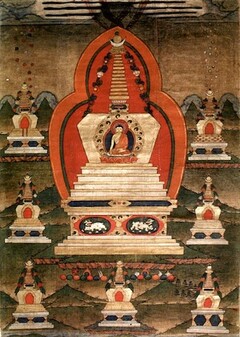
Then, with oṃ svabhāva śuddha sarva dharma svabhāva śuddho ’haṃ, consider that out of the state of emptiness, from paṃ there appears a lotus, from a a moon, and from raṃ a sun, on top of which from bhrūṃ appears the precious stūpa with a pedestal, Mount Meru section, dome, canopy, thirteen rings, parasol, rain canopy and finial. Apart from the dome, it is white in the east, yellow in the south, red in the west, and green in the north. The dome itself is blue. In its centre is a lion throne, and there is an elephant throne in the east, a fine-horse throne in the south, a peacock throne in the west, and a shang-shang bird throne in the north. Visualize that from the five syllables oṃ, hūṃ, traṃ, hrīḥ and āḥ arise the buddhas of the five families and their female counterparts. Invite the jñānasattvas and confer empowerment. Bless the body, speech and mind through oṃ āḥ hūṃ.
Stand and scatter flower petals while saying:
All you buddhas and bodhisattvas of the ten directions, turn your attention toward me! Until all sentient beings in all realms extending unto the limits of space have reached the level of non-abiding nirvāṇa, may you remain steadfast. Remain in these supports of enlightened body, speech and mind, in particular, for as long as they are not harmed by the four great elements, and carry out your enlightened activity of leading all who see, hear or touch these sacred objects to unsurpassed awakening.
oṃ supratiṣṭha vajraye svāhā oṃ hūṃ traṃ hrīḥ āḥ oṃ ye dharmā hetuprabhavā hetuṃ teṣāṃ tathāgato hy avadat | teṣāṃ ca yo nirodha evaṃ vādī mahāśramaṇaḥ svāhā
Scatter flower petals.
Circumambulate with:
oṃ namo bhagavate ratnaketu rājāya | tathāgatāya arhate samyaksaṃbuddhāya | tadyathā oṃ ratne ratne mahāratne ratnavijaye svāhā
Recite the Recollection of the Buddha. Then visualize vast clouds of offerings and say:
All the bright flowers that exist
In this world or in other worlds,
And what I have arranged here in devotion,
I offer to the protectors and their heirs.
oṃ vajra puṣpe āḥ hūṃ
Present the remaining offerings in a similar manner.
The sole guru of beings was born in Lumbinī,
And he dwelt in the city of Kapilavastu—
Homage to the Stūpas of the Sugata,
Ornamented by ten million precious qualities.[2]He sat beneath the bodhi tree in Magadha,
On the bank of the river called Nairañjanā—
Homage to the support for awakening,
The Stūpa of Vast Qualities.In Kāśikā, the city of Vārāṇasī,
With the marvellous, liberating Wheel of Dharma,
He cut through afflictions and obscurations—
Homage to the Four Wisdom Stūpas.At Śrāvastī, he thwarted the might of others,
And he displayed a great miracle at Jeta’s Grove,
And manifested a sublime thought in the three worlds—
Homage to the Stūpa of Defeating Extremists.In the sacred and exalted city of Sāṃkāśya,
He returned from heaven in a sublime descent.
Brahmā and Indra laid a crown at his feet—
Homage to the Stūpa of Thirty Gods’ Offerings.When the Saṅgha had become divided,
The Teacher’s listeners were reconciled
At the Bamboo Grove in Rājagṛha—
Homage to the Stūpa of Loving Kindness.When he gave up his conditioned lifetime,
His life was blessed yet again
And he was utterly free—
Homage to the Blessed Stūpa of Vaiśālī.In Kuśinagara, he inspired
Beings to practice virtue—
Homage to the Stūpa of Nirvāṇa,
Between the Mallas’ twin sal trees.I bow to all dharmakāyas abiding
At the eight stūpas of Śākyamuni,
In the ten directions, and elsewhere—
I humbly pay homage, always, to peace!
Recite this and scatter flowers. Then continue with:
Guru Vajradhara, all you buddhas and bodhisattvas of the ten directions, together with all you deities and your retinues who are present through the interdependent connection of the offering substances, turn your attention toward me.
Noble ones, great compassionate ones, since you possess wisdom and knowledge, loving compassion, enlightened activity and the power to grant protection, grant your blessings so that the precious teachings of the buddhas, a source of benefit and happiness, may spread far and wide and endure long into the future!
Please ensure that the genuine gurus, spiritual guides and allies of the teachings, live long, and that there be no obstacles to their practice, realization and activity as they flourish and increase, bringing vast benefit to beings.
Please ensure that for us Dharma practitioners there is no obstacle to our accomplishment of the ten types of Dharma activity which thereby flourish and increase.
Please eliminate obstacles that might bring harm or injury to our patrons and those around them, and ensure that all their wishes are fulfilled in accordance with the Dharma.
Grant your blessings, I pray, so that throughout the world, in every land, the harvests may be bountiful and livestock and resources thrive, as we avoid all forms of inner and outer turmoil, invasions, frost, hail, famine, and violence, and enjoy abundant happiness and prosperity.
Please ensure that we accomplish all that we wish for, in accordance with the Dharma.
Recite this three times, and scatter flowers.
If practising for the deceased, recite:
Please ensure that for the one called [insert name], all obstacles to the paths and stages may be pacified, and they may swiftly attain complete and perfect awakening.
Then with “akāro… etc.” dedicate the torma to the glorious and noble protectors, the dharmapāla guardians, and say:
Eliminate, I pray, all outer and inner harms and destructive forces within this support!
Then imagine that countless deities of auspiciousness all chant vajra songs of good fortune. Scatter flowers and recite the following in unison:
Possessing every excellence, like a mountain of burnished gold,
Lord of the three worlds who has abandoned the three types of flaw,
Awakened One whose eyes are like lotuses in full bloom—
Through such sublime auspiciousness, may all be well here and now!The teachings that he imparts are sublime and unchanging,
Famed throughout the three worlds, honoured by gods and humans alike,
The sacred Dharma which grants peace to all living beings—
Through such sublime auspiciousness, may all be well here and now!Those who possess the Dharma and are rich with the fortune of learning,
The Saṅgha, worshipped by humans, gods, and demi-gods,
Most supreme of communities, modest, and glorious—
Through such sublime auspiciousness, may all be well here and now!Through the power of the merit of the buddhas and their heirs,
The excellent declarations of all the gods,
The force of secret and vidyā mantras,
And the proclamations of those who speak truth,
May our merit be as firm and stable as a mountain,
May holders of the lineage appear as clearly as the sun and moon,
And may our fame and glory spread as far and wide as the sky itself—
Through these three, may all be well here and now!May the 80,000 classes of obstructing forces be pacified,
May we be freed from all adversity and harm,
And may all our circumstances be favourable and perfect in every way—
Through these four, may all be well here and now!May we live a hundred years and meet a hundred teachers,
May our lives be long and healthy, with every happiness and joy,
And may we always have renunciation and the wish to practise the supreme vehicle,
Through these five, may all be well here and now!Practising generosity, observing discipline,
Cultivating patience, applying diligence,
Resting in meditation and realizing reality—
Through these six, may all be well here and now!Vairocana and victorious Akṣobhya,
Ratnasambhava and Amitābha,
And Amoghasiddhi of the auspicious five families—
Through such sublime auspiciousness, may all be well here and now!May all the spirits gathered in this place,
Be it on the earth or in the sky,
Always show goodwill and kindness to all beings,
And practise Dharma day and night!
Then stabilise the consecration with oṃ supratiṣṭha-vajraye svāhā, and continue with:
Whatever mistakes I have made in this virtuous practice
Through the ignorance and confusion of my mind,
O Protector, you who are the refuge of all beings,
Please forgive and bear with all of them.Through this merit, may all beings attain the omniscient state of enlightenment
And conquer the enemy, faults and delusion.
May they all be liberated from this ocean of saṃsāra
And from its pounding waves of birth, old age, sickness, and death!
Once you have recited this, be seated and celebrate with a feast.
As nectarous water flowing from snowy peaks
Brings delight to many flocks of lovely birds,
May this explanation from my intellect bring delight
To the swans, the noble beings of Padma’s glacial lake.The recently arisen Stainless Rays of Light (Drimé Özer)
Set this down according to the essential vision of the tantras
As a supplement to the profound Ḍākinīs’ Heart-Essence
In the place called Orgyen Dzong.Through the virtue of this, may all beings in existence
Clearly see the nature of the luminous essence,
And with kāyas and wisdoms beyond union and separation,
Spontaneously arrive at the primordial state!
This concludes the rite for consecrating stūpas called Precious Net, which was set down by Pema Ledrel Tsal in Gangri Tökar. May it prove virtuous and excellent! Maṅgalam.
| Translated by Adam Pearcey with the generous support of the Tsadra Foundation, 2026.
Bibliography
Tibetan Edition
klong chen rab 'byams pa dri med 'od zer. "mchod rten rab gnas rin chen drwa ba" In snying thig ya bzhi. 13 vols. Delhi: Sherab Gyaltsen Lama, 1975. Vol. 9: 461–472 (6 folios)
Secondary Sources
Bentor, Yael. Consecration of Images and Stūpas in Indo-Tibetan Tantric Buddhism. Leiden: Brill, 1996
Nāgārjuna. "In Praise of the Stūpas at the Eight Great Sacred Places." Translated by Samye Translations (Monica Thunder and Peter Woods). Lotsawa House.
Version: 1.0–20261105
Notes
-
sku gzugs. The term can mean images or forms. Here it includes the physical form of the stūpa. ↩
-
This and the following verses are taken from Nāgārjuna, “In Praise of the Stūpas at the Eight Great Sacred Places”, translated by Samye Translations. ↩