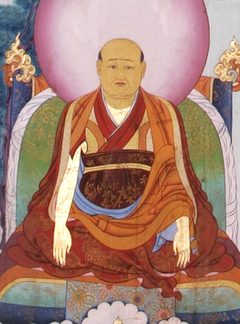
Path of Method and Path of Liberation
The Distinction Between the Path of Method and the Path of Liberation
by Patrul Rinpoche
Now, relying upon the oral instructions that the precious Lord of Refuge[1] has just given, as well as such scriptures as the Rampant Elephant Tantra,[2] I shall here explain the paths of method and liberation in a way that shows that the earlier and later commentaries, the tantric scriptures, and the oral instructions of the Lord of Refuge are all free of contradiction.
In general, neither the path of method nor the path of liberation is able, by itself, to bring progress on the path to freedom. This is the case for all vehicles, from the lowest vehicle of the śrāvakas up to the highest vehicle of the Great Perfection.
From the point of view of the extraordinary paths of method and liberation within the Vajra Vehicle of Secret Mantra, in general, the path of liberation is defined by the view, the actual path that liberates from saṃsāra, whereas the path of method is defined by the extraordinary methods for realizing that view, together with the great bliss and compassion that overcome the extreme of quiescence.
These two may be further considered from the perspective of the temporary situation of the path or from the perspective of the fruition that derives from the path, and so on.
From the perspective of the temporary situation of the practice of the path the division into the path of method and the path of liberation is based on the capacity of the students. Although such practitioners may be alike insofar as they are disciples to be tamed by the Secret Mantra Vehicle, they are of two types—those of sharp faculties and those of dull faculties.
Those of sharp faculties are capable of directly realizing the view, self-luminous and free from objects, either when they receive empowerment or based on reasoning. When disciples of dull faculties are introduced, they are unable to realize the view directly and are only able to understand it conceptually by way of a generic image.
Furthermore, among those who are able to realize the view directly are themselves of two types:
- those in whom realization arises in a way that can withstand adverse conditions, so that realization and liberation are decided in a single stroke
- those who, although they recognize their own nature directly in reliance upon methods and pith instructions, fall under the sway of distraction, delusion, and adverse circumstances because their practice is weak.
The former are the disciples of the instantaneous path of liberation and the latter are the disciples of the gradual path of liberation.
Such students of the [gradual] path of liberation practice by resting in the view—their realization. By meditating one-pointedly on the samādhi of great emptiness, the non-conceptual example-wisdom arises in their mind, just as it is. At the same time, as wind and mind dissolve into the central channel, the luminosity of light[3] becomes manifest. Enhancing this through the method of the five yogas of the generation stage, such practitioners reach the level of a matured vidyādhara, the fruition of the path that unites generation and perfection stages.
Although Lochen Rinpoche[4] connects this path with the perfection stage, while others state that it pertains to the generation stage, we may explain this without contradiction. For such a practitioner, the four empowerments are perfected all at once.
A follower of the path of method might be introduced to the nature of mind in reliance upon empowerment and reasoning, yet they will be unable to realize the view beyond a mere generic image. However much they strive in meditation, they cannot actually generate the example wisdom in this life [based on the path of liberation alone], and instead meditate gradually on the skilful means that pertain to each of the four empowerments.[5] Thereby they can bring about a direct realization of the view.
Thus in terms of the manner of realizing the view, the Vajra Vehicle of Secret Mantra surpasses that of the sūtra vehicle based on:
- the introduction through the skilful means of empowerment;
- and the fact that among the lines of reasoning, this approach relies solely upon the reasoning of direct perception.
The determination of perceived objects as empty is also found in the vehicle of characteristics; it is the direct liberation of the perceiving subject that is the special feature of this approach.
Let it be virtuous!
These were the words spoken by Patrul Rinpoche.
| Translated by Han Kop for the Longchen Nyingtik Project, 2026. With gratitude to Gyagar Khenpo Gyurme Dorje for his clarifications.
Bibliography
Tibetan Edition
o rgyan 'jigs med chos kyi dbang po. "thabs grol lam gyi khyad par" in gsung ʼbum o rgyan ʼjigs med chos kyi dbang po, Par gzhi gnyas pa par thengs gnyis pa, 8 vols. Khreng tuʼu: Si khron dpe skrun tshogs pa si khron mi rigs dpe skrun khang, 2009. (BDRC W1PD107142). Vol. 6: 176–178.
Secondary Sources
Jamgön Kongtrul. Treasury of Knowledge, Book Eight, Part Four: Esoteric Instructions. Trans. Kalu Rinpoché Translation Group. Ithaca, New York: Snow Lion Publications, 2008.
Jigme Lingpa & Kangyur Rinpoche. Treasury of Precious Qualities: Book Two: Vajrayana and the Great Perfection. Translated by Padmakara Translation Group. Boulder, CO: Shambhala Publications, 2013.
Version: 1.0–20260708
Notes
-
This must refer to Jigme Gyalwe Nyugu (1765–1843). ↩
-
Tib. glang chen rab ’bog ↩
-
Here light (snang ba) most likely refers to the first of the trio of light, increase of light and culmination of light (Tib. snang ba, mched pa and thob pa). These are sometimes translated as appearance, increase and attainment. ↩
-
Lochen Dharmaśrī (lo chen d+harma shrI, 1654–1717). ↩
-
Gyagar Khenpo Gyurme Dorje explains that if a student were able to realize the view when introduced, they would be able to follow the path of liberation, and there would be no need to follow the path of method. When they follow the path of method, they can still gain realization. The path of liberation is not totally absent, because without the path of liberation one cannot follow the path of method. ↩