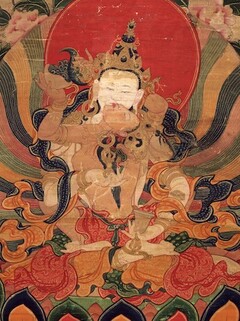
Vajrasattva Meditation and Recitation
3. Meditation and Recitation of Lama Vajrasattva
by Yukhok Chatralwa Chöying Rangdrol
In the past, while on the path of learning, Vajrasattva made the following aspiration:
In future, when I reach complete and perfect buddhahood, may those who have committed the five crimes with immediate retribution, or anyone whose samaya commitments have been impaired, be purified entirely of all their harmful actions and impairments merely by hearing my name, thinking of me, or reciting the hundred syllables, the most majestic of all the secret mantras! Until this is brought about may I remain, without awakening!
And:
May I be present before all those with impairments and breakages of samaya commitments and may I purify all their obscurations!
Due to the strength of these prayers, Vajrasattva’s enlightened aspirations are unlike those of other buddhas. In his nature, he embodies the hundreds of buddha families, the five buddha families and so on. Since he is the all-pervading lord of the hundred buddha families and the single buddha family of the great secret, he is unlike any other deity. You might go before each and every buddha dwelling in the ten directions and strive to apply the methods for confession, but it is said that it is better still to practise confession by visualizing your own teacher, the one from whom all the mandalas emanate and into whom they are reabsorbed, indivisible from Vajrasattva.
There are two categories: (1) that which is to be purified and (2) the means of purification.
1. The Four Obscurations To Be Purified
Karmic obscurations include naturally negative actions and infringements of vows.
Afflictive obscurations were defined by Lord Maitreya:
Any thought involving avarice and so on
Is held to be an afflictive obscuration.
Any thought involving avarice, lack of ethical discipline and so on, which impedes the pure enactment of the transcendent perfections, is held to be an afflictive obscuration.
Regarding cognitive obscurations, Lord Maitreya says:
Any thought involving subject, object and action
Is held to be a cognitive obscuration.
Any thought involving the three conceptual spheres of subject, object and action, which impedes the complete accomplishment of the transcendent perfections, is held to be a cognitive obscuration.
The habitual obscurations are explained in the sūtras as extremely subtle forms of cognitive obscuration, similar to the scent left behind in a container which once held musk. In the mantra tradition, they are the habitual tendencies of the transference of the three appearances, which are to be overcome by vajra-like primordial wisdom.
What do these four kinds of obscuration obscure?
- Naturally negative actions obscure the temporary attainment of the higher realms.
- Infringements of vows obscure the temporary attainment of the higher realms and the ultimate attainment of the three kinds of enlightenment.
- Afflictive obscurations obscure liberation.
- Cognitive obscurations and habitual obscurations obscure the level of omniscience.
2. The Means of Purification
How these obscurations are purified by means of the purifying remedy, the four powers, is as follows.
The text says, “Āḥ. I am in my ordinary form…” and so on. Bringing to mind the meaning of āḥ, the unborn nature of things, consider that you remain in your ordinary form, and above the crown of your head is a white eight-petalled lotus with a stem of approximately four finger-widths inserted into your brahma-aperture. At its centre is a white full-moon disc (as wide as the flower’s orange anthers), upon which stands a white syllable hūṃ representing the indivisibility of space and awareness. In an instant, the hūṃ transforms and becomes, in essence, your own root guru, and in form, Vajrasattva, brilliant white and emanating rays of light. He is peaceful, smiling, and has all the major and minor marks.
The five silken garments adorn his body: a white silk upper garment, a multi-coloured lower garment, crown pendants, a blue silk scarf which hangs down from the back of his crown, and ‘dancing sleeves’ like those seen in some old paintings. He is also adorned with the eight jewel ornaments: the jewel crown, earrings, short necklace, bracelets, anklets, waistband, a long jewelled necklace which extends below the navel, and a semodo—a shorter necklace which extends to his breast.
As it says in the Bilingual Concordance:[1]
A necklace (do shal) is a necklace of pearls or the like, which extends below the navel. A half-necklace, or what is called semodo, extends to the breast. Anklets are circular ornaments for the ankles.
In this way, he is adorned with the thirteen sambhogakāya ornaments.
He has one face and two hands. With his right hand he holds a five-pronged vajra of awareness and emptiness at his heart. His left hand holds a bell of appearance and emptiness at his hip. As a sign that he does not abide in either of the two extremes of existence or quiescence, his legs are crossed in vajra posture. In his lap sits the consort Vajragarvā,[2] who is white and holds a knife, representing the eradication of birth and death, in her right hand, and a skull-cup full of wisdom nectar, symbolizing great blissful union, in her left. Visualize the deities in an intimate embrace.
As you recite, “I take refuge in you and pray—purify all our negative actions!” think, with intense yearning and devotion, “Purify all the harmful actions and obscurations in my mindstream! Take care of me!” This constitutes the power of support.
Feeling intense regret and remorse for the harmful deeds you have committed in the past—“I acknowledge them! I confess them!”—is the power of regret.
Pledging that from this moment on you will not repeat them, even at the cost of your life, is the power of resolution.
Then, as a remedy for what you have done in the past, visualize a moon disc within the heart-centre of the Guru Vajrasattva and consort, and in its centre a syllable hūṃ, encircled by a string of white letters that form the hundred-syllable mantra. The letters turn clockwise, and are as fine as if drawn with a single hair. As you invoke the deities’ wisdom minds by reciting the mantra for a little while, the white nectar of great bliss begins to flow from the mantra garland, accompanied by rays of light. An immeasurable quantity of nectar flows through the bodies of the yab-yum deities, emerging from the point of their blissful union, and then, winding around the stem of the lotus, it descends like a great cloud of bodhicitta nectar or particles of camphor and enters your body through the brahma-aperture.
As if expelled by the powerful surge of a great flood, all the causes of suffering for me and for all sentient beings of the three realms—non-virtuous actions and afflictions—as well as their results, illnesses, emerge as pus and blood, all harmful forces emerge as insects, and all harmful deeds and obscurations, transgressions and spiritual pollution from broken samaya emerge as smoke, soot and vapours. This all gushes out through the pores of your skin and your two lower orifices. It flows into the wide open mouth of the Lord of Death, who resides nine levels below the earth’s surface and appears in the form of a red bull. As it reaches his stomach, consider that all discordant factors have been purified. While visualizing this, to recite the hundred-syllable mantra—at best, as many times as you can; or, in an average case, a hundred times; or twenty-one times at the very least—constitutes the power of action as an antidote.
Towards the end of the session consider that the Lord of Death and all the rest are satisfied. Karmic debts have been repaid. Past scores have been settled. The desire for vengeance has been pacified. Misdeeds and obscurations have been purified. Yama closes his mouth and fists, and lowers his arms. The earth closes over once again.
Once you have finished practising with the four powers in this way, imagine that your four chakras are filled with white nectar, and the harmful actions and obscurations associated with all three doors, together with their habitual tendencies, are all purified. The wisdom of bliss and emptiness and the four joys arise in your mind, so that your body and mind are flooded with immaculate bliss.
At the end make a pledge of confession, by generating devotion and intense yearning once again, and saying, “O Protector…” and so on. Guru Vajrasattva is pleased by your request for protection and the purification of your harmful deeds and transgressions. He has a smiling and happy expression as he grants his approval, saying, “Son/daughter of an enlightened family, your negative actions, obscurations, wrongdoing and downfalls are all purified.” With this, he melts into light, which is, in essence, great bliss and emptiness.
Then, he dissolves into you, and you are instantly transformed into Vajrasattva in union with his consort, with form, colour, hand implements and clothing all completely perfect—appearing yet empty, like a reflection in a mirror. At his heart, in the centre of a moon disc, is the seed syllable hūṃ, surrounded in the four directions by the syllables oṃ, vajra, sa and tva, from which emanate countless rays of white light. They make offerings to all the noble ones, whose blessings and accomplishments dissolve back into you. (Here, it was Zhabdrung Rinpoche[3] who told Lama Nyala[4] that it is acceptable to visualize the syllables and light rays as white in colour.) And then, shining out once more, the rays of light purify the harmful actions and obscurations of all beings.
The environment is transformed into the realm of Akaniṣṭha-Abhirati, and its inhabitants—all the beings of the three realms—become Vajrasattvas of the five families. Consider that they all recite the mantra together with you.
The Tantra of Vajrapāṇi’s Threefold Fierceness says that reciting the syllables oṃ vajrasattva hūṃ one hundred thousand times will overcome any impairments of the root samayas. Therefore, reciting the heart mantra as many times as possible purifies obscurations by means of the special generation stage (kyerim).
Finally, when all concepts of deity or mantra have dissolved into the state of natural luminosity, rest in the state of awareness and emptiness, in which all concepts of something to be purified and something that purifies are primordially lacking in true existence. This is to look into the face of the ultimate Vajrasattva, and it is the unsurpassed method for purifying obscurations based on the ultimate perfection stage (dzogrim).
As it is said:
The syllable āḥ signifies the unborn dharmatā—
Bodhicitta in which ground, path and fruit are indivisible.
To rest in this great perfection beyond purified and purifier—
Aware and empty, utterly free—is the king of confessions.
| Translated by Adam Pearcey, 2012. First published on Lotsawa House, 2026.
Version: 1.0–20260729
Notes
-
By Mipham Rinpoche ↩
-
Although Vajrāṭopā is sometimes given as the Sanskrit name of Vajrasattva’s consort, whose Tibetan name is Dorje Nyemma (rdo rje snyems ma), it seems that the correct Sanskrit name, which is attested in several extant sources, is Vajragarvā. ↩
-
Jamyang Khyentse Wangpo ↩
-
Tertön Sogyal Lerab Lingpa ↩