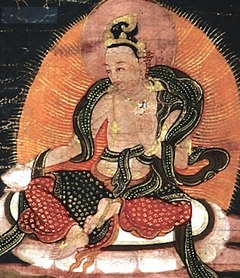
Khandro Nyingtik History
History Composed by Gyalwa Yungtön
from the Heart-Essence of the Ḍākinīs
Namo guru!
Dharmakāya Samantabhadra, sambhogakāya deities, peaceful and wrathful,
And the great nirmāṇakāya Vajradhara of the transmission of direct realization,
Together with the vidyādharas of the sign transmission, including Garab Dorje,
Śrī Siṃha, the Guru of Oḍḍiyāna and his consort,
And the king of Dharma, Rangjung Dorje,
We ordinary individuals pray to you in devotion.
Here, I shall recount the history of this special teaching, the extraordinary instruction known as the Heart-Essence of the Ḍākinīs, which comprises the heart-blood of all the ḍākinīs, and represents the pinnacle of all vehicles, the quintessence of all instructions, the key to direct personal experience, and the profoundest of the profound.
In the utterly pure expanse, the dharmadhātu palace of Akaniṣṭha, the immaculate dharmakāya Samantabhadra and his consort assumed forms with faces and arms out of a state of utter intangibility. Then, from the unelaborate dharmakāya, they taught glorious Vajrasattva in Akaniṣṭha by means of natural inspiration. Glorious Vajrasattva, adorned with the sambhogakāya signs and marks, then employed words to teach the emanation Garab Dorje, who belongs to the human realm but is the equal of the buddhas in his realization, in the palace of the Blazing Volcano charnel ground. He, in turn, taught the master Śrī Siṃha in the great Pāruṣyaka Grove charnel ground based on direct experience. Śrī Siṃha then revealed the fundamental natural beyond intellectual speculation to the great vidyādhara called Padma Tötreng Tsal, whose vajra-like form is immortal, in the charnel ground in Sosadvīpa. At the same time, he also entrusted him with the seventeen tantras, the Tantra of Samantabhadrī’s Sun of the Brilliant Expanse, the Self-Arisen Awareness Tantra, the Heart Mirror Tantra, the Tantra Without Letters, the Blazing Lamp Tantra, the Array of Studded Jewels Tantra, the Union of Sun and Moon Tantra, the Direct Introduction Tantra, the Pearl Necklace Tantra, the Tantra of Self-Liberated Awareness, the Self-Arisen Perfection Tantra, the Sixfold Great Expanse Tantra, the Tantra of the Blazing Relics, and the Tantra of Heaped Jewels,[1] as well as the six tantras of liberation through wearing: the Tantra of Immaculate Empty Clarity,[2] the Tantra of the Singular Knowledge That Brings Universal Freedom, the Tantra of the Unique Golden Syllable of Yangti, the Tantra That Is the Buddhas’ Only Child, the Tantra of Self-Emergent Awareness, and the Tantra of the Great Consummate Fruition, together with the testaments of the buddhas and vidyādharas, and the essential instruction on the essence of liberation through wearing. These instructions, the intent of the tantras set out clearly for the benefit of future generations, correspond to what the great master Padmākara transmitted in the cave of Yari Gong. Through them, even an individual of inferior capacity may attain attain full awakening in which no trace of the aggregates is left behind in as short a time as seven years and eleven months.
Then the magnificent master, with his body of great transference, arrived in Tibet, where he bound all the malicious gods and spirits under oath and brought countless disciples, including King Tri Songdetsen, to spiritual maturity. He concealed an inconceivable quantity of wisdom-mind treasures for future students. Seeing that Vimalamitra had come to teach the Heart-Essence of the Great Perfection, he himself did not widely propagate such teachings.
While he was staying in the Zhotö Tidro cave, the master was served by the lady Yeshe Tsogyal, who compiled and wrote down all the empowerments and instructions. She asked the Guru, “Are these teachings to be spread or concealed? How will they bring benefit to disciples?” The master replied:
"Now is not the time to propagate them. We must conceal them as treasure. The king’s daughter Princess Pema Sal lifted the casket containing the texts of the Heart-Essence to her head and made aspirations, so this is her assigned teaching. When she passes away, after several lifetimes, she will meet this Dharma in her final birth. For that reason, we must conceal it. Vimalamitra is overseeing the Heart-Essence teachings. Now is the time of his promulgation. My own Nyingtik teachings will appear when the Heart-Essence teachings of the Ancient Translations have been neglected and are close to disappearing. When teachings become widespread they do not endure for long. In the final age, when the human lifespan is fifty years, this princess will take birth as someone who will be guided by an emanation of the king. There will simply be a dharmic connection with the king during the final rebirth. It will be during the subsequent lifetime, that she, the revealer, will encounter the treasure of pith instructions. That will not be the time for benefitting beings but for practice. The revealer will live for the full span of fifty-nine years. He will make connections with those possessing pure karma and those who lack it. Some among them will travel to Sukhāvatī and become his disciples. Some will be reborn in lower realms. Breaches of samaya will cause the revealer to display the signs of passing. He might even pass away before the age of fifty. He should be wary of samaya breaches and diligent in confession. Should he do so, he will live out his full lifespan.
“At that time, it is possible that a woman with the blessings of the five classes of ḍākinī may appear. She will become the revealer’s disciple. If she appears and becomes his consort, the revealer’s life will be rejuvenated, and it is even possible that his lifespan might exceed fifty years. A destined disciple bearing the mark of a mole will appear. If he is given the complete instruction he will be able to benefit beings to some degree. If this does not come to pass, however, he will certainly become a disciple in the following lifetime and will attain awakening without remainder in the highlands of Kharak. If these teachings do not reach Lower Bumtang, they should be concealed at the original site of revelation or at a rock unfrequented by gods, spirits or human beings ready to be retrieved in the following lifetime. After passing from this life, the revealer will spend some time in the sambhogakāya realm. Then, he will be born in Tarpa Ling in Bumtang. After fifteen years, he will benefit beings. He will open many doors to treasure. Displaying miracles, he will live for seventeen years. If he takes as consort the five classes of ḍākinī in human form, this will bring abundant benefit. A son named Dawa Drakpa, an emanation of Hayagrīva, will be born. He too will benefit beings and uphold the teachings for ninety years. Since this is such an assigned Dharma, it is to be buried as treasure.”
Having said this, he concealed the volumes of the eighteen tantras in the Lion Rock cave at Bumtang.
The instructions that encapsulate the vision of these tantras and comprise the most profound cycle of the kusula were concealed at Tramo Drak in Danglung in Dakpo and entrusted to the treasure custodian Danglha.
The contents of the cycle may be enumerated as follows:
The six tantras of liberation through wearing and their six commentaries, the history, the creativity empowerment, the method of bearing the tantras, displaying signs, others’ benefit, the superior path of qualities and how they arise, the three testaments, the essential instruction on liberation through wearing. These are the twenty-three texts related to liberation through wearing.
Then there are the outer and inner practices of the five families, the elaborate vase empowerment, the ḍākinī actualization, third empowerment, practices related to the third empowerment, supplement to the empowerment, five special empowerments, common ritual manuals for the outer and inner practices, garland of principal secret practice manuals, empowerment rite, vase rite, purity of the maṇḍala, outer and inner feast offering, torma offering rite, feast offering for the secret practice, sequence for the three empowerments, addenda to the secret empowerment, addenda to the knowledge-wisdom empowerment, instructions on the ḍākinīs’ heart-essence, general themes, vitality stone rite, and ḍākinīs’wealth practice. These are the twenty-three texts related to empowerment and practical rites.
There are five texts in the instruction cycle: the Jewel Essence instruction on Tögal, its commentary Illuminating Lamp,[3] the Garland of Citations supportive instruction, the treatise on signs and the treatise on the measures of progress.
Then there are nine texts[4] of supportive instructions: the Great Heart-Essence, the Mirror Clarifying the Meaning, the introductory Path and Result, the Garland of Crucial Instructions, and Vajra Fluid Imbibing.
There are five texts of advice for the bardos: the character of the path of the peaceful bardo, the wrathful deities, wrathful bardo, advice for the bardo, and motivational instructions for the four bardos.
The collection of ancillary texts includes advice for cutting attachment to food and clothing, tummo practice, the tantra of Sokdrup Nakmo practice for guarding against obstacles on the path, related advice on the six occasions,[5] vitality stone, and further pith instructions.
Furthermore, the six tantras of liberation through wearing were transmitted as direct realization from Samantabhadra onwards down to Padma of Oḍḍiyāna. The master then taught them, and Tsogyal compiled them and wrote the six commentaries. The instruction on the essence of liberation through wearing was composed by Garab Dorje; then Śrī Siṃha taught it together with the testament to the master Padma.
Master Padma taught the other instructions in the cave of Yari Gong in accordance with the vision of the eighteen tantras. Kharchen Tsogyal then wrote the practical guidance, instructions and commentaries. The replies to the ḍākinī were set down in writing after Tsogyal put her questions to the master with the aim of dispelling doubt and avoiding errors.
The tantra of the protector of the teachings Sokdrup Nakmo and its associated instructions were concealed in a Maheśvara statue to the north of Bodhgayā. They were retrieved by the tīrthika Guhyaśrī, from whom Master Padma received them after offering a thousand measures of gold. The master then appointed Sokdrup Nakmo as a protector of the Khandro Nyingtik teachings.
Additional treasures not listed in the index include a longevity practice, a black Jambhala practice, the history of Princess Pema Sal and the inventory.
The master Padma and his consort concealed these collections of teachings in Tramo Drak. Later, Princess Pema Sal was reborn in Drildang Chöjung[6] with a mark on the inside of his right thigh resembling a ḍākinī’s eye.[7] The child was born in a year of the water element and the hare sign[8] and given the name Tsuldor.[9] He awakened his karmic predisposition and realized how all the phenomena of saṃsāra and nirvāṇa are mind. He received prophecies from local deities and ḍākinīs, and he came to possess the key treasury inventory. Then in the female Water Ox (1313) on the twenty-seventh day of the final month of autumn, he made offerings and prayed to the guru, yidam, ḍākinīs, dharma protectors, and treasure keepers, and then retrieved the treasure. He was assisted during this revelation by Lotön Dorje Bum.
The prophecy from Guru Rinpoche said that the precious Tsuldor should keep these teachings secret and practice them, and that if he were to conceal them once more in the original terma site, or in Bumtang, or in a rock not frequented by gods, demons or human beings, he would be of immeasurable benefit to beings in his next life, whereas not to do so would mean facing an obstacle to longevity from a breach of samaya. Falling prey to this second predicted outcome, he died.
As the yellow scrolls were still in the possession of Lotön Dorje Bum, it was from him that the Dharma Lord Rangjung Dorje received them.
On the eighth day of the sixth month in the female Iron Sheep year (1331) on the border between Old and New Tsari and Kongpo, in a hermitage behind a mountain pass, Kharakpa Drakpa Wangchuk and others made copies of the yellow scrolls. To inspire confidence in others, the Dharma Lord added the scroll of the Responses to the Ḍākinī’s Questions, which was written in twenty-two lines on a scroll of three finger-widths.[10]
If some foolish people suspect that the lineage of empowerment for the treasure was interrupted, they should know that the master Padma said that to see the yellow scrolls is to meet Master Padma’s enlightened form, to encounter the signs is to encounter his enlightened speech, and to encounter the meaning is to encounter his enlightened mind. In short, if any of the six means of transmitting the teachings remains intact, the lineage is unbroken. What are the six? (1) The direct wisdom-mind transmission of the victorious ones, (2) symbolic transmission of the vidyādharas, (3) oral transmission of individuals, (4) transmission of compassionate blessings, (5) transmission of ḍākinī entrustment, and (6) transmission of aspirational empowerment.
All six are complete here. The direct wisdom-mind transmission of the victorious ones refers to the natural reception of the creativity of awareness empowerment when the victorious buddhas of the five families merely direct their realization toward a suitable vessel. In a similar way, Padma said, “In consideration of beings in the future, I have concealed profound treasure teachings and empowerments. Whoever discovers them has the authorization-empowerment from the wisdom-mind transmission.”
The symbolic transmission of the vidyādharas is complete here too. Members of the lineage from Samantabhadra to the five families receive empowerment through the mere demonstration of symbolic gestures. Padma also left terma texts in which he promised that he would confer empowerment in a similar way on suitable vessels in the future. The disciples who are empowered in that way will receive blessings and empowerments, so there is authorization-empowerment. The Tantra of Sevenfold Awareness says:
Understanding the symbols and what they signify
Constitutes, among empowerments, the authorizing empowerment.
As for the oral transmission of individuals, several sūtras state that the nirmāṇakāya would appear in the form of texts in the future. The White Lotus of Compassion Sūtra says:
Mountains, pebbles and shrubs,
Great drums and wishing trees—
The sounds that originate therefrom
Are blessed by the victorious ones.
They too are held to be Dharma.
In addition, by practising unerringly according to the treasure texts, the guru, who is the buddha, and one’s own mind become inseparable. This itself is the sublime oral transmission. As a treasure prophecy states:
In the dharmakāya Samantabhadra
There is nothing we might refer to as a teacher,
No one who confers empowerment or teaches Dharma.
When one understands one’s own mind to be dharmakāya
One gains empowerment and transmission from the victors of the three times
And might be said to uphold the lineage.
The transmission of compassionate blessings is also complete. From Samantabhadra onwards, it is merely a matter of being blessed and receiving the creativity of awareness empowerment. Padma said that he would conceal profound treasures for future generations and that whoever revealed them or encountered them would receive blessings and gain the empowerment of the creativity of awareness.
The transmission of ḍākinī entrustment is also complete. From Samantabhadra to the destined recipient, the teaching is entrusted to the ḍākinīs. The treasure guardians receive a prophetic command to entrust the treasure to a suitable recipient.
The transmission of aspirational empowerment too is complete. Everything is transformed through aspiration, and aspirations are the buddhas’ words of truth. Such words are supremely infallible. In this case, Padma makes the aspiration, “May this meet with the destined one in future!” And, through the power of such aspiration, the destined one encounters it. Aspiration is a sublime element of all empowerment.
In short, merely to see a yellow scroll from Master Padma is to enter the retinue of those who saw him face-to-face, and to understand his realization unerringly is to become his heart-disciple and receive all the empowerments.
Thus, the empowerments, transmissions and texts, complete with these six modes of transmission, reached the precious lord.[11] For the uncommon lineage, consult the verse biography, which describes how the dharma lord Rangjung Dorje met many buddhas and bodhisattvas directly, received their blessings, and was empowered as a sovereign of Dharma.
The special lineage for this teaching is as follows. When the precious dharma lord [Rangjung Dorje] was in retreat at Jomo Gang, he had a vision in which Padmasambhava of Oḍḍiyāna appeared clearly in the space before him, conferred empowerment directly and granted blessings. In addition, when he was in retreat in the hermitage on the eastern side of Jomo Kharak, during the full moon in the seventh month, he had a dream in which he received the Guru’s blessings and empowerment. Then, when he was practising gaṇacakra in the Lotus Heart Cave, he had a pure vision in which a ḍākinī bestowed empowerment and blessings, and sang many songs of experience. He had a feeling that he would soon encounter an instruction from Master Padma that would be the culmination of those he had previously received, something exceptionally profound. Not long thereafter, the incarnation of Princess Pema Sal, the hidden yogin Tsuldor revealed the treasure containing the kusuli cycle of the most secret Dzogchen instructions, which Master Padma and his consort had hidden in Tramo Drak in Dang Lung in Dakpo. Tsuldor then gave this to his treasure assistant Lotön Dorje Bum, who, in turn, presented it to the dharma lord. Rinpoche was delighted, and the purpose of the earlier empowerments and blessings from the Guru and ḍākinī was realized. Later, in the first month of the male Water Monkey year (1332), in the Dechen hermitage at Tsurpu, as requested by the great attendant and master Yeshe Gyaltsen, [Rangjung Dorje] entrusted the teaching to five disciples: Drongruwa Khenpo Gyaltsen, Tokden Yegyal, Tulku Önpo Menlungpa, and me, the crazy Yungtön. Together with the shrine assistant and steward, there were seven of us to whom he granted the five empowerments and all the instructions in full with nothing omitted.
I, Dorje Palzangpo, a bhikṣu follower of Śākyamuni, then arranged this history, the practical arrangement of the five empowerments, the activity manuals for the outer and inner ḍākinī practices, and the activity manual for the secret practice of Hayagrīva and Vārāhī in union, together with its associated praise, according to the writings of Master Padma and the dharma lord’s oral instructions. However, if you compare them to what is found in the means of actualization, offering ritual and feast offering composed by Master Padma himself, there is not the slightest contradiction.
In the vast, sky-like expanse of the victors’ teachings,
The most secret Heart-Essence shines like the sun,
Emitting its rays of direct instruction in every direction,
And, with its threefold lineage, dispelling ignorance’s darkness.
The water-born lotus of my own mind has opened slightly,
The anthers of experience and realization have grown,
And the fragrance of the profoundest key instructions
Delights the gathering bees, those fortunate disciples.
No longer moving about in a frenzy of speculation,
But, with grown wings of directly realized awareness,
May they dance in the sky of phenomenal exhaustion
And proclaim the sound of the Dharma of selflessness.
May the blazing splendour of auspiciousness adorn the whole world!
Let it be virtuous! Maṅgalam.
| Translated by Adam Pearcey with the generous support of the Tsadra Foundation, 2026.
Bibliography
Tibetan Edition
"lo rgyus rgyal ba g.yung gis mdzad pa" In snying thig ya bzhi. 13 vols. Delhi: Sherab Gyaltsen Lama, 1975. Vol. 11: 405–422 (8.5 folios)
Secondary Sources
Arguillère Stéphane, “A King of Dharma forgotten on the Jewel Island: Was Me ban Chos rgyal Rin chen gling pa Rig ’dzin rGod ldem’s rDzogs chen master? (How half of the mKha’ ’gro snying thig got included in the dGongs pa zang thal)”, Revue d’Etudes Tibétaines, no. 68, Janvier 2024, pp. 69–147.
Dudjom Rinpoche. The Nyingma School of Tibetan Buddhism: Its Fundamentals and History. Translated by Gyurme Dorje and Matthew Kapstein. Boston: Wisdom Publications, 1991.
Gamble, Ruth. Reincarnation in Tibetan Buddhism: The Third Karmapa and the Invention of a Tradition. New York: Oxford University Press, 2018
Kunsang, Erik Pema. Wellsprings of the Great Perfection: Lives and Insights of the Early Masters in the Dzogchen Lineage. Boudhanath: Rangjung Yeshe Publications, 2006.
Version: 1.0–20260325
Notes
-
The list mentions only fourteen tantras, suggesting scribal error or corruption. The missing titles are: the Lion’s Perfect Power Tantra, the Tantra of Auspicious Beauty and the Word-Transcending Tantra. ↩
-
The first of the six tantras is usually referred to as the Essence of Liberation Through Wearing, but it begins with the syllables stong gsal meaning “empty clarity”, a possible reason for the title given here. ↩
-
Possibly what is now called Clarifying/Illuminating Mirror (gsal ba’i me long). ↩
-
The available editions list only five texts, suggestive of copyist’s error. The four missing texts are (almost certainly) the Yoga of the View, the Yoga of Meditation, the Yoga of Conduct and Fruition, and The Golden Rosary of Nectar: Replies to Questions. ↩
-
Note that the text itself refers to ’gyu dus rather than the rgyu dus that is given here. ↩
-
’bril ldang. In other sources, this is spelled Dritang (’bri thang). ↩
-
The same is said of Tulku Gyalsé Lekpa. See Prophecy Concerning Tulku Lekpa. ↩
-
Pema Ledrel Tsal is usually said to have been born in 1291, an Iron Hare year, but this suggests he was born in the Water Hare year of 1303. ↩
-
Short for Tsultrim Dorje. ↩
-
The translation of this line is tentative. ↩
-
Karmapa Rangjung Dorje ↩