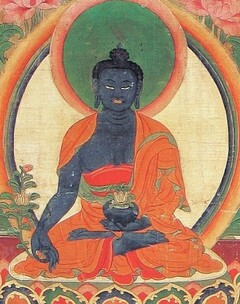
Introduction to the Medicine Buddha
Introduction to the Medicine Buddha
by Stefan Mang
Bhaiṣajyaguruvaiḍūryaprabha (Tib. sangs rgyas sman bla)—the Master of Healing, ‘Radiant like Lapis Lazuli’—is the buddha of healing, commonly known in English as the Medicine Buddha or Buddha of Healing.[1] His fame rests on the universal need for relief from sickness, yet his aspirations reach far beyond the healing of physical ailments, for in the Buddhist understanding sickness also embraces the afflictions of the mind.[2] The Medicine Buddha belongs to the Mahāyāna vision of innumerable buddhas, each presiding over a pure land in a different quarter of the universe: he is the buddha of the east, whose realm is Vaiḍūryanirbhāsa, ‘Shining like Lapis Lazuli’.[3] While he is attested in a considerable body of scripture,[4] the Tibetan Buddhist tradition highlights three canonical works dedicated to him:[5]
- The Detailed Account of the Previous Aspirations of the Blessed Bhaiṣajyaguruvaiḍūryaprabha (Bhagavānbhaiṣajyaguruvaiḍūryaprabhasya pūrvapraṇidhānaviśeṣavistāra, Toh 504), which sets out his twelve great aspirations.[6]
- The Detailed Account of the Previous Aspirations of the Seven Thus-Gone Ones (Saptatathāgatapūrvapraṇidhānaviśeṣavistāra, Toh 503), which sets out the aspirations of the seven tathāgatas of his cycle, himself included.[7]
- The Vaiḍūryaprabha Dhāraṇī (Vaiḍūryaprabhadhāraṇī, Toh 505), which contains his dhāraṇī and mantra.[8]
The account of his aspirations (Toh 504) appears to be the oldest of the three. A Chinese translation existed by the early fourth century, and several Sanskrit manuscripts were recovered from a stūpa at Gilgit; the account of the seven tathāgatas reproduces it almost word for word.[9] Although the royal catalogues of the Tibetan imperial period list the text as a sūtra, in the Kangyur this and the other texts dedicated to the Medicine Buddha are placed among the tantras of the kriyā yoga class, a placement that may reflect their strong ritual emphasis.[10]
Iconography
The Medicine Buddha’s body is likened in the account of his aspirations to vaiḍūrya, pure within and without and radiating a stainless light.[11] The exact identity of this gem, one of the seven precious substances, has long been debated. The Sankrit term vaiḍūrya (and Prakrit veruliya) is cognate with the English word beryl (via the Greek bērullos). Still, largely because the artistic traditions, including Nepalese and Tibetan paintings, depict the Medicine Buddha with skin of a deep blue, lapis lazuli remains a common choice for rendering vaiḍūrya in English.[12]
In the Tibetan Buddhist tradition the Medicine Buddha is generally depicted as peaceful in appearance, wearing the three robes of a monastic and seated in the vajra posture with the marks and signs of a buddha; he is identical to Buddha Śākyamuni in every respect but his colour, a brilliant blue in place of gold.[13] His right hand rests over the knee in the gesture of supreme generosity and holds the myrobalan (Skt. harītakī; Tib. a ru ra; Lat. Terminalia chebula),[14] signifying relief of sickness through relative means such as medical treatment, while his left hand rests in the gesture of meditation and holds a begging bowl, signifying the cure of suffering at its root through the realisation of absolute truth.[15] The Medicine Buddha is frequently shown surrounded by the other tathāgatas of his cycle, who together with him are known as the seven, or eight, Medicine Buddhas;[16] by the two bodhisattvas Sūryavairocana and Candravairocana, the ‘Solar’ and ‘Lunar Radiance’ who keep the treasury of his teachings;[17] and sometimes by the twelve great yakṣa generals who pledge to protect those who recall his name.[18]
The Twelve Aspirations
According to the account of his aspirations, he made twelve great aspirations, the cause of his vast enlightened activity, while still practising the bodhisattva path.[19] The first two concern the radiance of his future body, which, like pure beryl, would illuminate countless worlds, outshine the sun and moon and guide those who travel in darkness. The remaining ten turn to beings caught in saṃsāra: that none would lack anything; that those on mistaken or lesser paths would be led to the Great Vehicle, keep pure discipline and be established in correct view; that the sick, the disabled, the destitute and the persecuted would be healed and protected on hearing his name; and that the hungry would be fed and the naked clothed.
His buddhafield, Vaiḍūryanirbhāsa, lies far to the east: a world of pure beryl (or lapis lazuli) whose splendour is said to equal that of Sukhāvatī.[20] Those who hear his name and aspire to the realm of Amitābha are guided there at death by eight bodhisattvas, which is why prayers to the Medicine Buddha so often ask for rebirth in Sukhāvatī,[21] and none who has heard his name can be reborn in the lower realms.[22] The account also prescribes a forty-nine-day rite of offerings, recitation and lamps for the gravely ill and the dying, which rulers may likewise perform to avert calamity from their realm.[23]
The Medicine Buddha in Tibet
In Tibet the Medicine Buddha is honoured as the source of Tibetan medicine: the Four Tantras (rgyud bzhi), the foundational text of the Tibetan medical tradition, present him as the teacher of medicine, the role held by Dhanvantari and Ātreya in the classical Indian medical treatises.[24]
According to traditional accounts, the practice of the Medicine Buddha was brought to Tibet by the abbot Śāntarakṣita, who bestowed it upon several students, including the Tibetan king Tri Songdetsen, who became its main custodian.[25] The earliest Tibetan liturgies for the rites of the seven tathāgatas, preserved in the Tengyur (Toh 3132–3134), are attributed to one ‘Bodhisattva’, commonly identified with Śāntarakṣita, who is said to have composed the longest of them for the king’s longevity, the stability of his reign and the purification of his karma.[26] Later Tibetan Medicine Buddha liturgies appear to be based on these early texts and are therefore frequently titled sūtra-based Medicine Buddha rituals (sman bla’i mdo chog).[27] Since that time these rites have been especially esteemed by rulers, not only in Tibet but also in Mongolia and China. At the Mongol court the Narthang abbot Ze’u Drakpa Tsöndrü (ze’u grags pa brtson ’grus; 1253–1316), of the Kadampa school in whose hands the ritual tradition chiefly lay, took part in performing them for Kublai Khan (1215–1294) and his successor Öljeitü (1282–1316), and Kublai had several of the ritual texts translated into Chinese.[28] Tibetan liturgies commonly draw on the Medicine Buddha’s dhāraṇī, the source of the short mantra familiar from Tibetan practice, and on the short homage and mantra,[29] and in them one visualises the Medicine Buddha and receives his healing light and nectar.[30]
The texts gathered in this series belong to this long history of invocation and healing. Through them practitioners call upon the Medicine Buddha to pacify sickness and the dangers of this life, to purify the harmful actions that would otherwise ripen in lives to come, and to recognise in his blue radiance the awakened nature of mind, the cure of suffering at its root. In this way they carry forward the aspiration of a buddha who vowed that none who heard his name would languish in sickness or want.
Bibliography
84000: Translating the Words of the Buddha. The Detailed Account of the Previous Aspirations of the Blessed Bhaiṣajyaguruvaiḍūryaprabha ( Bhagavānbhaiṣajyaguruvaiḍūryaprabhasya pūrvapraṇidhānaviśeṣavistāra, bcom ldan ’das sman gyi bla bai ḍūrya’i ’od gyi smon lam gyi khyad par rgyas pa, Toh 504). Translated by Dharmachakra Translation Committee. Online publication. 84000: Translating the Words of the Buddha, 2021a. https://84000.co/translation/toh504.
______. The Detailed Account of the Previous Aspirations of the Seven Thus-Gone Ones (Saptatathāgatapūrvapraṇidhānaviśeṣavistāra, Toh 503). Translated by Dharmachakra Translation Committee. Online publication. 84000: Translating the Words of the Buddha, 2021b. https://84000.co/translation/toh503.
______. The Vaiḍūryaprabha Dhāraṇī (Vaiḍūryaprabhadhāraṇī, Toh 505). Translated by 84000 Translation Team. Online publication. 84000: Translating the Words of the Buddha, 2024. https://84000.co/translation/toh505.
______. A Mantra for Incanting Medicines When Administering Them (sman gtong ba’i tshe sman la sngags kyi gdab pa, Toh 505a). Translated by Catherine Dalton. Online publication. 84000: Translating the Words of the Buddha, 2023. https://84000.co/translation/toh505a.
Birnbaum, Raoul. The Healing Buddha. Rev. ed. Boston: Shambhala Publications, 1989.
Thrangu Rinpoche. Medicine Buddha Teachings. Oral translation by Lama Yeshe Gyamtso; introduced, edited and annotated by Lama Tashi Namgyal. Ithaca, NY: Snow Lion Publications, 2004.
Tulku Thondup. Boundless Healing: Meditation Exercises to Enlighten the Mind and Heal the Body. Boston: Shambhala Publications, 2000.
van der Kuijp, Leonard W. J. The Kālacakra and the Patronage of Tibetan Buddhism by the Mongol Imperial Family. Central Eurasian Studies Lectures 4. Bloomington: Department of Central Eurasian Studies, Indiana University, 2004.
Winder, Marianne. “Vaidurya: The Tibetan Medicine Buddha.” Bulletin of Tibetology, 1990, nos. 1–3: 27–37.
Zwilling, Leonard. “On Bhaiṣajyaguru and His Cult.” In Studies in History of Buddhism: Papers Presented at the International Conference on the History of Buddhism at the University of Wisconsin, Madison, edited by A.K. Narain, 413–421. Delhi: B.R. Publishing Co., 1980.
Version: 1.0–20261030
Notes
-
For a list of the various names of the Medicine Buddha, see Birnbaum 1989, 54–55. ↩
-
84000 2021a, i.9; Zwilling 1980, 413. ↩
-
84000 2021a, 1.6, 1.21. ↩
-
Birnbaum 1989, 54–55. ↩
-
Thrangu Rinpoche 2004, 105. ↩
-
For a translation, see 84000 2021a. ↩
-
For a translation, see 84000 2021b. ↩
-
For a translation, see 84000 2024. ↩
-
84000 2021a, i.6–i.8; Zwilling 1980, 414, 417. ↩
-
84000 2021a, i.8; Zwilling 1980, 418. ↩
-
84000 2021a, 1.9. ↩
-
Winder 1990, 27–36, argues instead for beryl or aquamarine; the account of his aspirations itself likens his body to a ‘precious blue beryl’ (84000 2021a, 1.9); Birnbaum 1989, 65–66. It is also worth noting that beryl is less familiar in Central and East Asia than in South Asia, whereas lapis lazuli comes from Afghanistan. ↩
-
Thrangu Rinpoche 2004, 31–32. ↩
-
The fruit of a plant of the Himalayas held to possess extraordinary healing properties and to promote longevity, and also regarded as conducive to meditation; see the 84000 Glossary. ↩
-
Thrangu Rinpoche 2004, 31–32. ↩
-
The scriptures count seven buddhas, with the Medicine Buddha as the seventh (84000 2021b, i.2–i.3). Tibetan practice and art add Buddha Śākyamuni as an eighth (Thrangu Rinpoche 2004, 16, 32), presumably as the Supreme Physician and to complete the eightfold symmetry favoured by Tibetan artists (Birnbaum 1989, 93). ↩
-
84000 2021a, 1.22; Birnbaum 1989, 66, who also gives the variants Sūryaprabha and Candraprabha. ↩
-
84000 2021a, 1.53–1.54. ↩
-
84000 2021a, 1.8–1.19; cf. Birnbaum 1989, 62. ↩
-
84000 2021a, 1.21–1.22. ↩
-
84000 2021a, 1.30; Zwilling 1980, 415. ↩
-
84000 2021a, 1.43. ↩
-
84000 2021a, 1.45–1.52; the rite is detailed at 1.49, the instructions for kings at 1.50 and the nine kinds of untimely death at 1.52. ↩
-
Zwilling 1980, 413. ↩
-
Thrangu Rinpoche 2004, 18. ↩
-
84000 2021b, i.12; van der Kuijp 2004, 5–6. Van der Kuijp notes that the attribution was not unanimous: Ngorchen Kunga Zangpo (1382–1456) reports the view that the long and short versions were written by Kadampa teachers (6n16). ↩
-
Zwilling 1980, 417, 421n52, who notes that all the Tibetan Medicine Buddha liturgies he examined are based on these three texts. ↩
-
84000 2021b, i.12; Zwilling 1980, 417; van der Kuijp 2004, 4, 8. ↩
-
84000 2021a, i.9. ↩
-
Tulku Thondup 2000, 139–141. ↩