Introduction to Nāgas
Introduction to Nāgas
by Stefan Mang
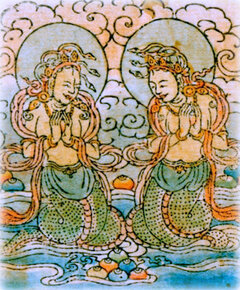
Nāgas (Skt. nāga, fem. nāgī or nāginī; Tib. klu)[1] form a class of semi-divine, serpentine beings central to the cosmology and popular religious life of South and Inner Asia. Rites honouring them are attested on the Indian subcontinent for well over two thousand years and, carried along with Buddhism itself, became deeply rooted in Tibet, where they remain a vital presence in religious life today.[2] Nāgas are reckoned native to the land itself, dwelling in lakes, rivers and springs and among the roots of large trees—their collective domain known as the nāgaloka (klu yul)—where they are believed to keep watch over treasures.[3] Traditionally nāgas are depicted with a human head and upper body joined to the coiled tail and spread hood of a cobra.[4] In principle, however, any snake might be considered a nāga.[5] They are credited with formidable magical powers, among them the ability to pass unnoticed in fully human guise.[6] Nāgas are also said to command the waters, bringing rain, flood or drought at will.[7] Buddhist cosmology places them under the authority of Virūpākṣa, guardian of the western quarter, and assigns them a share in guarding the heaven of the Thirty-Three (Trāyastriṃśa).[8] They recur throughout Buddhist narrative literature as figures of two minds, capable of both harm and devotion. Garuḍa, the great mythical bird, is reckoned the nāgas’ natural enemy and predator:[9] serpents are said to lose their poison at the mere sight of him, and for this reason he is widely invoked, in both India and Tibet, for protection against nāgas and the harm they cause.
Iconography
Nāgas are traditionally depicted with a human torso joined to the coiled tail of a serpent, crowned by a canopy of one, three, five, seven or nine snake-heads. Several buddhas and adepts, including Nāgārjuna, are shown sheltered by a similar hood, in a manner recalling the nāga king Mucalinda’s protection of the Buddha.[10] In peaceful form nāgas hold a wish-granting jewel, a vase of nectar or a concealed treasure text; in wrathful form they brandish snakes and weapons, and ocean nāgas may hold a pearl or a branch of coral.[11] The nāgas’ fivefold caste division, distinguished by colour, also furnishes the iconography of wrathful Heruka deities such as Vajrapāṇi, Vajrakīla, Hayagrīva and Garuḍa, who wear the eight great nāgas as serpent ornaments at the crown, ears, neck, chest and limbs. These nāgas symbolise mastery over anger, control over the eight nāga realms and all eight classes of spirits, the elimination of the eight worldly concerns, and the attainment of the eight great siddhis. In the wrathful landscape of the eight great charnel grounds, the eight great nāgas appear rising waist-upwards from the waters of the eight great rivers or lakes, hands folded in supplication and holding a nāga-jewel between their palms—the waters symbolising compassion, the nāgas the pāramitās, and the jewels the four means of gathering disciples.[12]
The Buddha and the Nāgas
Nāgas recur throughout the earliest accounts of Buddha Śākyamuni’s life,[13] appearing by turns as devotees, obstacles and converts along the path to his awakening. Nāgas were already present at his birth: the nāga kings Nanda and Upananda are said to have appeared in the sky above the Lumbinī garden and poured down two streams of water, one warm and one cool, to bathe the newborn Bodhisattva.[14] Before settling beneath the Bodhi tree, the Bodhisattva was persuaded to leave a cave he had chosen for his final meditation by the nāga who dwelt within it,[15] and after he had bathed in the Nairañjanā River, a nāga maiden offered him a jewelled seat on its bank.[16] When he tested his resolve by casting his alms bowl into the river, the nāga king Sāgara received it into his subterranean palace.[17] Most celebrated of all is the nāga king Mucalinda who, during the second week after the enlightenment, coiled seven times about the Buddha’s body and spread his hood above him to shelter him from an unseasonal storm.[18] Not every encounter was so peaceful: at Uruvilvā the Buddha subdued a ferocious fire-spitting nāga worshipped by the brahmin Kāśyapa and his followers, taming it through loving-kindness rather than force, in an episode that became the turning point in the conversion of Kāśyapa and his five hundred disciples.[19] In the course of his teaching, too, the Buddha is said to have preached the Dharma directly to nāgas, who also feature as interlocutors in several sūtras of their own.[20] Another well-known episode appears in the eleventh chapter of the Lotus Sūtra (Saddharmapuṇḍarīka), where the young daughter of the nāga king Sāgara offers a jewel to the Buddha and, in that same instant, passes through the ten stages of the bodhisattva path to reach buddhahood before the assembled audience.[21] After the Buddha’s mahāparinirvāṇa, the nāgas of Rāmagrāma are said to have drawn one of the eight original relic stūpas into their subterranean realm to guard for themselves—the only one of the eight said to have survived intact into Aśoka’s reign.[22] Read together, such episodes cast the nāga as a figure at once dangerous and devoted, whose submission before, and instruction by, the Buddha prefigures the class’s later role as protector of the Dharma and, as at Rāmagrāma, guardian of the Buddha’s own relics.[23] The nāgas’ role as guardians extends to scriptures too. Tradition holds that Nāgārjuna (fl. c. 2nd century CE) journeyed to the realm of the nāgas beneath the ocean to recover the Prajñāpāramitā sūtras, which the Buddha had entrusted to them for safekeeping until the world was karmically ripe to receive them.[24]
Nāgas in Tibet
In Tibet, the Indian nāga was assimilated to the indigenous lu (klu), a class of water- and earth-dwelling spirits already woven into pre-Buddhist cosmology, so that the resulting cult represents a fusion of Indian Buddhist, Bön and local Tibetan elements.[25] Of the eight classes of spirits said to inhabit and interact with the human realm, three were probably most prominent from an early date: the lu, dwelling in the underworld and its waters; the sadak (sa bdag; ‘lords of the soil’), who inhabit the earth itself; and the nyen (gnyan; ‘earth spirits’), who occupy every place upon it.[26] Their goodwill must be secured through offering, and their dwelling-places must not be defiled: an extensive ritual literature, both Bön (the klu ’bum) and Buddhist, addresses the lu directly, propitiating them to avert drought and secure rainfall and making amends when their dwellings have been disturbed, since such offences are held to provoke ‘lu-né’ (klu nad), a category of affliction in Tibetan medicine—leprosy chief among its forms.[27] Such afflictions may also be treated by invoking Garuḍa (khyung), who is called upon to counter the harm they cause. The taming of the nāgas through Garuḍa features prominently in the biographies of Guru Padmasambhava. While establishing Samye Monastery, Guru Padmasambhava first pacified the nāga king Maldro Zichen (mal gro gzi can) and his subjects by building them a temple at Lake Maldro (mal gro mtsho), yet found their minds still untamed. Meditating in wrathful union with Garuḍa he compelled the nāgas to submit; he then proposed an alliance between the worlds above and below the earth, after which gold washed up on the shores of the lake and the nāgas supplied the timber needed to complete the monastery.[28]
Ritual and Textual Practice
Nāgas remain a living presence in Tibetan Buddhist practice, honoured through torma and libation offerings (klu gtor, klu gsol), especially during the summer months when their activity is thought to peak, and propitiated in times of illness or environmental disturbance. As beings who resent having the ground disturbed, nāgas are also propitiated before construction work of any kind begins.[29] A well-known liturgy of this kind is Lasel Chenmo (bla gsal chen mo, “The Great Spirit Clearing”), a sang (bsang; incense-smoke) offering to the nāgas composed as a treasure (gter ma) of Guru Padmasambhava and revealed by the seventeenth-century master Karma Chakme (karma chags med, 1613–1678). Nāgas also appear as custodians and benefactors within the treasure tradition itself. In his own account of the 1866 revelation at Lake Sengö Yumtso, Chokgyur Dechen Lingpa describes how the “royal nāgas guarding the treasure” were persuaded to honour their oath, whereupon the “bodhisattva nāga kings tossed flowers of gold dust on the shore,” flecking the lakeshore with gold as the concealed teachings were drawn forth,[30] along with some gold powder of exceptional quality that was later used in the frescoes adorning the temple walls at Dzongsar monastery.[31] Because of their guardianship of such hidden riches, both material and spiritual, nāga realms are reckoned more broadly among the places where treasure-revealers (gter ston) recover concealed teachings, a number of which, as previously with the Buddha, are said to have been entrusted by Guru Padmasambhava directly to nāga custodians.
The texts gathered in this series belong to this long history of exchange between the human and nāga realms: offering to them, propitiating them, and, on occasion, seeking their pardon as beings who are at once among the most feared and the most richly rewarding of Buddhism’s non-human interlocutors.
Further Reading
84000: Translating the Words of the Buddha. The Questions of the Nāga King Sāgara (Sāgaranāgarājaparipṛcchā, klu’i rgyal po rgya mtshos zhus pa, Toh 155). Translated by Sakya Pandita Translation Group (Tsechen Kunchab Ling). Online publication. 84000: Translating the Words of the Buddha, 2011. https://84000.co/translation/toh155.
______. The Verses of Nāga King Drum (Nāgarājabherīgāthā, klu’i rgyal po rnga sgra’i tshigs su bcad pa, Toh 325). Translated by Sonam Tsering Ngulphu and Norzin Dolma. Online publication. 84000: Translating the Words of the Buddha, 2020. https://84000.co/translation/toh325.
______. The Play in Full (Lalitavistara, rgya cher rol pa, Toh 95). Translated by Dharmachakra Translation Committee. Online publication. 84000: Translating the Words of the Buddha, 2025. https://84000.co/translation/toh95.
______. The White Lotus of the Good Dharma (Saddharmapuṇḍarīka, dam pa’i chos pad ma dkar po, Toh 113). Translated by Peter Alan Roberts and team. Online publication. 84000: Translating the Words of the Buddha, 2025. https://84000.co/translation/toh113.
Akester, Matthew, trans. The Life of Jamyang Khyentsé Wangpo. Delhi: Shechen Publications, 2012.
Beer, Robert. The Encyclopedia of Tibetan Symbols and Motifs. Boston: Shambhala, 1999.
Bellezza, John Vincent. Spirit-Mediums, Sacred Mountains and Related Bon Textual Traditions in Upper Tibet: Calling Down the Gods. Leiden: Brill, 2005.
Bloss, Lowell W. “The Buddha and the Nāga: A Study of Folk Religiosity.” History of Religions 13 (1973): 36–53.
Buswell, Robert E., Jr., and Donald S. Lopez Jr. The Princeton Dictionary of Buddhism. Princeton, NJ: Princeton University Press, 2014.
Chavannes, Édouard. “Voyage de Song Yun dans l’Udyāna et le Gandhāra (518–522 p.C.).” Bulletin de l’École française d’Extrême-Orient 3 (1903): 379–441.
Chokgyur Dechen Lingpa. “Exquisite Melody of the Auspicious Tamboura.” Translated by Samye Translations. Lotsawa House, 2023.
Cozad, Laurie. Sacred Snakes: Orthodox Images of Indian Snake Worship. Aurora, CO: Davies Group, 2004.
Cozad, Laurie Ann. “Nāgas.” In Brill Encyclopaedia of Hinduism, vol. 5, edited by Knut A. Jacobsen, 72–80. Leiden: Brill, 2018.
Deeg, Max. “Indian Regional Nāga Cults and Individual Nāga Stories in Chinese Buddhist Travelogues.” Acta Asiatica Varsoviensia 34 (2021): 51–78.
______. “‘Once upon a Time’—So What? The Importance of Place in Buddhist Narratives.” Religions 14 (2023): 690.
Erik Pema Kunsang, trans. The Lotus-Born: The Life Story of Padmasambhava. Edited by Marcia Binder Schmidt. Boston: Shambhala, 1999.
Gnoli, Raniero, ed. The Gilgit Manuscript of the Saṅghabhedavastu. 2 vols. Rome: Istituto Italiano per il Medio ed Estremo Oriente, 1977–78.
Horner, I. B., trans. The Book of the Discipline (Vinaya-Piṭaka), vol. 4: Mahāvagga. London: Pali Text Society, 1951.
Karma Chakme. “Lasel Chenmo: A Sang Offering to the Nāgas.” Lotsawa House, 2017.
Kloppenborg, Ria, trans. The Sūtra on the Foundation of the Buddhist Order (Catuṣpariṣatsūtra). Leiden: Brill, 1973.
Li, Rongxi, trans. The Great Tang Dynasty Record of the Western Regions. Berkeley: Numata Center for Buddhist Translation and Research, 1996.
______, trans. “The Journey of the Eminent Monk Faxian.” In Lives of Great Monks and Nuns. Berkeley: Numata Center for Buddhist Translation and Research, 2002.
Rhys Davids, T. W., trans. Nidānakathā. Edited and revised by Ānandajoti Bhikkhu. Ancient Buddhist Texts, 2020.
Samye Translations. Following in Your Footsteps: The Lotus-Born Guru in Tibet, vol. 3. Boudha, Kathmandu: Rangjung Yeshe Publications, 2023.
Slouber, Michael. “Gāruḍa Medicine: A History of Snakebite and Religious Healing in South Asia.” PhD diss., University of California, Berkeley, 2012.
Strong, John S. The Legend of King Aśoka: A Study and Translation of the Aśokāvadāna. Princeton, NJ: Princeton University Press, 1983.
Tāranātha. “Three Reasons for Confidence: A Work Telling the Life and Liberation Story of the Great Master Padmakara.” Translated by David Teasdale. Lotsawa House, 2019.
Tucci, Giuseppe. Tibetan Painted Scrolls. Rome: La Libreria dello Stato, 1949.
Vogel, Jean Philippe. Indian Serpent-Lore, or the Nāgas in Hindu Legend and Art. London: Arthur Probsthain, 1926.
Zin, Monika. Mitleid und Wunderkraft: Schwierige Bekehrungen und ihre Ikonographie im Indischen Buddhismus. Wiesbaden: Harrassowitz Verlag, 2006.
Version: 1.0–20260819
Notes
-
As Deeg (2021, 53–54) observes, the Sanskrit term nāga is a comparatively late arrival in Old Indo-Aryan as a word for a serpentine being, later than terms such as sarpa and (Vedic) ahi; unlike in Brahmanical sources, where nāgas appear only from the epics onward, the term is first attested in Buddhist textual sources, though not necessarily older as texts than the Brahmanical ones. ↩
-
Cozad 2018, 72. ↩
-
Buswell and Lopez 2014, 561. ↩
-
Vogel 1926, 3–4. ↩
-
Cozad 2018, 77–78. ↩
-
Vogel 1926, 3–4. ↩
-
Deeg 2021, 54; cf. Beer 1999, 70. ↩
-
Buswell and Lopez 2014, 561. ↩
-
The mythical origin of the nāgas and Garuḍa is told in the Mahābhārata, where the two are cousins, born respectively to the sister-wives Kadrū and Vinatā of the sage Kaśyapa. After Kadrū tricked her sister into slavery, Garuḍa sought to free his mother by seizing the gods’ nectar of immortality for the nāgas; but Indra reclaimed it before they could drink it, and only when Garuḍa won the boon of making the nāgas his food did their enmity begin, and he has preyed on them ever since. See Vogel 1926, 47–55. ↩
-
Beer 1999, 70–71. ↩
-
Beer 1999, 71. ↩
-
Beer 1999, 70–71. ↩
-
What follows below are some prominent samples of the complex interactions of the Buddha’s with the nāgas. For a full discussion, see: Vogel 1926, 93–131. ↩
-
Lalitavistara (84000 2025, 7.29). ↩
-
This episode is referred to in the Sanghabhedavastu (Skt. Gnoli 1977–78, Vol. 1, 111; for a translation of the relevant passage see Deeg 2023, 690). It was later retold and further elaborated by Faxian (Li 2002, 196) and Xuanzang (Li 1996, 214–215). ↩
-
Lalitavistara (84000 2025, 18.39). ↩
-
Nidānakathā (Rhys Davids 2020, 174); cf. Lalitavistara (84000 2025, 18.40). ↩
-
Nidānakathā (Rhys Davids 2020, 187–188); cf. Lalitavistara (84000 2025, 24.89). ↩
-
Vinaya-Piṭaka (Horner 1951, 32–45); Catuṣpariṣatsūtra (Kloppenborg 1973, 50–71); Zin 2006, 136–166. ↩
-
Vogel 1926, 115–116; see also The Verses of Nāga King Drum (84000 2020, Toh 325) and The Questions of the Nāga King Sāgara (84000 2011, Toh 155), two canonical discourses addressed by the Buddha to nāga kings. ↩
-
Buswell and Lopez 2014, 561; cf. Saddharmapuṇḍarīka, ch. 11 (84000 2025b). ↩
-
Strong 1983, 219–221. ↩
-
Bloss 1973, 49–50; Deeg 2021. ↩
-
Vogel 1926, 23. ↩
-
Tucci 1949, vol. 2, 723. ↩
-
Beer 1999, 70. ↩
-
Bellezza 2005, 368–374. Cf. Beer 1999, 70, who lists leprosy, cancer, kidney complaints and skin ailments among the afflictions attributed to offended nāgas. ↩
-
Samye Translations 2023, 156–157. Cf. Erik Pema Kunsang 1999, 128–130; and Teasdale 2019. ↩
-
Buswell and Lopez 2014, 561; Cozad 2018, 77. ↩
-
Chokgyur Dechen Lingpa, “Exquisite Melody of the Auspicious Tamboura,” trans. Samye Translations, Lotsawa House, 2023. ↩
-
Akester 2012, foreword. ↩