The Four Applications of Breath

This text contains instructions on the yogic practices of channels and winds (tsa-lung) from the Longchen Nyingtik tradition. If practised incorrectly and without supervision, these practices can cause serious physical and mental problems, and therefore these texts have traditionally been kept secret and restricted to practitioners—and this is still the case today. After careful consideration and in consultation with the lineage holders of the Longchen Nyingtik, these texts are now being published online, for the benefit of serious practitioners who have received the appropriate transmissions and are practising under the guidance of a qualified teacher. Given their nature, please treat these texts with respect and do not reproduce them on any social media platforms.
The Four Applications of Breath
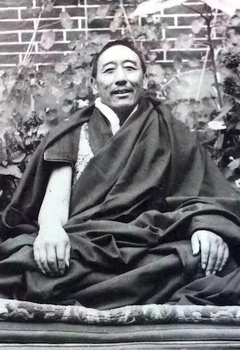
by the Second Adzom Drukpa, Tupten Pema Trinlé
The four applications of breath are:
Drawing in like a hook,
Filling like a vase,
Binding or gently pressing, like a knot pressed tight with the thumb
And shooting like an arrow—these are the four.
Chennga Lhazikpa says:[1]
The four applications are drawing in, filling, gently pressing,
And shooting like an arrow.
The crucial point of the body is the seven-point posture. Make fists with both hands and place them face down on your knees. The crucial point of speech is to exhale the stale air gently and at length, three times (clear the stale air with the lines ‘disease, demons, negative actions and obscurations…’).
Then inhale fully and gently press the prāṇa down below the navel, while also slightly raising the lower prāṇas, without using excessive force. Thus, unite the prāṇas at the navel and gently hold the vase breath. If holding the breath becomes uncomfortable, inhale a little more and gently press (zhilwa).
If it becomes uncomfortable again, breathe out slowly, subtly and at length, and then forcefully expel the remaining breath, with sound. Then breathe in again, holding the vase breath and gently pressing as before.
After doing four such rounds of breath, rest and breathe naturally. At first, when you are not yet experienced, don’t hold the breath for too long but hold it gently and for an appropriate duration.
If you cannot hold the breath any longer, gently press and gather (zhilwa) the prāṇas by turning the belly clockwise and anticlockwise and moving it forwards and backwards.
Again, if you cannot hold the breath any longer, exhale subtly and at length. If you can hold the breath forcefully and are able to retain it for a long time without much discomfort, then that is a sign that you have mastered the vase breath.
These are the words of Adzom Drukpa Tupten Pema Trinlé Palzangpo.
| Translated by Han Kop and Matthias Staber for the Longchen Nyingtik Project, 2026. With gratitude to Lama Jigme Namgyal for his clarifications.
Bibliography
Tibetan Edition
a 'dzom 'brug sprul thub bstan pad+ma 'phrin las. “rlung sbyor ba bzhi ldan”. In 'jigs med rnam rgyal, rdzogs pa chen po snying thig gong 'og las/ rlung dang thig le'i rdzogs rim phyogs bsgrigs. Private publication, [n.d.].
Version: 1.0–20261104
Notes
-
The first citation and the line following it in our text , which is our only witness, unfortunately appears badly corrupted. It reads: rlung sbyor ba bzhi ldan ni/ lcags kyu bzhin du ’gugs pa/bum pa bzhin du gzhil ba/‘theb rnon gyi rgya mdud bzhin du bsdams pa/mda’ ltar ’phen pa dang bzhi/sngar ltar gzigs pas/ Firstly, this passage has clearly been taken from Minling Terchen’s Ornament of Samantabhadra’s Wisdom Mind: Notes on the Instructions and Visualizations of the Great Perfection: Essence of the Profound Meaning of Ati (rdzogs pa chen po a ti zab don snying po’i khrid dmigs zin bris su spel ba kun bzang dgongs rgyan), where these two citations appear in exactly the same order. Secondly, the explanation of the four applications is fairly uniform throughout the Kagyü tradition, so listing gentle pressing as the second application is very odd. Thirdly, the second citation confirms that the second application is filling, not gentle pressing. For these three reasons, we have amended the text. ↩