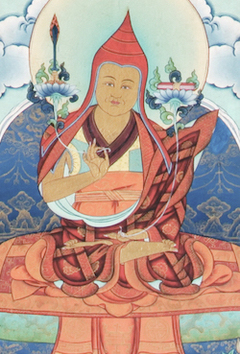
Advice for Gyurme Dorje
Translator’s Introduction
Jigme Tenpe Nyima seems to have taken a particular interest in memory. Among his best-known works is An Explanation of Dhāraṇī, on the mnemonic powers of bodhisattvas, a text widely praised for its originality. (Amdo Geshe Jampal Rolwe Lodrö, for instance, called it an “unsurpassed wonder,” while his foremost student, Do-ngak Chökyi Gyatso, eulogized it in a series of verses.)[1] And in his writings on the Great Perfection too, Jigme Tenpe Nyima often refers to memory in the specific sense of remembering the pure awareness introduced by the teacher. In fact, some instructions describe the path of Trekchö as little more than a process of remembering rigpa—or, to put it another way, remaining undistracted from rigpa. Although we might term this mindfulness, it is not mindfulness as the term is generally understood in other (lower) forms of Buddhism. Indeed, Dzogchen distinguishes its own brand of uncontrived, natural mindfulness from what it considers to be the artificial, unnatural mindfulness cultivated through lower forms of meditation. Deliberately holding an object in mind and paying attention to it can be compared to hanging a coat on a peg, these teachings say: the object and what holds it in place are separate, brought together only through circumstances. In the Great Perfection, by contrast, mindfulness is understood as a property of pure awareness itself, as intrinsic as heat is to fire.
Advice for the Devoted Student Gyurme Dorje
by Dodrupchen Jigme Tenpe Nyima
From the oceanic treasury of stainless knowledge
Flow the river-like teachings of the aural lineage,
The mighty waters of the supreme vajra vehicle –
Khyentse Özer, at your feet I bow!
Here I shall offer an essential summary of the key points of the view and meditation of the definitively secret Great Perfection, presenting them in the context of the six forms of mindfulness. This has two parts: a general summary and a detailed explanation.
I. General Summary
The omniscient guru said:[1]
Beginners achieve non-distraction through deliberate application.
Students of meditation and post-meditation are naturally undistracted.
Familiarity brings non-distraction as perceptions dawn as wisdom.
With expansive realization, there is no distraction nor one who is distracted.
With ultimate stability, what were objects of distraction are assuredly dharmatā.
And, with phenomenal dissolution, illustrations or expressions no longer apply.
II. Detailed Explanation
This has six sections: (1) applied mindfulness; (2) natural mindfulness, (3) mindfulness during post-meditative experience; (4) mindfulness of direct realization; (5) mindfulness encompassing experience; and (6) the mindfulness of phenomenal dissolution.
1. Applied Mindfulness
This is equivalent to the first of the three modes of liberation the great master Vimalamitra described: liberation through recognising thought, which is compared to meeting an old acquaintance. In this regard, if you have already practised the general generation phase of Unsurpassable Secret Mantra, there is no need to cultivate śamatha separately. Still, this should not be taken to imply that the perfection phase can only ever be practised on the basis of the generation phase. After all, it is well known that in this tradition of the king of vehicles clear light is made manifest through the pursuit of naked, primordially pure awareness alone.
Moreover, there are some whose minds are unsuited to samādhi, because of the prominent movement of thought. They cannot swiftly distinguish the ordinary mind from the pure awareness of rigpa within their own experience. This is because rigpa is the most rarefied aspect of mind and awareness and is extremely difficult to lay bare in a mind that is disturbed. It is therefore crucially important that right at the outset, before sustaining the essence of rigpa, you look directly into the essence of mind.
To distinguish among stillness, movement and awareness, movement refers to any subtle or coarse level of thought, whether good or bad, belonging to the category of mental profusion. Stillness means the absence of dullness and agitation in an essentially clear, penetrating mind. And awareness is that which notices whether movement has overtaken the mind as it sustains the flow of stillness.
Furthermore, both focusing your attention when it is scattered and allowing concentrated thought to disperse into agitation are considered hindrances to samādhi. You must therefore allow all movement, good and bad, to subside calmly and gently within the experience of stillness. For this, instructions on dispelling hindrances, such as bringing out the clarity of mind whenever it is dull, or looking directly into the essence of mind whenever it is agitated, are extremely important. Otherwise, a subtle dullness of mind can intensify, leading to ordinary śamatha and only strengthening delusion.
In short, pure samādhi, with the kind of mental pliancy required to focus on any given object, means maintaining an awareness that is untainted by any of the faults of meditative concentration, such as laziness, dullness or agitation, without letting it slip away. The most important means of sustaining such a state is to remain in an experience of mind’s own essence without allowing it to be lost. And for such a method, we must settle primarily through mindfulness (or remembering). What it means to be mindful – or not passing beyond the bounds of mindfulness – in this context is that you do not lose the essence of mind.
The term applied is used because when meditating there is no reduction of effort in samādhi — and that alone is at the very heart of the practice. This then is what we call applied mindfulness.
2. Natural Mindfulness
When the mind is made pliable through applied mindfulness, the practitioner takes as the path the pure awareness of rigpa, which is beyond the ordinary mind. This is based on the second mode of liberation from the approach of the Natural Great Perfection, the instruction on liberating thoughts just as a snake uncoils its own knots. At this stage, any intellectual speculation or form of analytical meditation on emptiness would prove insufficient by itself. Instead, everything must be brought together and integrated into this, the ultimate of all swift paths for attaining enlightenment. Of course, it is true that there could be no greater object of meditative equipoise than the emptiness in which all things are eliminated — down to their flesh and bones. Nevertheless, the Unsurpassed level of Vajrayāna is vastly superior in its methods for settling. A tantra says:
Because of which, through sacred bliss,
You will gain supreme accomplishment in this very life.
As this indicates, once the natural, co-emergent primordial liberation, the very state of the Original Protector, is made manifest, each moment can bring the equivalent of many aeons of ordinary accumulation. It is only the works of the Great Perfection that teach the uncommon aspects of the supreme, unchanging wisdom, as it is universally known in the second (i.e., perfection) phase of Unsurpassed Mantra. And it is only these same texts that teach the means of making this wisdom manifest, treating the practice of pursuing naked awareness — and naked awareness alone — as the most important of practices from the very moment you set out on the path of Unsurpassed Mantra. Having understood the key point of the path, therefore, we must take it into our experience.
The actual means of bringing this about is to take the pure awareness that the guru introduced us to in the past as the main practice. As we settle evenly into an experience of this awareness, without fabrication or contrivance, even if all dualistic thoughts do not fade into all-pervading space right away, they will be rendered ineffective. It is rather like someone afflicted with a severe illness — no matter how much you might show them arrays of brightly cooloured silk, their mind will be so oppressed by suffering that they will have no thought of looking. Just so, the mind’s ordinary mode of apprehension will be so overwhelmed by the features of clear light that it can experience only vivid clarity.
Furthermore, what we call “sustaining the flow of awareness” does not involve identifying with the wisdom that the guru introduced. Nor does it mean thinking about the way in which the introduction was effected. Rather, it means recognising the ultimate point at which the eighty conceptualizations and the karmic winds, together with any habitual tendencies, dissolve, and then remaining without losing that recognition. This alone is the very cornerstone of all forms of Trekchö meditation.
The mindfulness of not losing the essence of pure awareness, as just described, is called natural mindfulness (literally, the mindfulness of dharmatā). The key to this is as follows. There are many occasions in multiple tantras when the term “ultimate truth of clear light” is used. Yet, until genuine clear light is seen, the union of awareness and emptiness is not perfected, and this term refers to what has always been, in its essence, inexpressible emptiness and clarity. Here too, by the same logic, there can be distinctions in what is labelled dharmatā, just as we speak of sixteen types of emptiness, where the distinctions relate to the bases of emptiness — that is, the things that are empty — rather than emptiness itself. The mode of emptiness is just as explained in the texts on the Middle Way. But since the basis of emptiness here is rigpa, we can consider its emptiness as special; just as sentient beings and noble buddhas are equally empty, but, owing to the difference in their respective bases for emptiness, buddhas are said to be svabhāvikakȳa, while beings are not. Therefore, as this stage involves the mindfulness of not losing an experience of the intrinsic nature of this basis of emptiness, which is the mind of clear light, it is referred to as natural (or dharmatā) mindfulness.
3. Mindfulness During Post-Meditative Experience
At this stage, you not only sustain the essence of awareness during meditative equipoise, in the manner just explained, but practice this in post-meditation too. This means you recognise how all forms of mental elaboration, including the objects of the six senses and perceptions related to them, are all primordially pure. In other words, it means being certain that these phenomena arise as the creative expression of awareness, and yet never stray from the genuine kāya of the ground of liberation, the mind of clear light, or Samantabhadra. The second Omniscient One, Jigme Lingpa, spelled out how to bring the infinite purity of the radiance of spontaneous perfection onto the path in his answers to questions on meditation. Here, it is as Lhatsün, the lord of ḍākinīs,[2] says:
I am a yogi of the Great Perfection,
Realizing all phenomena to be naked awareness.
If you understand the key point in this way, then the path of Trekchö in the Great Perfection essentially boils down to an understanding of how appearances and perceptions are liberated in the ground. Everything that appears in this world, be it animate or inanimate, originates from karma, and the root of karma is mind. Candrakīrti explains this point, as well as how mind is the most important factor in the three realms, in his commentary to Introduction to the Middle Way. Such accounts serve as a foundation. Still, going further, we must understand that the mind, which is the most important factor in the three realms, is mounted upon wind energy. And ultimately the activity of generating and absorbing all this wind energy is as explained in The Blazing Charnel Ground Heap:[3]
The essence of mind is wisdom,
To which dualistic perception arises as its creative expression.
As this indicates, the ultimate owner of the mind, or basis for its generation, is said to be the wisdom of clear light. If you explain precisely how everything comes down to pure awareness itself, it exposes the deceit of most foolish meditators today — those who only feign realization, who believe that ultimately the significance of rigpa’s expressive power involves nothing more than avoiding such terrible crimes as putting me to the sword and women to the spear.
The practice, then, is to transform all that you experience and perceive during post-meditation into the yoga of recognizing rigpa’s expressions as illusory. If you can maintain an experience of mindfulness that is imperturbable and all-pervasive, it will also become a support for inspiring rigpa during meditation. The way in which this works is very clearly explained not only in Dzogchen’s own tantras but also in the Mahāyoga tantras and the commentaries on their intention.
4. Mindfulness of Direct Realization
The three modes of liberation relate to the stage of meditating on the Great Perfection; they do not explain the stage of realization. The inconceivable awareness of the Great Perfection is, therefore, clear light that is entirely free not only from the marks of conceptuality but also even from the three illuminating experiences. This is the view of the omniscient Jigme Lingpa, the great pioneering commentator on this king of vehicles. In Training in the Pure Realms of the Three Kāyas, he explains how the three illuminating experiences arise and then immediately follows this with a description of the features of ultimate clear light:
In this moment, may I realize the primordial purity of the present, the space that is free from conceptual mind,
As ‘ordinary’ awareness, fresh, vast and boundless.
And through the power of gaining certainty and meditating in that state,
In that very instant may I seize the stronghold
Of the space of the primordial ground, the secret depth of inner luminosity,
The vast expanse of youthful vase body, endowed with its six special qualities!
This is an explanation of what is beyond description. The dawning of clear light referred to here is necessarily identical to direct realization in the Great Perfection. And this cannot occur until the wind-energy enters the central channel. As the Omniscient One said:
With the karmic winds of dualistic perception inside the central channel,
In the Great Perfection, there is no notion that they could lead one astray.
This refers to the stage that begins when the wind energies enter the central channel with very little force. In the main practice of meditation, the karmic winds and the movement of thought that is dependent upon them are naturally brought to a halt. The three modes of liberation are therefore means of sustaining the practice when thoughts have not yet disappeared.
Direct seeing in the Great Perfection occurs from Dzogchen’s own path of joining onwards, while Dzogchen meditation begins on the path of accumulation. Some so-called great meditators have not so much as glimpsed even the general tendency of this vajra path. They have no idea that settling without accepting or rejecting thoughts, which generally comes later, brings about the warmth that usually occurs earlier. To such practitioners, even talk of the crucial point of how our thoughts fade into basic space will seem bizarre, like seeing a white crow for the very first time. Still, I shall persist, as untroubled as a madman striking a yak on the nose.
What we are concerned with here corresponds to the line, “With expansive realization, there is no longer distraction nor one who is distracted.” This means that when we see the mind of clear light vividly and clearly in the Great Perfection, the six sensory objects that are potential sources of distraction and the dualistic perception that could be distracted are no more. They have disappeared entirely within great natural clarity, following the dissolution of the karmic winds. That is the real sense of this line, not some form of stability that must be protected from distraction.
As long as there is movement of wind energy, the actual face of pure awareness will be obscured during meditative equipoise by the thoughts and three illuminating experiences that are rigpa’s expression. And therefore, as long as practitioners do not neglect the natural resting place of experience, they will not stray from the vajra-like nature of the mind. Although we might term this mindfulness, you must understand that it is not at all like lesser ways of being mindful.
5. Mindfulness Encompassing Experience
The fifth stage corresponds to the fusing together of the power of the practice of meditative equipoise and experiences during post-meditation. This means there is an emphasis on the experience of realization, in which appearance and awareness arise as the radiance of clear light. There is some similarity here with the third stage described above. However, that type of mindfulness was a means of sustaining experience between sessions, when meditating on the essence of pure awareness. By contrast, this is a way of integrating post-meditative appearances from the point when rigpa can be elicited through the force of experience. So, just as there is a great difference in the power of your practice based on whether the wind energies have entered the central channel during meditation, in post-meditative experience too there is a vast difference in how this power is integrated.
6. Mindfulness of Phenomenal Exhaustion
The Supplement: Vast Expanse of Space, which presents the five paths in the Great Perfection, explains that this form of mindfulness comes about once the realization of the path of seeing has been made manifest. This could be interpreted in very different ways, based on whether it is the Great Perfection more generally that is seen or not seen, or the profound dharmatā, which is the spontaneously perfect rigpa of the Great Perfection. While the former can occur at the path of joining, the latter occurs only from the path of seeing. Although this kind of explanation of the five paths is rather imprecise, it is extremely simple. Even so, these days there are very few for whom this level of the union of rigpa and emptiness arises in the mind. As the pure awareness of clear light is untainted by any deluded thought, the term sky-like can be applied even at the earlier stage. Nevertheless, it is only at the later stage that we reach the essence of wisdom in which even the slightest trace of dualistic perception has faded into inconceivable emptiness beyond any extreme. And this makes the later stage uniquely beyond illustration and expression. An extensive presentation of these points can be found in the inexhaustible collections of works by the omniscient kings of Dharma, Longchen Rabjam and Jigme Lingpa, and their followers, but I shall say no more here.
In general, if you hold the position that there is a difference between the “dissolution of phenomena” as one of the four visions and what it means here, then the stage of rigpa reaching full measure — one of the four visions — must also be included here. But if you hold the position that there is no difference, then you should know that rigpa reaching full measure and the final experience of “the sphere of precious spontaneous accomplishment” must be grouped together.
Thus, these lines (of the original verse by Longchenpa) encapsulate how to accomplish śamatha in the beginning, how to cultivate clear light in the middle, how the Great Perfection arises at the end, and how its fruition is attained. In other words, they include both the path and fruition of this, the king of all vehicles.
This talk of the sovereign, supreme and wondrous vehicle
Is like the merest droplet among drops of dew,
The tiniest fragment among fragments —
Still, may it inspire all the world to practise virtue!
As a reply to the devoted student Gyurme Dorje, the beggar Jigme wrote down whatever arose in his mind during a tea break. May it prove virtuous and auspicious!
| Translated by Adam Pearcey, 2018. First published on Lotsawa House, 2026.
Bibliography
Tibetan Edition
'jigs med bstan pa'i nyi ma. “dad ldan 'gyur med rdo rje'i ngor gdams pa.” In rdo grub chen 'jigs med bstan pa'i nyi ma'i gsung ’bum. 7 vols. Chengdu: Si khron mi rigs dpe skrun khang. Vol. 2: 41–53.
Secondary Sources
Pearcey, Adam. A Greater Perfection? Scholasticism, Comparativism and Issues of Sectarian Identity in Early 20th Century Writings on rDzogs-chen. Unpublished PhD thesis. SOAS, University of London. 2018.
______. Beyond the Ordinary Mind: Dzogchen, Rimé, and the Path of Perfect Wisdom. Boulder: Snow Lion, 2018.
Version: 1.0–20260309