Meditation Advice to the Nun Chötso
Translators’ Introduction
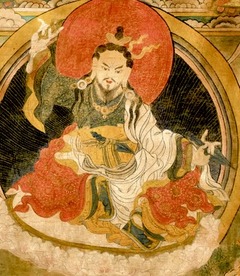
The Tibetan visionary Dudjom Lingpa (1835–1903) composed a dozen songs of advice to Buddhist nuns, yoginīs, and even a queen.[1] These contain exhortations to practice, warnings about the pitfalls of saṃsāra, and advanced meditation advice specific to Dzogchen, the Great Perfection. From these songs, one can imagine a small community of ardent female practitioners on retreat in the rugged conditions of nomadic Golok in eastern Tibet. Though addressed to a nun, the song translated here contains profound and nuanced advice for any longtime meditator.[2]
Meditation Advice to the Nun Chötso[1]
by Dudjom Lingpa
I pay homage at the feet of the Lake-Born Vajra!
When mind is clear and buoyant, it’s joyful.[2]
The undercurrent of thoughts naturally dissolves,
including negative emotions and confusion.
Not blank, the experience is brilliant and vivid.[3]
This is a sure sign that śamatha is starting to take hold.
Whenever experiences of bliss, clarity, or non-thought arise,
don’t hang onto them or fixate, being too deliberate in meditation.
But also don’t doubt yourself or try to get rid of the experience.
If it’s joyful, let it be joyful. If it’s clear, let it be clear.
Be natural, not trying to make it a certain way.
Simply attend to experience, whether joyful, clear, or calm.
The crux of the path is not straying into diversions or delusions.
When outwardly distracted, wild and scattered,
stay steady and eventually it will dissipate.[4]
When inwardly dull and hazy, or full of doubt and regret,
recognize that and shout “Phaṭ” to clear the mind.
Settle without holding to a technique. Be done with that.
Just relax—at ease—letting go of distraction and meditation.
In post-meditation, similarly, maintain the natural state.
This is the view and conduct for whatever you do, staying or moving.
Mindful and aware of your true nature, keep it fresh!
Without grasping onto ideas like “this is it” or “this isn’t it,”
remain unwavering, free from distraction.[5]
Stay with meditation but don’t confine it by grasping.
Don’t lose that state. But also don’t try to make it happen.
That way, you can’t go astray, make mistakes, or get lost.
After all, there’s no other place to go! Even so, a key point:
don’t confuse virtue and vice, what to accept and reject.[6]
The wild beggar, Dudjom Dorje, composed this at the Drö Cave,[7] gathering place of ḍākinīs, on behalf of the nun Chötso. Virtue!
| Translated by Ringu Tulku and Holly Gayley, 2018. Revised in 2022.
Bibliography
Tibetan Sources
bdud 'joms gling pa. "dge ma chos mtsho." In sprul pa'i gter chen bdud 'joms gling pa'i zab gter gsang ba'i chos sde. Thimphu, Bhutan: Lama Kuenzang Wangdue, 2004. BDRC W28732. Vol. 18: 75–76.
bdud 'joms gling pa. “dge ma chos mtsho.” In mkhaʼ ʼgroʼi chos mdzod chen mo. 53 vols. Lhasa: Bod ljongs bod yig dpe rnying dpe skrun khang, 2017. Vol. 52: 269–270.
Secondary Sources
Anam Thubten. Releasing the Knot of Mind: Instructions on Resting in Stillness and Awareness. Boulder, CO: Shambhala Publications, 2026.
Gayley, Holly. "The In/Visibility of Nuns and Yoginīs in Dudjom Lingpa's Songs of Advice" in Living Treasure: Buddhist and Tibetan Studies in Honor of Janet Gyatso, edited by Holly Gayley and Andrew Quintman. Somerville, MA: Wisdom Publications, 2023.
Version: 1.0–20260120
Notes
-
Many of Dudjom Lingpa’s songs, as found in his collected works, are untitled including this one. The name of the recipient, the nun Chötso, is found in the colophon. Here we have transposed her name as a stand-in title along with the song’s topic, meditation advice. ↩
-
The Tibetan terms for “clear” and “buoyant” are gsal and hrig ge. ↩
-
Ringu Tulku explained the term sa ler as the perceptual experience of leaving the dusty plains and reaching the Tibetan plateau, where everything is “brilliant” and “vivid.” For the sake of clarity, we have included both terms in the translation. ↩
-
The term ngang skyong literally means to “sustain a state or continuum.” According to teachings by Chakung Jigme Wangdrak in May 2022, this refers to sustaining the continuum of awareness (rig pa). Here we translate this as “stay steady” and, later in the song, the same phrase is translated “maintain the natural state.” ↩
-
Ringu Tulku qualified this line by saying at a certain point distraction need not impede meditation. ↩
-
What to accept and what to reject (blang dor) is the Tibetan way of referring to Buddhist ethics. Here “accepting” means to pursue virtue or positive actions and “rejecting” means to abandon vice or negative actions. ↩
-
’bros phug ↩