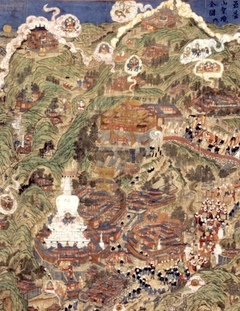
Fa Mi of Hidden Demon Rock
Fa Mi of Hidden Demon Rock[1]
from the Ḍākinīs’ Great Dharma Treasury
The supreme sacred site of Wutai Shan[2] is a majestic and captivating mountainscape in the northeast section of Wutai County[3] in Shanxi Province.[4] Framed by plains, its rugged and awe-inspiring five peaks stand, grand and majestic. Viewed from afar, it looks like the beautiful levels of a shrine, which is why it is also referred to as the “Five Platform Mountain.”[5] It is also called the “Mountain Clear and Cool”[6] for the way that it enchants the minds of all who see it. Buddhist texts, especially, refer to it by that name.
In the chapter on the bodhisattvas’ dwelling places in the forty-fifth fascicle of the Play in Full (Lalitavistara Sūtra), it says,
In a land to the northeast, there is a clear and cool mountain that has been the abode of countless bodhisattvas since ancient times. Now, the bodhisattva Mañjuśrī resides there, constantly teaching the holy Dharma to an audience of ten thousand bodhisattvas.[7]
In the Sūtra on Mañjuśrī’s Jewel Dhāraṇī,[8] the Buddha says,
After I pass into nirvāṇa, there will be a kingdom in the northeast part of Jambudvīpa called Mahā China.[9] There stands a mountain called “Five Peaks.” Ārya Mañjuśrīkumara always goes there. Constantly present there, he teaches the Dharma for the benefit of beings.
Mahā China mentioned in that passage corresponds to contemporary China.[10] Such scriptural citations tell us that Wutai Shan is the supreme sacred site where Mañjuśrī came into the human world and stayed forever. Thus, it is well-founded when Tibetan Buddhists say that China is the pure realm of Mañjuśrī.
The Five Peaks
The central peak is called Emerald Cliff Mountain;[11] the eastern peak is Blue Lake Mountain;[12] the Western peak is Hanging Sun Mountain;[13] the southern peak is Splendid Mountain;[14] and the northern peak is Stirring Leaves Mountain.[15] The northern peak is the tallest, standing a magnificent 3,058 meters above sea level.
The western prominence is a smooth, flat mesa, more than a kilometer around, rising to 2,773 meters.[16] At night, from a distance, it looks like the moon is hanging over it, which is why it is also referred to as the Moon Hanging Mountain.[17] Limpid, pure rivulets cascade down its slopes, spread out like fingers. Its craggy vales offer solitude and silence. The landscape of the western peak’s ridges, which extend for twenty kilometers,[18] inspired Upāsaka Ta Yang[19] to write the following poem:
Should you reach the summit of the western peak,
You will truly find yourself in the supreme pure land:
Beside the Ari Pool,[20] a form like a golden bridge;
A path between two mirrors;[21]
Fragrant incense rising in abundance;
Lion’s footprints;[22]
A river teeming with precious qualities—
Sweet, clear, and cool;
If a bodhisattva arrives at this place,
A host of nāgas comes to welcome them.
A little over twenty kilometers from the western peak, there is a wondrous site called Hidden Demon Rock.[23] This is where, in the ancient past, Ārya Mañjuśrī subdued the nāga demons,[24] bound them under oath, and concealed them. That is how it got its name.
During the Ming Dynasty (1368–1644),[25] Master Hanshan Deqing (1546–1623)[26] described this rocky prominence:
The fine path to it, winding like sheep guts, is blanketed by fallen leaves;
Venomous vipers slither and dart, darkening travelers’ minds;
Sheer cliffs kiss the sky on either side of a narrow, gated defile;
The wild red rocks are inaccessible, serving only as launching pads for vultures’ flights;
Though human-friendly birds fly around, carefree,
Monkeys, choking off the road, shriek all day and night.
Mists and smoke roll in naturally and tarry;
There, one is free from the burden of saying “Come on up,” and welcoming guests.[27]
The Story of Fa Mi
This supreme sacred site, Hidden Demon Rock, has a marvelous history. During the Northern Qi Dynasty (550 to 577 CE),[28] a spiritually accomplished woman, a great meditator, took this sublime place as her seat. Her name was Fa Mi.[29] Her realization soared as high as the sky, she had immense spiritual courage, and she was undefiled by saṃsāra’s smog.
Early in her career, she gave guiding instructions to everyone around the western peak of Wutai Shan. For the final fifty years of her life, she remained in strict retreat at Hidden Demon Rock. For sustenance, she consumed the wild greens that grew on the mountain. Her hardships were immeasurable. Through the power of her meditation, she magnetized the minds of all the people of the realm. They were powerless to resist and developed faith and devotion to her. Around the age of eighty, she passed away.
Posthumously, to commemorate the life and meditation of this accomplished master, people called the place where she stayed Hidden Demon Mountain,[30] for at that site, she meditated on a demon-taming samādhi.[31] Because the teaching by which she tamed demons was so secret, to this day, no one has known what it was. All we can know about the dharma she practiced is that it was as inconceivable as the sword in Mañjuśrī’s hand.
Heshang He’s Visions of Fa Mi
During the Tang Dynasty (618 to 907 CE), a great meditator named Heshang He[32] went on pilgrimage to the former seat of the siddhā Fa Mi. During his visit, he had many wonderous visions by which [Fa Mi’s] sublime realization transferred to his mindstream.
The cliffs to the east rose to a height of three-thousand meters. On the smooth surface of their stone, he saw a five-colored glow, like the pattern of a rainbow. A narrow crevice leading up was lined with trees, their roots boring into the core of the rock. Holding to these trees, he slowly made his way to the top of the eastern cliffs and discovered a path, no wider than a human body, leading down the western side of the ridge. At that point, he saw many naturally arising visions. In the middle of the arena-like expanse of space, many cosmic mansions of the buddhas arose in his experience, and he spontaneously uttered these words:
The footprints of your meditation, [Fa Mi],
Enchant and warm the minds
Of travelers who see them.
Although there are no written records of this sublime siddhā’s [i.e., Fa Mi’s] meditative accomplishments, visiting her seat can arouse the profound significance of her meditation in our mindstreams, just as it was born in the mind of this Tang-era meditator. Because of this experience, he also became known as the “Meditator of Hidden Demon Rock.”
The Song of Master Fa Mi[33]
In the primordial absence of doubt,
What is really realized by the “wisdom of realization”?
In the primordial absence of hesitation,
What is the great purpose of grand aspirations?
When immersed in limpid space,
How can I be bothered by hunger and thirst?
How wonderful, this mountain stream;
The moon hangs on the peak of the western mountain.
Since there’s no need to travel, living is easy.
Fa Mi’s mind
Is so limpid, so lucid.
For fifty years, she has not descended from the mountain,
For there is no mountain to descend.
With her one-pointed mind, she tames demons.
Every day, demons enliven and satisfy her with their desperate cries.
Taming the demons of Hidden Demon Rock
Is Fa Mi’s private, secret training.
This poem, written by her, describes how Fa Mi savored her life on the Hanging Moon Mountain of Wutai Shan’s western peak.
This story was translated from Chinese to Tibetan by Khenmo Dawa Drolma.
| Translated by Joseph McClellan, 2026.
Bibliography
Tibetan Source
mkhan mo zla ba sgrol ma, trans. "h+pha mes bdud 'dul bdud sbas brag gi rnam thar." (2017). In mkhaʼ ʼgroʼi chos mdzod chen mo (Par gzhi dang poʼi par thengs dang po, Vol. 8, pp. 304–308. Bod ljongs bod yig dpe rnying dpe skrun khang. BDRC W3CN2459.
Secondary Sources
Cartelli, Mary Anne. The Five-Colored Clouds of Mount Wutai: Poems from Dunhuang. Leiden: Brill, 2013.
Hsu Sung-Peng. A Buddhist Leader in Ming China. The Life and Thought of Han-shan Te-Ch'ing. University Park and London: The Pennsylvania State University Press, 1979.
Version: 1.1–20260626
Notes
-
Mary Anne Cartelli, working from Chinese sources, mentions Fa Mi (法秘) and this site, Mimo yan (秘巖), in The Five-Colored Clouds of Mount Wutai: Poems from Dunhuang (Brill, 2013), 104n70: Mysterious Woman Cliff, located west of the Western Terrace, is described extensively in GuQLZ, 1095b–1095c. Huixiang says the cliff was named for a praiseworthy nun named Fami 法秘, who lived there for fifty years during the Northern Qi dynasty. Mo is an obscure Chinese character. It may be a variant of 嫲 (Kangxi 38.11): “paternal grandmother.” Therefore, an alternative translation might be Grandma Mi Cliff. Robert Gimello thinks mo may be the transliteration of Mārā. See Robert M. Gimello, “Chang Shang-ying on Wu-t’ai shan,” in Pilgrims and Sacred Sites in China, ed. Susan Naquin and Chün-fang Yü, 138. This cliff may be the same as Mysterious Demon Cliff (Mimo yan 秘魔巖), which is also found on the Western Terrace and discussed in QLSZ, 24. ↩
-
ri bo rtse lnga—Five Peaked Mountain. ↩
-
rtse lnga rdzong. ↩
-
hran shas zhing chen. ↩
-
ri stegs lnga. ↩
-
ri bo dwangs bsil. ↩
-
mdo rgya cher rol pa, Toh. 95. We find no such passage in the Tibetan editions of this sūtra, which contains twenty-seven sections. This reference is likely a paraphrase of a Chinese edition. ↩
-
’jam dpal chos mdzod nor bu’i gzungs mdo. There is no such title in the Tibetan Kangyur, nor is this quote found in canonical databases. It must be a paraphrase of a Chinese source. ↩
-
tsi na chen pa. ↩
-
krung go (中国, Zhōngguó). ↩
-
brag ljang ri. 翠岩峰. ↩
-
mtsho mthing ri. 望海峰. ↩
-
nyi ’ger ri. The peak is traditionally called Hanging Moon Mountain (掛月峰), which is how it is described below, as zla ’ger. ↩
-
mdzes sdug ri. 锦绣峰. ↩
-
lo ’khrugs ri. 叶斗峰. ↩
-
le bar gnyis; Ch. 里 (lǐ). A contemporary measurement of five hundred meters, or, more traditionally, 500 paces. ↩
-
zla ’ger ri bo. ↩
-
le bar bzhi bcu—Forty lǐ. ↩
-
dge bsnyen (居士, jūshì) tha yang (perhaps 大勇). Unidentified. ↩
-
a ri rdzing bu. Unidentified. In contemporary language, a ri means America, which is certainly not intended here. We take it as a toponym, unless it is meant to relate to ārya. ↩
-
Extremely tentative and incomplete. We cannot make any good sense of the line lam gor me lung cha gcig. We expect a significant corruption of the text here. Lam go(r) is not an attested term. It might mean something like “along/around the road”, taking gor as related to gor gor (“round/oval”), or “roundabout.” Even more puzzling is me lung: fire + scripture/valley/handle. This is likely a typo for me long (“mirror”), though that does not give any clearer meaning. Thus, only the elements lam (path) and cha gcig (a pair) are clear. If we assume that it should read me long, we might imagine a pair of shiny things, such as lakes; however, since the site is described as accessible by a narrow defile between cliffs, there would be no space for two lakes. Perhaps a more appropriate reading is to take the smooth faces of the surrounding cliffs as mirrors. Thanks to Kelsang Lhamo for confirming the text’s incoherence here and sharing her speculations about the meaning. A final ‘Hail Mary’ of a literal translation might be “Fire and scripture to [help] know the path,” taking me (fire) as a torch, and gor as go bor (to understand). ↩
-
seng ge zhabs rje. Likely a figurative reference to Mañjuśrī. ↩
-
bdud sbas brag. ↩
-
klu bdud. ↩
-
men rgyal rabs. ↩
-
slob dpon de chen; 憨山德清 or 弘覺禪師. See Hsu Sung-Peng, A Buddhist Leader in Ming China: The Life and Thought of Han-shan Te-Ch’ing (Pennsylvania State University Press, 1979). ↩
-
In the source text, the Hanshan quotation is never explicitly concluded with the Tibetan equivalent of closing quotation marks. We assume the quote ends here, since at this point the lines are no longer metered and the style shifts from poetry to explanation. ↩
-
pe ce rgyal rabs; 北齊 or 北齐. ↩
-
hpha me. 法秘. ↩
-
bdud sbas ri. ↩
-
bdud ’dul ba’i ting ’dzin. ↩
-
he shang hes; 和尚和 / 僧和. The name suggests simply, “the monk He.” ↩
-
The lines are unmetered. ↩