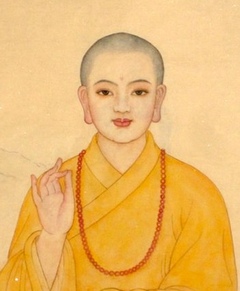
Jingjian: The Earliest Chinese Bhikṣuṇī
Jingjian: The Earliest Chinese Bhikṣuṇī
from the Ḍākinīs’ Great Dharma Treasury
The earliest Chinese bhikṣuni, Jingjian,[1] was born into the Zhong[2] clan. Her given name was Lingyi.[3] Her father, Zhong Dan,[4] was the governor of the Wuwei district of Gansu.[5] In her youth, Jingjian was a diligent student, but her life would see many twists and turns. She married young,[6] but her husband passed away, and she found herself in poverty, forced to earn a meager living teaching musical instruments and calligraphy to the children of the aristocracy. Eventually, she had the good fortune to hear about the holy Dharma, and she was filled with joy and faith. However, failing to grasp the deeper meaning of the holy Dharma, she grew discouraged.[7]
Later on, during the height of the Jin Dynasty (265–420 CE),[8] she was fortunate to meet an eminent[9] Dharma master named Fashi.[10] Having thoroughly studied the holy Dharma, he had become exceptionally learned. He had established a new monastery in the western quarter of the capital and was teaching there when she encountered him. In Master Fashi’s presence, she cut through her doubts about the Dharma, and her spiritual potential awakened.
She thought to herself,
Birth and death are vital matters.[11] There is not much time in life, so it is better to train earlier in the Dharma rather than later. Now, I am still in the full bloom of my youth, so why wouldn’t I put all my efforts into the holy Dharma? I will fully understand the holy Dharma and then work to benefit myself and others.
She then borrowed books from Master Fashi and, arousing immense diligence, pursued comprehensive studies. Not only did she come to understand the meanings of all the sūtras, but she also gained experience in the profound key points of practice.
One day, she approached Master Fashi with the following question:
Teacher, when I study the sūtras, I see the terms “bhikṣu and bhikṣuṇī.” In the Buddha’s Dharma, is it permissible for both men and women to go forth?[12] If it is permissible, I beg that you look on me and hold me with your compassion and grant me ordination.
Master Fashi replied, “In the western lands, both men and women are ordained, but in our China, conditions are incomplete, so we still don’t have ordination for women.”
Jingjian then asked, “If ordination for both women and men is discussed in the Buddha’s teachings, and here in China we have it only for men, is there a difference in the Vinaya rules for men and women? Why can’t women practice going forth?”
Master Fashi replied, “In the scriptures transmitted from the western lands, there is a difference between men and women’s Vinaya vows. It is said that bhikṣus have 250 rules and bhikṣuṇīs have more than 300 rules. I will have to ask others about the details; then I can tell you more.”
Another master told them, “There is no great difference between a bhikṣu’s Vinaya rules and those of a bhikṣuṇī, though, technically, a bhikṣuṇī has more vows to keep. If you really want to proceed with ordination, it is best to take first, from a bhikṣu, the ten basic vows of a novice, or srāmaṇerī,[13] and guard those.”
Upon hearing that, Jingjian requested and received srāmaṇerī ordination from a Western[14] monk named Zhi-shan,[15] and she kept her vows perfectly. She was China’s first srāmaṇerī. Twenty-four other women joined her and also received ordination. In the western quarter of the capital, they established Zhulin Nunnery.[16] Since there were no bhikṣuṇīs to guide them, the nuns all relied on Jingjian to clarify their doubts about Dharma. She was described as wise, compassionate, generous, and humble, with pure motivation, a soft voice, gentle character, and pure conduct. These qualities allowed her to get along with everyone, and everyone respected her; everyone was open to her teachings, and they all gained immense benefit.
At some point in the Eastern Jin period (317–420 CE),[17] a monk from the west named Master Sengjian arrived,[18] carrying a complete copy of the bhikṣunis’ Vinaya.[19] Now in possession of these scriptures, on the eighth day of the second month of 357 CE, they founded a Vinaya academy at Luoyang and transmitted the Vinaya vows.
When Jingjian requested bhikṣuṇī ordination, the requisite conditions were not met because there was no bhikṣuṇī preceptor to receive it from. When the masters looked into the matter, they determined she could not receive the vows, worrying that if she did, it could lay the ground for future discord in the Chinese sangha.[20] They continued discussing the matter and discovered a line in the scriptures that said, “If one receives the vows on a riverbank, the vows are valid, and the faults do not obtain.”[21] Consequently, Jingjian, together with four other women and Master Sengjian, boarded a boat moored on the riverbank, and there received full ordination.[22]
Because of her leadership role, Jingjian is credited as China’s first bhikṣuṇī. It is said that when she received her vows, an unprecedented sweet fragrance wafted through the four directions, everyone’s faith in her intensified, and she guarded all her vows like her very eyes.
In 361 CE, at the end of the Shengping period,[23] one day, people smelled the same sweet fragrance in the air, and the red band of a rainbow extended down from the sky like a rope. High up, a beautiful woman resembling a devakanyā[24]—a daughter of the gods—appeared, scattering flowers all around. At the sight of this, Bhikṣuṇī Jingjian said to her community, “All of you, please strive in the Dharma even more than before. As for me, it’s time to go.” With these words, she flew up, entered the band of the rainbow, and her body and the rainbow became indistinguishable. Only later was it understood that she had attained the rainbow body of great transference[25] spoken of in the Tibetan Buddhist tradition.
This story was translated from Chinese to Tibetan by Khenmo Dawa Drolma.
| Translated by Joseph McClellan, 2026.
Bibliography
Tibetan Source
mkhan mo zla ba sgrol ma, trans. “rgya nag gi dge slong ma sngon ma ching can mo” (2017). In mkhaʼ ʼgroʼi chos mdzod chen mo (Par gzhi dang poʼi par thengs dang po, Vol. 8, pp. 300—303). Bod ljongs bod yig dpe rnying dpe skrun khang. BDRC MW3CN2459_990B84
Secondary Sources
Ann Heirman, "Chinese Nuns and Their Ordination in Fifth-Century China," Journal of the International Association of Buddhist Studies 24.2 (2001): 275–304.
Buddhist Text Translation Society, trans. The Sixth Patriarch's Dharma Jewel Platform Sutra. Buddhist Text Translation Society, 2001.
Kieffer-Pülz, Petra. "Translocal Debates and Legal Hermeneutics: Early Pāli Vinaya Texts in the Adjudication of Sīmā Procedures, C. 1200–1900. Buddhism, Law & Society 2 (2016–2017).
Lee, Lily Xiao Hong; Stefanowska, A. D.; Wiles, Sue, eds. Biographical Dictionary of Chinese Women: Antiquity Through Sui, 1600 B.C.E.– 618 C.E. Armonk and London: East Gate Book, 2017.
O'Brian, Barbara. "Chinese Buddhist Nuns: A History of Perseverance." Patheos.com, 2013. https://www.patheos.com/blogs/thereligioushistorynerd/2023/03/chinese-buddhist-nuns-a-history-of-perseverance/.
Shaheen, James. “The Great Matter.” Tricycle Magazine, Fall 2013.
Sumana Samanera. "Going Forth: A Call to Buddhist Monkhood." Access to Insight, 1995. https://www.accesstoinsight.org/lib/authors/sumana/wheel027.html
Thubten Chodron. "The sramanera/sramanerika precepts." 1996. https://thubtenchodron.org/1996/06/precepts/.
Tsai, Kathryn Ann, trans. Lives of the Nuns: Biographies of Chinese Buddhist Nuns from the Fourth to Sixth Centuries. Honolulu: University of Hawai'i Press, 1994.
Yampolsky, Philip B. The Platform Sutra of the Sixth Patriarch. New York and London: Columbia University Press, 1967.
Version: 1.0–20260702
Notes
-
chin can mo. A creative phoneticization of 淨檢, which Tsai phoneticizes as Chu Ching-chien. For other accounts of her life, see O’Brian, “Chinese Buddhist Nuns: A History of Perseverance”; Lee, “Zhu Jingjian,” 391–393; Tsai, Lives of the Nuns, 17–19. ↩
-
krong. Tsai (17) gives “Chung.” ↩
-
Khenmo Dawa Drolma gives the given name as nen yan. Since we do not know the Khenmo’s sources, we follow Lee (391) and Tsai (17), who, adducing several Chinese sources, name her Zhong Lingyi or Chung Ling-i (仲令儀). ↩
-
Khenmo Dawa Drolma gives his name as nian yan cin. However, we follow Lee (“Zhu Jingjian,” 391), who gives the name Zhong Dan (仲誕). Tsai gives Chung Tan (17). ↩
-
kan so 甘肃. ↩
-
She was likely still a child, since below, several years after her husband’s death, she speaks of still being in her youth, using terms usually associated with teenage years. ↩
-
Lee (391) offers a fuller picture: “Her family came from Pengcheng (in the region of the present-day provinces of northwest Jiangsu and southern Shandong) but her father… was governor of Wuwei (present-day Wuwei District in Gansu Province), a district far from their native place. It is not known whether Zhu Jingjian went to live in Wuwei when her father was stationed there, but both Pengcheng and Wuwei were on the Silk Road, through which Buddhist influence entered China. This was particularly so in the case of Wuwei because of its proximity to Central Asia, whence came many Buddhist monks to preach in China. Thus it is conceivable that Zhu Jingjian initially came into contact with Buddhism while she was living in one of these cities. However, in later life she moved to Luoyang, the eastern capital of the Jin dynasty, where her convent life was mainly spent.” Cf. Tsai, 17. ↩
-
jun jan—晉朝. ↩
-
The source text reads a dri’i skyes chen, and we are unsure about a dri. The Mönlam Dictionary has it, enigmatically, as an Indian word meaning ri dang nyi ma (“mountains and sun”), which does not seem relevant. No such name or title is found in Lee (391) or Tsai’s (17) accounts. ↩
-
法始 ↩
-
This is a reference to a famous line from the Platform Sūtra:
Unexpectedly one day the Fifth Patriarch called his disciples to come, and when they had assembled, he said: “Let me preach to you. For people in this world birth and death are vital matters. You disciples make offerings all day long and seek only the field of blessings, but you do not seek to escape from the bitter sea of birth and death. Your own self-nature obscures the gateway to blessings; how can you be saved? All of you return to your rooms and look into yourselves. Men of wisdom will of themselves grasp the original nature of their prajñā intuition. Each of you write a verse and bring it to me. I will read your verses, and if there is one who is awakened to the cardinal meaning, I will give him the robe and the Dharma and make him the Sixth Patriarch. Hurry, hurry!” (trans. Yampolsky, The Platform Sūtra, 128)
Cf. Hua, The Sixth Patriarch’s Dharma Jewel Platform Sutra, 60; Shaheen, “The Great Matter.” ↩
-
rab tu byung. This term often connotes general renunciation, but it has its roots in the sūtras and the Pāli word pabbajja. Sumana Samanera explains, “Pabbajja,... in Pali, the language of the Buddhist texts, means Going forth, namely from the household life to the homelessness of a Buddhist monk. The Pali word Pabbajja is also the term for the first ordination bestowed for entry into the Buddhist monastic Order (Sangha) by which the candidate becomes a Novice or Samanera”(“Going Forth,” https://www.accesstoinsight.org/lib/authors/sumana/wheel027.html). ↩
-
(1) Killing (To break from the root, one must kill a human being with intention); (2) taking what is not given (stealing) (To break from the root, one must steal something that could bring about legal intervention in one’s society); (3) sexual intercourse (To break from the root, one must have intention and experience orgasm. This refers to heterosexual or homosexual contact); (4) lying (To break from the root, one must lie about one’s spiritual attainments); (5) taking intoxicants (this includes alcohol and recreational drugs); (6) singing, dancing, playing music; (7) wearing perfume, ornaments or cosmetics to beautify the body; (8) sitting on a high or expensive bed or throne; (9) eating after midday; (10) touching gold, silver or precious objects (including money) [Thubten Chodron, “The sramanera/sramanerika precepts,” https://thubtenchodron.org/1996/06/precepts/]. ↩
-
In Tsai (18–19), he is identified as Kashmiri. ↩
-
kri hran. ↩
-
Khenmo Dawa Drolma gives kro nen dgon. However, since Tibetan phoneticizations are extremely idiosyncratic, we follow the name Zhulin, given by Lee (“Zhu Jingjian,” 392). ↩
-
shar jun; 东晋. Lee (“Zhu Jingjian,” 392), gives the more specific “Xiankang reign period (335–342).” ↩
-
hrin can. ↩
-
Lee (392) and Tsai (19) specify that this was the Mahāsānghika Vinaya. ↩
-
Ann Heirman (“Chinese Nuns and Their Ordination in Fifth Century China,” 289) discusses what seems to be this very controversy in China, though the characters she refers to have different names:
When the discussion on the validity of a nun’s ordination that was only held before the bhikṣuṇīsaṃgha reached its peak, the Chinese nun Hui-kuo asked whether Chinese women could receive the ordination in the way that Mahāprajāpatī did. She too did not receive the ordination from the bhikṣuṇīsaṃgha. As mentioned in the Pi-ch’iu-ni chuan, the central Asian monk Guṇavarman was of the opinion that there was no difference between Mahāprajāpatī and the Chinese women. The Pi-ch’iu-ni chuan is not clear as to why Guṇavarman accepted Mahāprajāpatī’s ordination as a precedent, but it seems to suggest that he put the absence of a bhikṣuṇīsaṃgha at the time of the first ordination in China at the same level as the absence of nuns at the time of Mahāprajāpatī’s ordination. In both countries, the ordination of the first nun necessarily had to be carried out without a bhikṣuṇīsaṃgha. However, when the nun Hui-kuo insisted on the case, Guṇavarman added that according to the vinaya rules, a candidate must receive the ordination from a minimum quorum of ten fully ordained nuns, except in border areas where five nuns are sufficient. When asked what exactly a border area is, he seems to consider also China as belonging to it, in which case a minimum quorum of five nuns is needed. This explains why Guṇavarman says: "The correct view is that, if there is an established assembly present, one cannot but go along with all the requirements.
And she continues:
Once a bhikṣuṇīsaṃgha had been established, the only way to receive an ordination was through an ordination ceremony in both saμghas by means of a jñapticaturtha karman. This obligation is one of the eight fundamental rules accepted by Mahāprajāpatī, and is never to be transgressed. It assures the proper and uninterrupted transmission of the rules for women from the time of the Buddha onward.
As already mentioned above, this obligation created a major problem in China. In the absence of a bhikṣuṇīsaṃgha, the first Chinese nun was ordained in the presence of a chapter of monks only. At first, the Vinaya master Guṇavarman did not seem to consider this a problem, maybe because he thought that China was that far away from India that it was permitted to nuns to follow in Mahāprajāpatī ’s footsteps and to start all over again. However, pressed by more questions, he agreed to a new ordination, this time in the presence of a chapter of Sinhalese nuns. Doing so, he never said that the first ordination was invalid, he only said that a second ordination would augment the value of the first one."(293) ↩
-
This seems to stem from recondite debates about the technical boundaries of a monastic body and the rules that pertain to those bodies, defined by their boundaries. For communities on water, a boundary called an udakukkhepasīmā applies, which seems to have offered a loophole to the nuns in our story. See Kieffer-Pülz, “Translocal Debates and Legal Hermeneutics,” 117–118. ↩
-
Lee (392) offers the following account:
During the Xiankang reign period (335–342), the monk Sengjian obtained a copy of a nun’s ritual and rule book of the Mahāsānghika sect and by 357 this book had been translated into Chinese in Luoyang. A foreign monk (whose origin is not specified) then built a dais for the purpose of bestowing the precepts on nuns. However, the Chinese monk Daochang objected to this on the basis that, according to the monastic rules, an assembly of nuns was required to be present at the ordination of nuns and therefore, since there were no nuns in China at that time, the ordination could not take place. His objection was not acknowledged but, according to one interpretation of Zhu Jingjian’s biography in Lives of the Nuns (Biqiuni zhuan), she and four other women received the precepts according to the newly translated rule book on a boat on the Si River, possibly because of the objection. Zhu Jingjian is therefore honored as the first Chinese Buddhist nun. ↩
-
到升平, 357–361 CE, following Tsai (19). The Khenmo writes shar jun rgyal rabs kyi mjug, “at the end of the Eastern Jin Dynasty,” which seems to conflate the Eastern Jin Dynasty (317–420), with the Shengping sub-era of 357–361. ↩
-
lha’i bu mo ↩
-
‘ja’ lus ’pho ba chen po ↩