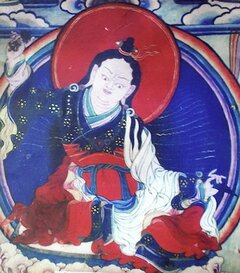
Advice
Advice[1]
by Tutob Lingpa
You must never look down on the law of karma and provisional merit-making while pretending you have realized the view. If your view is undeluded, then your self-interest and pretenses will come to an end, and all your intentions will naturally become noble. You will automatically delight in what is good for others. Therefore, until your self-interests are totally gone, and until you are no longer oriented around the eight worldly concerns, you must contemplate the four reorientations of the preliminary practices and train your mind in bodhicitta.
Early in your practice, when you are training in the creation and completion stages, if you have auspicious dreams and ostensible signs of accomplishment, if you are impressed with yourself, these are actually obstacles that will deaden your practice.[2] It’s better to be like Tangtong Gyalpo. When he was in retreat performing longevity practices, after seven days, he had a vivid vision of Amitāyus, but his first reaction was, “This is an obstacle from Māra (the Deluder)” and he tossed a handful of ashes at it. He then practiced in the same place for three more years until he again had a vision of Amitāyus, which this time carried the blessing of becoming a vidyādhara with power over life (tshe yi rig ’dzin).
And even if you have no signs, you should never indulge in hope or anxiety; just keep cultivating faith in your guru and in the Dharma, and practice diligently. When Asaṅga meditated on Maitreya for twelve years at Kukkuṭapāda Mountain, nothing happened; not so much as an encouraging dream. However, that whole time, his obscurations were being undermined. Finally, when genuine compassion arose in his mind, all his obscurations were completely purified, and accomplishment was his.
This is why, from now on, you should exert yourself in the two accumulations of merit and wisdom, the creation and completion stages, and the union of emptiness and compassion. If you never give up on these as the guiding principles of your practice, the two kāyas—the fruition that dwells naturally within you—will become fully evident, without a doubt.
In these degenerate times, people pay lip service to religion while praising themselves, cutting others down, and cultivating distorted outlooks. Don’t be like them. Be humble and wear old clothes. Even if you don’t turn into some kind of religious adept, you can at least avoid doing bad things. Keep faith without being a fanatic, try to see the world with pure perception, and be loving and compassionate. Look at your mind moment by moment to see if your heart and attitude are good. You shouldn’t want to be anything more than one of those old, good-natured, contented people with nothing to prove or to hide, who just sit in the mountains and recite oṃ maṇi padme hūm. If you can get beyond your present fixation with the signs of religious accomplishment, you’ll be an authentic practitioner.[3]
—Extracted from Gyurme Tenzin’s biography of Tutob Lingpa.
| Translated by Joseph McClellan, 2026.
Bibliography
Tibetan Source
Gyurme Tenzin ('gyur med bstan 'dzin). 2019. "gsang bdag dngos snang he ru ka dpal mthu stobs gling pa'i rnam thar drang srong dgyes glu". In "gu ru'i thugs bcud zab tig rgya mtsho'i kha skong rnam thar dang zin bris skor"gsung ʼbum mthu stobs gling pa par gzhi dang po. Lha sa: Bod ljongs bod yig dpe rnying dpe skrun khang. (BDRC MW3CN27505). Vol. 10: 71–73
Version: 1.0–20260702
Notes
-
This teaching is extracted from Gyurme Tenzin’s biography of the great tertön, where it is presented as a synthesis representing Tutob Lingpa teaching style and favorite themes. ↩
-
bdud kyi bar chad yin. Lit. “They are obstacles of Māra.” We borrow Richard Barron’s looser but felicitous rendering (Barron, trans, Treasury of Precious Instructions, vol. 1 (Shambhala, forthcoming) as a gloss for the same phrase that appears just below. ↩
-
Gyurme Tenzin 2019, pp. 71–73. ↩