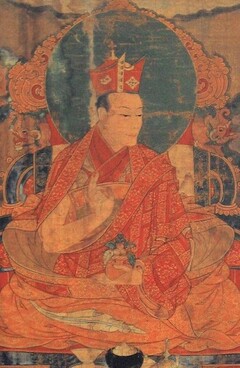
Mahāmudrā Way of Resting
The Mahāmudrā Way of Resting
by the Fifth Shamarpa, Könchok Yenlak
With my body, speech, and mind full of devotion, I bow to the successive incarnations
Of the Karmapa, the ultimate guru, the sublime conqueror.
I will now explain the interests of the royal lineage
Of that great high priest,[1] the King of Dharma.
What is termed “mahāmudrā” is the indivisible unity of appearances and emptiness—the very nature of all of saṃsāra and nirvāṇa.
On the difference between saṃsāra and nirvāṇa, it is said,
Freedom is nothing but the cessation of error.[2]
In other words, when there is confusion, that is saṃsāra; when confusion is cleared away, that is nirvāṇa.
This confusion is called “conceptual fixation.”[3] It is taught that saṃsāra is nothing more than conceptual fixation. The absence of conceptual fixation is nirvāṇa.
In light of all this, this saṃsāric situation is ground mahāmudrā; meditation aimed at abandoning saṃsāra is path mahāmudrā; and attaining awakening after abandoning saṃsāra is fruition mahāmudrā.[4]
Of those three, the process of cultivating the path involves three themes:
I. The view to be understood.
II. Meditation in harmony with that view.
III. Conduct that brings out the full potential of your meditation.[5]
I. View
All things[6] are the mind’s display;[7] there is nothing outside the mind. They are like dreams during sleep. This is why Lord Nāropa said,
All things are your own mind.
Perceiving them as external is a confused orientation.[8]
Like dreams, they are devoid of essence.[9]
When you examine this mind for yourself, you see that it was not the same yesterday as it is today; it was not the same this morning as it is right now. Even within a single instant, it is a changing thing, impermanent and empty. A tantra says,[10]
Your mind is primordially unborn.
Its defining characteristic is emptiness.[11]
Yet, emptiness is not blank nothingness, for in our present situation, the appearances of day and night arise unceasingly. When we die, the appearances of the bardo and the appearances of our next life will arise. Thus, appearances cannot be suppressed. We can compare them to the moon’s reflection in water: its essence is empty, yet its appearance still arises. A tantra says,
Not real, not unreal—
All things are like the moon in water.
O yoginīs, understand this for yourselves.[12]
When you genuinely realize the natural condition of this view, without any contrivance, this is called “natural liberation.”
The following analogy illustrates this: When we mistake a striped rope for a snake, we are terrified. Then, when we see that it is just a rope, it is not that the snake had to be eradicated and the rope had to be newly established; it is enough to simply rest in the recognition of the rope as a rope.
Victorious Maitreya says,
Here, there is not the slightest thing to take away;
There is not the slightest thing to add.
Viewing what is as it is,[13]
When you see what is, you are completely free.
II. The Practice of Meditation: Equipoise
Arouse the spirit of awakening by thinking, “All sentient beings have been my parents. In the past, I have perceived them as enemies, abused them, and caused them suffering. As a result, I suffer, wandering through saṃsāra, as if I were tethered to a pillar.[14] Now, going the other way, I will help others; others will help me; and I will attain the state of awakening that benefits myself and others!”
Meditate on your guru at the crown of your head. With your body, adopt the key points of physical posture, and abandon all other actions. This is isolation of the body.
With your speech, pray to your guru, and let your breath settle naturally. This is isolation of speech.
Then, with your mind, don’t pursue what has passed; don’t think about things you did before or things that happened before. Don’t anticipate what has not yet come; don’t think about what will happen or what you will do in the future. Don’t formulate ideas about the present. Without thinking “This is it” or “This isn’t it,” “It’s there” or “It’s not there,” “It is” or “It isn’t”—without thinking anything at all, just rest in the experiences of your six senses without any grasping. This is isolation of mind.
Again and again, remind yourself of these three [isolations], and apply yourself diligently.
Lord Marpa sang,
The endpoint of the supreme vehicle, the essential meaning,
Boundlessness, mental non-deliberation,
The dharma of mahāmudrā, is introduced [like this]:[15]
These apparent objects, reified as external,
Are a vast unfolding, flowing on and on.[16]
This mental consciousness, reifying what is internal,
Is realized to be unborn dharmakāya.
And Tilopa said,
Remain in a state of non-meditation.
When you attain what is non-attainable, you attain mahāmudrā.[17]
III. Conduct: Post-Meditation
The presence or absence of Dharma in your being will be determined by your conduct. If your conduct is not harmonious with the Dharma, then your view and meditation will be ineffective—mere talk. Either that, or your conduct will be evidence that your view and meditation are off track.
In light of this, the following verse applies to conduct:
There is not a single thing
That is not dependently arisen.
Therefore, there is not a single thing
That is not empty.[18]
Thus, if you engage in virtuous actions, you will enjoy the fruit of happiness, and if you engage in unvirtuous actions, the result will be suffering. This is the infallible truth of dependent origination.
It is just as when a barley seed—the cause—interacts with the conditions of warmth and moisture, the result is a barley shoot, not a bean. Accordingly, until you realize the natural condition, you should treat cause and effect with great care. Once you realize the natural condition, illusion-like conduct will unfold automatically, and you will benefit others effortlessly and spontaneously.
Conclusion: Traversing the Paths and Levels of the Bodhisattvas
The first level of the bodhisattvas, Intense Joy, is when, going beyond superficial understanding, you directly realize mind’s essence, free from elaborations—the unity of appearances and emptiness.
You might wonder why the enlightened qualities associated with attaining that level do not manifest all at once. [But] enlightened qualities unfold gradually, as Zhang Yudrak[19] explains:
Realization’s resplendent dawn
Is the utterly pure path of seeing itself...
While its enlightened qualities and powers may not have arisen,
Who could deny that it is the path of seeing?
The sun, when it has just arisen in the morning,
Cannot yet melt the glaciers
Or bake the earth and stones,
But who would deny that it is the sun?
This has been the instruction on pointing out the mind, mahāmudrā, the single white remedy that cures a hundred ills. Through it, may all beings be liberated.
Written by the bhikṣu from the order of Śākyamuni, the Fifth Shamar, Könchok Bang,[20] at Ngomgang Monastery,[21] to fulfill the requests of Agyal of the royal House of Jang.[22]
| Translated by Joseph McClellan, 2026. The initial draft was checked against and incorporated many elements of Clayton Ingerson’s excellent oral translation of Tana Dungse Rinpoche’s commentary on the text from May 1–3, 2026, at the Boulder Shambhala Center.
Bibliography
Source Text
Shamar V Konchok Yenlak (Zhwa dmar 05 dkon mchog yan lag). "phyag chen gyi bzhag thabs". In Nges don phyag rgya chen poʼi khrid mdzod. Vol. 11, pp. 531538. [New Delhi]: [rNam par rgyal ba dpal zhwa dmar baʼi chos sde], 1997. BDRC MW23447.
Alternative Editions
Shamar V Konchok Yenlak (Zhwa dmar 05 dkon mchog yan lag). "phyag chen bzhag thabs". In gsung thor bu dkon mchog yan lag. Vol. 1, pp. 69–75. Gangtok: Dzongsar Chhentse Labrang, 1974. BDRC MW23927.
Shamar V Konchok Yenlak (Zhwa dmar 05 dkon mchog yan lag). "phyag chen gyi bzhag thabs". In gsung thor bu dkon mchog yan lag. Vol. 2, pp. 151–157. Gangtok: Dzongsar Chhentse Labrang, 1974. BDRC MW23927.
Other Tibetan Texts
Bongtrul (ʼbrong sprul 07 dkon mchog lhun grub snyan grags rnam rgyal), ed. "bka' brgyud rin po'i che'i mgur mtsho ye shes byin 'beb". In ʼbri lugs bang mdzod skor lnga, vol. 68. Khrin tu dar rgyas par ʼdebs las gnyer ʼgan ʼkhri tshad yod spyi gnyer khang, 2021–2022. BDRC MW3KG218.
Bongtrul (ed.), "rje til+li pa'i phyag chen gang+gA ma". In <ʼbri lugs bang mdzod skor lnga, vol. 88. Khrin tu dar rgyas par ʼdebs las gnyer ʼgan ʼkhri tshad yod spyi gnyer khang, 2021–2022. BDRC MW3KG218.
Khedup Wangyel & Tsangnyon Heruka (mkhas grub dbang gi rgyal po & gtsang smyon he ru ka rus pa’i rgyan can). “rje btsun mar pa’i rnam par thar pa”. In bkaʼ brgyud gser ʼphreng. Topden Tshering ; Distributor, Tibetan Bonpo Monastic Centre, 1975. BDRC MW23564.
Maitreya ['byams pa]. Sublime Continuum (theg pa chen po rgyud bla ma'i bstan bcos; Mahāyānottaratantraśāstraratnagotravibhāga). Derge Tengyur. Toh 4024 ff. 54v–73r.
Mar mi dwags gsum gyi rnam thar. In ris med chos rig gter mdzod las thengs gnyis pa dang gsum pa. Si khron bod yig dpe rnying bsdud sgrig khang, 2016. BDRC MW3CN7099.
Marpa Lotsawa [mar pa lo tsā ba chos kyi blo gros]. rje btsun mar pa lo tsA'i rnam thar ngo mtshar sa ma ya. In gsung ʼbum chos kyi blo gros, vol. 1. Krung goʼi bod rig pa dpe skrun khang, 2011. BDRC MW1KG14303.
Secondary Texts
Augustine, Tomy. Yoga Tantra: Theory and Practice In Light of the Hevajra Tantra; A Metaphysical Perspective. Delhi: Sri Satguru Publications, 2008.
Brunnhölzl, Karl. When the Clouds Part: The Uttaratantra and Its Meditative Tradition as a Bridge Between Sūtra and Tantra. Boston and London: Snow Lion, 2014.
Farrow, G.W. and I. Menon. The Concealed Essence of the Hevajra Tantra, With the Commentary Yogaratnamala. Delhi: Motilal Banarsidass, 2001.
Garfield, Jay. The Fundamental Wisdom of the Middle Way: Nagarjuna's Mulamadhyamakakarika. Oxford: Oxford University Press, 1995.
Karma Phuntsho. Mipham's Dialectics and the Debates on Emptiness: To Be, Not To Be Or Neither. London and New York: RoutledgeCurzon, 2005.
Karmapa III, Rangjung Dorje. "Aspiration of the Mahāmudrā of Definitive Meaning." Translated by Adam Pearcey. Lotsawa House, 2020. https://www.lotsawahouse.org/tibetan-masters/third-karmapa-rangjung-dorje/mahamudra-aspiration.
Korobov, Vladimir. "Mimesis: Some Reflections on Bodhicitta Verses in the Second Chapter of Guhyasamājatantra." Acta Orientalia Vilnensia 11.1. (2010): 125–143.
Martin, Dan. "Zhang Yudrakpa Tsondru Drakpa." Treasury of Lives, 2008. https://treasuryoflives.org/biographies/view/Zhang-Yudrakpa-Tsondru-Drakpa/3182.
Mathes, Klaus Dieter. "The Role of the Bodhicittavivaraṇa in the Mahāmudrā Tradition of the Dwags po bka' brgyud." Journal of the International Association of Tibetan Studies (JIATS). 2010, no. 5.
Mipam Rinpoche [ʼJu mi pham ʼjam dbyangs rnam rgyal rgya mtsho]. gnyug sems skor gsum dang gzhung spyiʼi dkaʼ gnad. gSer ljongs bla ma rung lnga rig nang bstan slob grwa chen mo, 2006. BDRC MW1KG13017.
Nālanda Translation Committee. The Rain of Wisdom. Boston and London: Shambhala, 1980.
Snellgrove, D.L. The Hevajra Tantra: A Critical Study. London: Oxford University Press, 1959.
Version: 1.0–20260706
Notes
-
“High priest” (mdun na ’don chen po) is a reference to the Karmapa’s historical role as guru to several Chinese and Mongolian emperors. ↩
-
Famous words from Maitreya’s Ornament of Mahāyāna Sūtras (mdo sde rgyan; Skt. mahāyāna-sūtrālaṃkāra). ↩
-
“Conceptual fixation” (rnam rtog) is a more technical rendering of the term often translated as “discursive thinking” (Sanskrit vikalpa). Both senses are valid: the saṃsāric mind latches on to some aspect of reality, then it becomes caught in a discursive loop based on that initial fixation. ↩
-
Tana Dungse Rinpoche points out that this discussion of ground, path, and fruition mahāmudrā relates to the following stanza of Karmapa III, Rangjung Dorje’s “Aspiration of the Mahāmudrā of Definitive Meaning” (Pearcey trans.): “The ground is the two truths, free from eternalist and nihilistic extremes; the supreme path, twofold accumulation, unlimited by projection and denial, brings the fruition, twofold benefit, free from the extremes of existence and quiescence...” ↩
-
Tana Dungse Rinpoche points out that these lines—on the framework of view, meditation, and conduct—are closely related to the following stanza of Karmapa III’s “Aspiration” (Pearcey trans.): “Eliminating misconceptions of the ground brings assurance in the view; to sustain that view without distraction is the key point of meditation, and to train in all of meditation’s facets is the supreme form of action.” ↩
-
“Things” renders chos (dharmas), which are the fundamental units of existence, whether mental or non-mental. “Phenomena” is a common and adequate alternative; however, technically, it connotes only what appears to consciousness and does not cover whatever parts of reality may not be available to perception. ↩
-
chos thams cad rang sems kyi snang tshul yin. The term snang tshul, “way of appearing,” carries the technical weight standing in opposition to gnas tshul, “the way it really is.” Thus, all things are not the way the mind really is (i.e., mind’s nature); they are just the way the mind appears or expresses itself. This technical sense comes off somewhat awkwardly, however, even in Tibetan, and Tana Dungse Rinpoche glosses the phrase here as similar to rtsal (“energy”) and rol pa (“display”). ↩
-
“Orientation” translates blo, one of the many words related to English’s “mind.” Blo connotes the rational, ratiocinative, judging mind—the aspect of the mind that is trying to figure things out. ↩
-
Tana Dungse Rinpoche points out that these lines relate directly to Karmapa III’s “Aspiration” (Pearcey trans.): “All phenomena are but the apparitions of the mind; mind itself is without mind, empty of mind’s essence...” ↩
-
As in the earlier sūtra verse, Shamar Rinpoche here does not give a title, no doubt because he wants to avoid cluttering this pith instruction with scholarly details. Nevertheless, these are famous lines from the Guhyasamāja Tantra (gsang na ’dus pa), the Gathering of Secrets Tantra. ↩
-
The second line of this widely quoted stanza is almost always given as stong pa nyid kyi rang bzhin no (“Its nature is emptiness”). A few instances of this alternate phrasing can be found in the literature, for example, in Mipham Rinpoche [ʼJu mi pham ʼjam dbyangs rnam rgyal rgya mtsho, gnyug sems skor gsum dang gzhung spyiʼi dkaʼ gnad (gSer ljongs, 2006), 20. Cf. Korobov. “Mimesis: Some Reflections on Bodhicitta Verses in the Second Chapter of Guhyasamājatantra,” 128. ↩
-
These lines derive from the Hevajra Tantra, Toh 418. Derge Kangyur, rgyud ’bum vol. nga, ff. 18a.3–4. In the authoritative Derge edition and the vast majority of instances where the lines are quoted in Tibetan secondary literature, the final line reads ’dod pas rnal ’byor mas shes gyis (“Yoginīs should understand this, according to their wish”), whereas, in the Gangtok and Delhi editions of the Fifth Shamar’s text, the line reads ’dod pa rnal ’byor pas shes gyis, which would suggest something more like “Yogis should understand [this] claim.” The canonical Derge phrasing is vindicated by the original tantra’s context and the Sanskrit (Augustine, Yoga Tantra: Theory and Practice, 147; Farrow and Menon, The Concealed Essence of the Hevajra Tantra, 195), which reads udakacandropamaṃ sarvaṃ yoginyo janatecchayā//. The Sanskrit makes it clear that ’dod pa should be in the instrumental case of ’dod pas and the masculine rnal ’byor pa should be the feminine rnal ’byor ma, since in this passage of the tantra, an assembly of yoginīs is being addressed (Snellgrove, The Hevajra Tantra, 98), and yoginīs is in the vocative case. For more natural English, we simplify ’dod pas, (“as you wish,” “at your will”) to “for yourselves.” ↩
-
These famous lines are usually attributed to Maitreya in his Sublime Continuum (Mahāyānottaratantraśāstra; theg pa chen po rgyud bla ma’i bstan bcos), Toh 4024, D61b6. However, they are also found in a number of other texts, some of which may precede the Sublime Continuum. On this complicated history, see Brunnhölzl, When the Clouds Part, 1103–4n1488.
The Tibetan translation plays on the term yang dag (“true/correct/as it really is”), repeating it three times. Most often, yang dag carries a comparative sense of correctness vis-à-vis what is incorrect. However, it can carry a more neutral sense of just what is the case. This is reflected in the original Sanskrit, where the corresponding root term is bhūta, “[what has] become,” i.e., what is the case, without any particular emphasis added to it. For this reason, we opt for the simplified English “what is as it is,” as opposed to “truth” or similar elevated terms.
Tibetan: ’di la bsal bya ci yang med // gzhag par bya ba cung zad med // yang dag
nyid la yang dag lta // yang dag mthong na rnam par grol //.
Sanskrit: nāpaneyam ataḥ kiṃcid upaneyaṃ na kiṃcana | draṣṭavyaṃ bhūtato bhūtaṃ bhūtadarśī vimucyate. ↩
-
Tana Dungse Rinpoche and Ingerson vindicate the Delhi edition: ka ba’i ’breng lcag ltar over the Gangtok: dka’ ba’i ’breng lcag. ↩
-
These verses are extracted from a song Marpa sang summarizing the instructions he received from his guru, Maitripa. A longer, slightly different version is translated in Nālanda Translation Committee, The Rain of Wisdom, 151–153. ↩
-
Both editions of Shamar’s text read gdal ba chen por rgyun chad med. This wording is also found in several other editions, such as mar mi dwags gsum gyi rnam thar, 56. Alternatively, and probably in error, gdal ba chen po rgyun chad med is found in Marpa Lotsawa, rje btsun mar pa lo tsA’i rnam thar ngo mtshar sa ma ya, 158.
The line is more commonly found as bde ba chen por rgyun chad med (“flow uninterruptedly as great bliss”). See, for example, Khedrup Wangyel and Tsangnyon Heruka, rje btsun mar pa’i rnam par thar pa, 370; Bongtrul (ed.), bka’ brgyud rin po’i che’i mgur mtsho ye shes byin ’beb, 87. ↩
-
These are famous lines from Tilopa’s Ganges Mahāmudrā (phyag chen gang+gA ma) instructions for Nāropa. See Bongtrul (ed.), rje til+li pa’i phyag chen gang+gA ma, 853. ↩
-
Nāgārjuna’s Mūlamadhyamakakārikā XXIV:19. Sanskrit: apratītyasamutpanno dharmaḥ kaścin na vidyate / yasmāt, tasmādaśūnyo hi dharmaḥ kaścin na vidyate. Tibetan: rten cing ’brel ’byung ma gtogs pa’i / chos ‘ga’ yod par ma yin no/ de phyir stong nyid ma gtogs pa’i chos ‘ga’ yod pa ma yin no. Also found in Tibetan as gang zhig rten ’brel ma yin pa’i / / chos ‘ga’ yod pa ma yin no / / de phyir stong nyid ma yin pa’i / / chos ‘ga’ yod pa ma yin no/ / (verses from Karma Phuntsho, Mipham’s Dialectics and the Debates on Emptiness, 230n37. See also Garfield 1995, XXIV:19). Karma Phuntsho translates this stanza as “There is nothing whatsoever that is not dependently originated, therefore there is nothing whatsoever that is not empty” (32). Nāgārjuna makes this same key point in his Vigrahavyāvartanī: “That thing which is dependently originated is described as empty” [Sanskrit: yaś ca pratītyabhāvo bhāvānāṃ. śūnyateti sāproktā; Tibetan: rten nas ’byung ba’i dngos rnams gang// de ni stong nyid ces brjod de//] (Karma Phuntsho, Mipham’s Dialectics and the Debates on Emptiness, 230 n. 38). ↩
-
Zhang Yudrakpa Tsondru Drakpa (zhang g.yu brag pa brtson ’grus grags pa, 1123–1193). For his biography, see Martin, “ Zhang Yudrakpa Tsondru Drakpa,” https://treasuryoflives.org/biographies/view/Zhang-Yudrakpa-Tsondru-Drakpa/3182. ↩
-
dkon mchog ’bangs. ↩
-
ngom sgang dgon. BDRC G2GS1049 ↩
-
’jang rgyal rigs a rgyal. ↩