Brief Notes on Longchen Nyingtik Ngöndro
Brief Notes on the Preliminaries of the Heart-Essence of the Vast Expanse
by Jamyang Khyentse Chökyi Lodrö
Taking Refuge
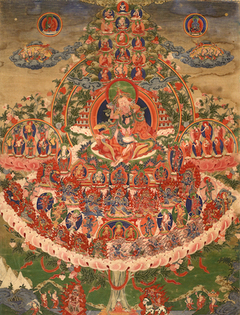
Begin by visualizing a pure realm in front of you. The ground is made of lapis lazuli, and in its centre is a wish-fulfilling tree with five branches. On the central branch, upon a lotus, moon disc and lion throne, sits the Vajradhara of Oḍḍiyāna. Above his head are the lineage gurus, one above another. On the front branch is our teacher, the king of the Śākyas, in dispassionate nirmāṇakāya form.[1] On the right are the Eight Close Sons. At the back is the jewel of the Dharma in the form of books. On the left is the Saṅgha of śrāvakas and pratyekabuddhas, including the supreme pair.[2] You stand at the foot of the tree, and in front of you are the enemies and obstructing forces that harm you. To your right and left are your father and mother from this life, behind you are your relatives and friends, surrounded by the sentient beings of the six classes. All together, with body, speech and mind and with one-pointed determination, remember the qualities of the objects of refuge, and with strong faith and devotion recite the words of the refuge.
In the true Three Jewels, the Sugatas; in the Three Roots;
In channels, winds and bindus, and their nature, bodhicitta;
And in the maṇḍala of essence, nature, and compassion,
I take refuge until I realize the heart of enlightenment.[3]
In general, the guru is the Buddha, Dharma and Saṅgha—the true Three Jewels. How is this so? The guru’s body is the Saṅgha, the guru’s speech the Dharma and the guru’s mind the Buddha.
Inwardly, of all the ocean of infinite Sugatas beyond the imagination, there is none who is not included within the Three Roots. The guru—the omnipresent, glorious embodiment of all families, the Great Vajradhara—is the root of blessings. The yidam deities, who are also none other than the guru, are the root of accomplishment. From the very beginning, they have always been spontaneously present in the maṇḍala of the three seats of completeness.[4] The root of enlightened activity is the ḍākinīs and Dharma protectors—all of whom represent the enlightened activity of the glorious guru’s three secrets and the powerful radiance of the guru’s compassion, naturally appearing beyond union or separation, like the sun and its rays.
Secretly, the primordial purity of the channels of your own body’s vajra aggregates is the nirmāṇakāya. The primordial purity of the winds is the saṃbhogakāya. The primordial purity of the bindus is the dharmakāya. Ultimately that purity has the nature of the three kāyas and is mind and awareness: unfabricated, fundamental bodhicitta. Its essence is the natural, profound clarity of primordial purity and great emptiness—the dharmakāya wisdom abiding in the ground. Its nature is the spontaneously present radiance of the kāyas and wisdoms that, while dissolving into inner luminosity, remains unclouded—the saṃbhogakāya wisdom abiding in the ground. Its compassion is the radiance of awareness that pervades all that is animate and inanimate in saṃsāra and nirvāṇa, radiating and manifesting in every possible way. This compassion, devoid of any limitations or bias, is the nirmāṇakāya wisdom abiding in the ground. These three kāyas differ merely in name, while in reality they are indivisible: the natural state beyond mind and imagination, the awareness beyond causes and conditions, effort and exertion; the intrinsic great maṇḍala of the three kāyas.
What is illustrated is the absolute guru of Oḍḍiyāna, the Great Vajradhara in actuality. You need to recognize that he is your own true nature and that he radiates outwardly as the exemplifying, illustrative guru of the appearing objects of refuge. Arouse a stable certainty that seeks no other refuge, and take refuge until you realize the ultimate heart of enlightenment.
Other instruction manuals mention that, when concluding your session, as a result of your renewed heartfelt devotion, immeasurable light rays radiate from the hosts of deities of the field of refuge. They touch you and all sentient beings, increasing your lifespan, merit and wealth, and pacifying all diseases, evil spirits, negative actions and obscurations. Everyone transforms into light and dissolves into the objects of refuge. The objects of refuge also melt into light and dissolve into the guru in the centre, the embodiment of all objects of refuge. The guru then dissolves into the dharmakāya, the state of simplicity. This was a presentation from the relative point of view. Then, within that state, without manipulating or trying to correct anything, relax the mind in its own place, free from the rising and falling of thoughts, and leave it wherever it is. That is the refuge of knowing the absolute. Finally, light rays radiate from the objects of refuge and touch you and others, purifying negative actions and obscurations. Imagine that the blessings of the objects of refuge enter your mind, and then rest in a state without reference.
Generating Bodhicitta
Think of all sentient beings in the universe, and in particular your father and mother. With an excellent, altruistic intention rooted in compassion, generate the twofold bodhicitta.
Hoḥ. Misled by manifold appearances, like reflections of the moon in water,
Beings wander endlessly astray in saṃsāra’s vicious cycle.
To bring them comfort and ease in the luminous space of awareness,
I generate bodhicitta by means of the four immeasurables.
The meaning of the words is as follows. The syllable hoḥ is an expression of wonder at the great mind set upon awakening. In beings’ all-ground (concordant with ignorance) are stored manifold habitual tendencies, which are imperceptible. All the pure and impure appearances of locations, objects[5] and bodies, within existence and peace, no matter how they might appear, are like reflections of the moon in water. Like a reflection in a mirror, they are not there yet can still appear. In reality they are characterised by impermanence and are by nature compounded and momentary. This deceptive, false aspect of appearance is like an illusory image. By clinging to particular forms as real, again and again, beings continuously circle in saṃsāra’s three planes of existence, like a whirling firebrand. With winds, mind and consciousness entwined, one after another, their karmic winds drag them endlessly along to good places and bad, as they wander in uncertainty. Beings with such minds never meet their true nature, the all-pervading space of phenomena as it is, the great union of awareness and emptiness, and are entirely and endlessly obscured by thoughts.
To bring fatigued beings who have roamed in existence from time without beginning comfort and ease in the all-pervading space, the great fundamental luminosity that is the domain of the primordial wisdom of one’s own natural awareness, we immerse ourselves in the mindset of great beings, associated with the four immeasurables such as equanimity. We focus on complete awakening with insight[6] and with compassion we focus on the benefit of others. In this way, endowed with the twofold purpose, we generate supreme bodhicitta. Here the full stop indicates that both the main mind and all the remaining mental states are generated.[7]
When you practise refuge and bodhicitta together, the dissolution of the field of refuge is done as normal and as shown in the instruction manuals. If you have separate sessions for refuge and bodhicitta, then for the refuge you dissolve the field of refuge as usual and as shown in the instruction manuals. During the practice of bodhicitta, you imagine that the field of refuge dissolves into you. This is mentioned in the guide by Khyentse Wangpo.
Meditation and Recitation on Vajrasattva
Āḥ. I am in my ordinary form. Above my head
On a white lotus, in the centre of a moon-disc seat
Is hūṃ, which becomes the Guru Vajrasattva:
Brilliant white, with complete saṃbhogakāya adornments,
Holding vajra and bell, and embracing the consort Vajragarvā.[8]
I take refuge in you and pray—purify all our negative actions!With the deepest regret I acknowledge them all and ask your forgiveness:
From now on—even if my life is at stake—I shall refrain from indulging in them again.
In your heart, upon a full moon
Is the syllable hūṃ, encircled by the mantra.
Reciting the mantra invokes your wisdom mind, and
From the point of union of the blissful play of yab-yum
A cloud of bodhicitta nectar
Flows down like a shining stream of milk.[9] Through this,
For me and all sentient beings of the three worlds
May our negative karma and destructive emotions—the causes of suffering—
Illnesses, harmful influences, negative actions and obscurations, along with wrongdoing, downfalls, and blockages due to breakages of samaya,
Be purified, till not a single one remains!
Generate a mindset that aims to purify all the natural and proscribed negative actions, obscurations, faults, downfalls, impairments and breakages which have been accumulated during lives without beginning and which have become adverse circumstances for traversing the path, those you can remember and those you cannot remember. By reciting the unborn syllable āḥ, the glorious saṃbhogakāya Guru Vajrasattva arises from all-pervading space, opening the door to the magical manifestation of his three secrets. I am in my ordinary form, a body of flesh and blood that is the ripening of karma. Above my head, above the brahma-aperture, is a white lotus, the seat of Vajrasattva. It has eight petals and its stem is inserted about four finger-widths into my crown. In the centre, at the level of the anther, is a moon disc (like the full moon), upon which is a white syllable hūṃ, which instantly becomes the glorious Guru Vajrasattva. His body is brilliant white in colour, bright and shining like a crystal and ornamented with the complete thirteen saṃbhogakāya adornments and the nine peaceful demeanours. He has two hands, his right holding a vajra at his heart and his left a bell resting on his hip. He embraces and is in sexual union with his own natural radiance, the consort Vajragarvā. She is white and holds a knife and skullcup. The male deity is in the vajra posture and his consort in the lotus posture. Visualize them clearly and, with fierce longing and devotion, think the following: “I and all others take refuge in you, Guru Vajrasattva and consort, to protect us from the fears of saṃsāra and the lower realms, and pray—purify all our negative actions and obscurations!” This is the power of support.
With remorse and the deepest regret—so much so that you almost lose your mind—[10]I verbally acknowledge all negative actions and downfalls that I have done previously. This is the power of regret.
Considering my body, speech and mind as one, with my mind I ask your forgiveness for all negative actions and breakages and impairments of samayas and rely on an antidote. This is the power of action as an antidote.
From now on—even if my life is at stake—I shall think “I will not commit any negative action” and refrain from indulging in non-virtuous actions of body, speech and mind, and keep them far away. This special mindset of abandonment is the power of restoration.
Now, endowed with these four powers, there is the extraordinary method of focusing on the flow of compassion that purifies obscurations. Guru Vajrasattva, in your heart, upon a full moon maṇḍala, radiant and clear, is the white syllable hūṃ, encircled by the mantra garland of the hundred-syllable mantra, arranged clockwise and brilliantly white like pearls. These syllables are not like something inanimate. Since they are the seed syllables of the Hundred Peaceful and Wrathful Deities, and the deities and mantras are indivisible, they possess the life-force of wisdom. If you meditate like this and make the visualization very clear, then even if you cannot visualize the whole mantra garland, it’s also fine simply to arrange it like a coiled snake. Recite the hundred-syllable mantra in the manner of a prayer. Its natural sound invokes the wisdom mind of the guru above your head. From the mantra garland upon the moon in his heart an immeasurable flow of nectar, white with a tinge of red, descends. Simultaneously, from the male and female deities’ play of passionate great bliss, from the point of union of the vajra and lotus joined together, a stream of bodhicitta nectar flows down like a cascade of camphor. It flows through the stem of the lotus seat and descends through the brahma-aperture. Through this, for me and all sentient beings, since mere subjective appearance are of one taste in and indivisible with the natural state of reality, and through this entrance for the purification of negativity, the vital points of my own subjectivity and the natural state of reality are pressed. This also benefits others, just as when you generate in your own mind the sacred mindset of bodhicitta for others’ benefit, this also benefits others.
May the causes of suffering for myself and the three worlds, namely the obscurations of the origin of suffering and negative karma and the obscurations of destructive emotions and knowable things, and the results of those, the various forms of suffering: my own perpetuating aggregates and the confused conceptions of the sensory consciousnesses that give rise to the four hundred and four illnesses, the eighty thousand types of obstructing forces, the three hundred and sixty harmful influences, negative actions consisting of inherent misdeeds and proscribed misdeeds related to the three sets of vows, together with latent non-virtues—in short, all the various wrongdoing and downfalls that fundamentally obscure the genuine natural state, may they be entirely purified including even their subtlest aspects, till nothing, not even a single one remains! While thinking that the stream of nectar-like great compassion purifies them at their very root and blesses you so all your stains are removed, recite the hundred-syllable mantra.
Here the purification of negative actions and obscurations and the visualizations that accompany the arising of the wisdom of the four joys of great bliss and the four empowerments should be done according to the instruction manuals.
The Meaning of the Hundred-Syllable Mantra
Vajrasattva, protect the samaya! Vajrasattva, remain close to me. Please be steadfast towards me. Be pleased[11] with me. Be loving towards me.[12] Make me flourish.[13] Grant me all the accomplishments. In all my actions too, make my mind virtuous and excellent. Vajra of all the tathāgatas, do not forsake me![14] Make me adamantine in nature. Great samayasattva, āḥ.
After that, the meaning of the lines for confessing and taking the vows starting with “In my ignorance…” is easy to understand. At the end, Vajrasattva grants his approval of the purification of negative actions and obscurations. Together with his consort, he melts into light and dissolves into you. Immediately you arise in the form of Vajrasattva. In your heart, upon a moon disc, is natural awareness in the form of a white syllable hūṃ. Around it the white mantra-garland is arranged in a clockwise direction, from which white light-rays radiate and return. The visualizations and recitations for your own and others’ benefit can be known from the instruction manuals. All of this relates to the purification of obscurations based on the generation phase.
As for the purification of obscurations based on the ultimate perfection phase without characteristics, it goes beyond all notions of what is being confessed, the act of confessing and the object to whom one confesses. The world and its inhabitants and the deities of the five families and their surroundings all dissolve into you. You yourself also dissolve into the original all-pervading space of luminosity beyond concepts. Recognize and maintain the absolute Vajrasattva of awareness-emptiness.
The Maṇḍala Offering
Visualize the field of merit in the same manner as the field of refuge. The details of the visualization can be found in the instruction manuals. The meaning of the liturgy is as follows. The verses are preceded by oṃ āḥ hūṃ, the seed syllables of the three kāyas.
1. Nirmāṇakāya Maṇḍala Offering
Oṃ āḥ hūṃ.
One billion universes—a hundred times ten million worlds,[15]
Filled with all the wealth of gods and human beings, like the seven precious riches,[16]
My bodies, my possessions, and my sources of merit, all together, I offer them in their entirety, so that
I may be born as a nirmāṇakāya and turn the wheel of Dharma, liberating all beings!
It says in the Treasury of Abhidharma:
One thousand worlds, each with four continents,
A sun and moon, a Great Mountain,
Desire god realms, and Brahmā’s World,
Are called a Thousand-fold World System.
A thousand of those, the second thousand,
Is called an Intermediate World System.
A thousand of those is the Third-order Thousand-fold.
They are destroyed and formed together.[17]
A realm of one billion universes—a hundred times ten million worlds—is filled to overflowing with all the excellent wealth of gods and human beings, like the seven precious riches such as the wheel, the jewel and the queen. Not only that, my bodies which I hold so dear, the possessions that I cling to and in particular the things to which I am attached, and also beings like enemies, friends and everyone in between—such is their nature but we imagine them in especially sublime forms—all together, I offer them in their entirety. Through the strength of that, may the result be that I attain the dharmakāya kingdom and am born with the excellent ability to turn the wheel of Dharma! (Here there are nine heaps: the centre, the four directions and the four intermediate directions.) Do the practice as a prayer and aspiration.
2. Saṃbhogakāya Maṇḍala Offering
The highest heaven of great bliss, the realm of Ghanavyūha,
Perfect with the five certainties,[18] the maṇḍala of the five buddha families,
And inconceivably vast clouds of offerings of every variety of sensory delight—
With this offering, may I enjoy the perfection of the saṃbhogakāya fields!
It is the highest heaven—Akaniṣṭha—because it does not fall under the sphere of influence of characteristics and concepts. It is great bliss because even the names of the causes and results of suffering are unknown. It is perpetually replete with the taste of perfect enjoyments and the great nectar of the primordial wisdom of indivisible union. The inexhaustible wheel of ornaments, the realm of Ghanavyūha, the Dense Array of massed clouds of qualities, is perfect with the five certainties of place, time, teacher, retinue and Dharma. The five primordial wisdoms empowered with the great continuous wheel of eternity arise in their particular forms. The retinue of the five buddha families of victorious ones consists of hosts of male and female bodhisattvas of the smaller families. Their inconceivable maṇḍalas radiate out as the illusory net. The objects of the vajra faculties are the goddesses of sensory delight such as the Vajra Lady of Form that grant happiness uninterruptedly in the three times. The outer, inner and secret consorts are the dance of sixteen-fold bliss. In the hands of the charming goddesses are inconceivably vast clouds of offerings without end—with this offering, may I enjoy the palace and deities of the saṃbhogakāya fields! (Here there are five heaps: the centre and the four directions.)
3. Dharmakāya Maṇḍala Offering
Where all appearance and existence are completely pure from the very beginning—the youthful vase body,
Ornamented by the play of dharmatā, unceasing compassion,
The realm[19] where all clinging to the perception of kāyas and tiklés is naturally liberated—
With this wisdom offering, may I enjoy the freedom of the dharmakāya reality!
All appearance (the container) and existence (the contents) are completely pure from the very beginning—the youthful three-kāya vase that is beyond birth, death and transference. That primordial wisdom body is dissolved in the great luminosity of inner basic space, yet this does not mean that it is dull. Its compassion is the great embodiment that never wavers from the ocean of immaculate and spontaneous qualities such as light. Its radiance arises as outward clarity, which is unceasing and pervades and shines through the whole of saṃsāra and nirvāṇa. All that appears is the play of dharmatā dissolving into dharmatā, the ornament of the kāyas, pure realms and wisdoms, which are the self-appearance that is beyond thoughts and expressions. Moreover, within the great omnipresent and all-encompassing space of reality no impure entities can be found even though you look for them. Its adornments of inconceivable kāyas and tiklés are naturally liberated and devoid of the conceptual elaborations that cling to mental fabrications and characteristics. By offering this array free of limitations and bias, may I enjoy the self-appearing freedom of the dharmakāya reality! (Here there is a single heap.)
By bringing an understanding like this into your practice of offering, you will purify obscurations, perfect the accumulations and obtain the state of the three kāyas.
The Inner Practice of Gathering the Accumulations of the Kusāli[20]
Under the field of refuge, visualize the lower guests. The meaning of the words to be recited is as follows.
Phaṭ! By abandoning my cherishing of the body, the demon of the son of the devas is destroyed.
My consciousness shoots out through the brahma-aperture into all-pervading space,
Destroys the demon of the Lord of Death and transforms into Tröma,
In her right hand, the hooked knife that symbolizes destruction of the demon of afflictions.[21]
Slicing the top off my corpse’s skull, she destroys the demon of the aggregates.[22]
Her left hand holds the skullcup to carry out her activity,
Places it on the fireplace of three human heads—representing the three kāyas;
Inside it is the corpse, now an offering as vast as a billion worlds,
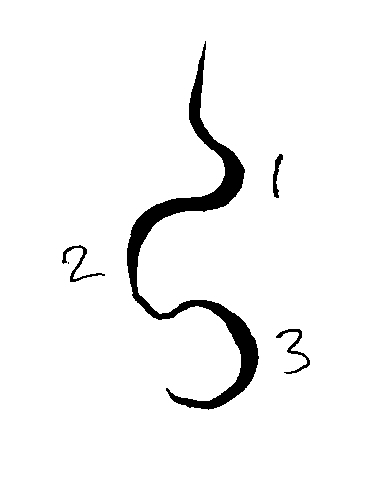
Melted into nectar by an a-stroke and haṃ,
Purified, multiplied and transformed through the power of oṃ āḥ hūṃ.
oṃ āḥ hūṃ
Pha, the syllable of skilful means, eliminates grasping at concepts of objects. Ṭ, the syllable of insight, eliminates grasping at concepts of the subject. Therefore, utter phaṭ and leave awareness free from any focus. This body is defiled and belongs to the truth of suffering. We have been cherishing this aggregate of form as “I” and “self” throughout beginningless time. This is like being under the spell of an evil spirit: destroy and abandon it. We are distracted by the joy and bliss of sensory delights, the demon of the son of the devas. Destroy it and dissolve it in all-pervading space. The nature of my consciousness, awareness itself, shoots out into the all-pervading space of the sky in the form of a sphere of light through the opening of the brahma-aperture on the crown of my head. The nature of this awareness has never ever experienced death and so destroys the demon of the Lord of Death.
This awareness in the form of a sphere of light transforms into Black Tröma. In her right hand is a hooked knife made of copper, the colour of molten iron and with a vajra handle, which destroys at their root all the demons of afflictive and non-afflictive delusion. It destroys the demon of the aggregates (the aggregate of form, the ripening of the four elements coming together). With it she abruptly slices the top off my corpse’s skull. Her left hand holds the skullcup to carry out her activity and places the kapāla on the fireplace of three human heads—dry, fresh and old—representing the three kāyas. That vessel is as vast as a billion worlds and inside it is the huge and magnificent corpse, fatty and greasy, now completely filling all the realms of a billion worlds. It is scooped up in its entirety with the tip of the hooked knife and placed in the skullcup.
Then imagine that from your heart emanate activity goddesses, white in colour and holding a skullcup, retrieving the nectar and offering it.
Phaṭ! The guests above—the root and lineage gurus and yidams—by my offering are pleased,
Whereby merit and wisdom are accumulated, and ordinary and supreme siddhis attained.[24]
The guests below, belonging to saṃsāra, are satisfied by my offering; karmic debts are repaid.
In particular, by satisfying malicious and negative forces,
All illnesses, destructive influences, and obstacles are pacified, dissolving into all-pervading space;
Harmful circumstances and clinging to self are exploded.
Finally offering, offerer and guests—all
Dissolve into the nature of Dzogpachenpo, the great simplicity: A
The guests above are those invited out of respect, the Jewels: the deities of the Three Roots, the buddhas, bodhisattvas, śrāvakas and pratyekabuddhas. The guests invited because of their qualities are the protectors: the oath-bound ones of the three tantras, dharma protectors and guardians, and the wealth deities, treasure custodians and those champions of the good and virtuous. Their wishes are fulfilled, they are pleased and the impairments and breakages of samayas are confessed and amended. Moreover, they are delighted with this supreme samaya substance of the vajra nectar, whereby the two accumulations of merit and wisdom are accumulated and the supreme siddhi of the level of union and the ordinary siddhis of the four enlightened activities and the eight accomplishments are attained. The guests below are those who are objects of our compassion: beings of the six classes roaming in saṃsāra. All are satisfied and pleased, and karmic debts—the debts of previous lives—and creditors who scheme to take your life are repaid. In particular, by satisfying your personal malicious and negative forces—the guests of karmic debts—with your very own flesh and blood exactly according to their needs, all their wishes are fulfilled and all illnesses, destructive influences and adventitious outer, inner and secret obstacles are pacified, dissolving into the all-pervading space of reality free of any conceptual reference. Through this vast offering, old karma is diminished and all minor and incidental harmful circumstances and clinging to self—the great demon of clinging at the view of a self where there is none—are exploded and smashed to thousands of pieces with the sharp weapon of selflessness of the Great Mother, the transcendent perfection of insight, and the hammer of vajra-like meditative concentration. Finally the house of the deluded body and mind is destroyed: the offering, offerer (the one who is making the offerings) and guests—all dissolve into the unconfused nature, the state of how things are, the naturally free Dzogpachenpo, the pristine great expanse that is how it always has been, unaltered, without projection or withdrawal. Apply the irreversible seal of the unborn syllable A, the Great Mother.
Guru Yoga
With vivid, eager and confident faith, arouse a strong and ardent devotion and recite the text starting with:
Emaho! My entire perception, spontaneously perfect, is a realm of infinite purity,
The Copper-Coloured Mountain of Glory, perfectly arrayed, in the centre of which
My own body is Vajrayoginī,
With one face and two hands, brilliant red and holding hooked knife and skull,
My two feet gracefully poised, my three eyes gazing into the sky.
Above my head, on a blossoming hundred thousand-petalled lotus, sun and moon disc seat,
Inseparable from my own root master, embodiment of all sources of refuge, appears
Guru Rinpoche, in the supreme nirmāṇakāya form of the Lake-born Vajra.
His body glows with youth, white with a tinge of red.
He wears a gown, monastic shawl, cloak and robe.
With one face, two hands and seated in royal poise.
In his right hand he holds the vajra, in his left a skullcup containing the vase of immortality.
On his head he wears a five-petalled lotus hat.
Cradled in his left arm he holds the ‘supreme consort’ of bliss and emptiness,
Concealed as the three-pointed khaṭvāṅga trident.
He presides amidst a shimmering aura of rays and rings of rainbow light.
All around him, enveloped in a beautiful lattice of five-coloured light,
Are King Tri Songdetsen, the twenty-five disciples,
The paṇḍits, siddhas and vidyādharas of India and Tibet, yidam deities,
Ḍākinīs, and dharmapālas and oath-bound guardians—like billowing clouds,
Visualized vivid and distinct, in the great equality of clarity and emptiness.
Emaho is an expression of wonder. What is so wondrous? The self-manifest pure realm with its palace and deities. The Mahāguru describes it in the manner of an inspired utterance, like an introductory setting of a tantra. The text says my perception because this refers to one’s own natural awareness as dharmakāya, which does not belong to other disciples’ minds. Regarding the way the pure ground abides, the entire pure realm with its kāyas and wisdom lights and so on is spontaneously perfect, free from conceptual characteristics. Now, at the time of the path, it is actualized, in such a way that the result ripens in the ground. The ultimate method to actualize this ground of liberation is guru yoga. The outer world and inner inhabitants in their entirety are one with the great primordial purity of awareness. Wherever reality’s all-pervading space of awareness pervades, there is Akaniṣṭha’s Palace of Lotus Light’s infinite and limitless realm. The symbols, meanings and signs of its ornaments and arrays are perfectly complete. In its centre I visualize my own body, not in its ordinary form but as the venerable Vajrayoginī, instantaneously perfect as soon as I think of her. She has one face, which illustrates the sole sphere, and two hands, which illustrate the two truths. As a sign that she passionately looks after beings, her body is brilliant red in colour. She raises a hooked knife that completely eradicates the four demons. In her left hand, she holds a blood-filled skull at her heart, which liberates the three realms into basic space. As a sign that she does not remain in the extremes of existence or peace, her right leg is extended and her left is slightly bent, gracefully poised. Her three eyes symbolize the three kāyas and are gazing directly, fixed at the wisdom-heart of the guru who abides in the sky. As you visualize her in this manner, then, in the sky directly above her head, upon an enormous and blossoming hundred thousand-petalled lotus and sun and moon disc seats, which symbolize the purity of semen and blood, abides your own gracious root master, the embodiment of all sources of refuge. Your guru appears in the form of the great guru from Oḍḍiyāna, as described in the instruction manuals. The meaning of the remaining words is easy to understand, so I will not elaborate upon them.
The retinue of deities of the Three Roots arises solely from the Mahāguru’s compassion—the magical display of the great primordial wisdom of awareness-emptiness—and their mind-streams are not different. This is a profound and crucial point. If you know that the guru is the embodiment of all sources of refuge, then whatever they do will appear as enlightened activity endowed with the skilful means that tames beings. Remembering the kindness of these sources of refuge, your mind will be overtaken by devotion, and this fervent longing has the ability to transform your ordinary mind into awareness. Remembering them again and again without fail, ordinary appearances can be brought to a halt. Remind yourself again and again that your guru is the embodiment of unlimited knowledge, love and wisdom. Relying solely on this kind of devotion is crucial.
Invite the wisdom being (jñānasattva) and dissolve it into the samaya being (samayasattva), and then offer the seven branches. Then, with ardent faith and devotion, recite the prayers. Fearing this text might become too wordy, I will not elaborate any further.
Receiving the Empowerments
When receiving the empowerments, there are the three vajra syllables. First you need to meditate on the guru being directly present in the visualization. Then, whether you visualize the syllables in Indian or Tibetan script doesn’t matter; either way is fine, as long as you imagine that they have the nature of nectar made of light rays. Negative actions of the body and obscurations of the channels refers to objects of purification such as all types of non-virtuous, negative actions that have been accumulated by the body, all the impurities of the elements that came about through confusion, and the impure channels such as the seventy-two thousand channels. A completely matured vidyādhara refers to a practitioner whose mind is matured in the dharmatā but who has not yet broken the seal of the physical aggregates of karmic maturation. Therefore we call such a person a completely matured vidyādhara. Negative activity of the speech and obscurations of the winds refers to objects of purification such as non-virtuous actions accumulated by speech, all sounds uttered and words spoken, and all the ordinary winds such as the five main winds and the five branch winds, including all their modifications. A vidyādhara with power over life is someone who has attained the vajra body beyond birth and death. Negative activity of the mind and obscurations of the bindus refers to the objects of purification such as non-virtuous activity of the mind and all the coarse and subtle elements that are based on the pure essences of the body. Caṇḍālī is a name for the short-a of the inner heat practice. Mahāmudrā vidyādhara refers to someone whose body is a body of light in the form of a yidam deity, much like the gods of the desire and form realms, and who abides on any of the nine levels of the path of meditation. The karma of the ground of all and cognitive obscurations refers to the objects of purification such as all the obscurations of habitual tendencies that are found in the dharma element of the concept-free all-ground, in particular all the obscuring impurities of semen, blood and mind, and all the coarse and subtle grasping at characteristics that are cognitive obscurations, such as clinging to the perfection of the deities in the generation phase and clinging to experiences of bliss, clarity and non-thought in the perfection phase. The spontaneously accomplished vidyādhara refers exclusively to someone who either remains at the end of the continuum of the tenth ground or is at the ground of ultimate buddhahood.
Then the section where you are propelled into your guru’s heart and your guru’s wisdom and your mind merge is clearly described in the instruction manuals and also in the liturgy itself, so it’s easy to understand.
When you arise from your session, clearly visualize the deity and the palace and never separate from the threefold outlook.[25] Combine all daily activities with the appearance of the guru and develop the strength of your practice, which will enhance your path and cause all obstacles to be naturally liberated. This is a special feature of this profound and direct path.
This was written in Norchi[26] by Chökyi Lodrö to fulfil the request of Khenchung[27] Yutok Senge.
| Translated by Han Kop and edited by Adam Pearcey for the Jamyang Khyentse Chökyi Lodrö Sungbum and Longchen Nyingtik Projects with the kind assistance of Tulku Dawa Zangpo and Khenpo Tashi Tseten, 2026.
Bibliography
Tibetan Editions
'jam dbyangs chos kyi blo gros. “klong chen snying tig gi sngon 'gro'i zin tho nyung ngu”. In gsung 'bum/ 'jam dbyangs chos kyi blo gros. Bir, H.P.: Khyentse Labrang, 2012, vol. 8: 37–58. (BDRC W1KG12986)
'jam dbyangs chos kyi blo gros. “klong snying sngon 'gro'i zin tho nyung ngu”. In bkra dge nas nyar tshags mdzad pa'i dpe rnying dpe dkon. [s.l.]: [s.n.], [n.d.], vol. 12: 103–136. (BDRC W2PD17515)
Secondary Sources
Dakpo Tashi Namgyal. Moonbeams of Mahāmudrā. With Dispelling the Darkness of Ignorance by Wangchuk Dorje, the Ninth Karmapa. Translated by Elizabeth M. Callahan. Tsadra Foundation Series. Boulder: Snow Lion, 2019.
Jamgön Kongtrul Lodrö Tayé. Myriad Worlds: Buddhist Cosmology in Abhidharma, Kālacakra, and Dzog-chen. Translated and edited by the International Translation Committee of Kunkhyab Chöling founded by the V.V. Kalu Rinpoché. Ithaca: Snow Lion, 1995.
Jamyang Khyentse Wangpo. "A Profound Concentration of Nectar: Essentialized Stages of Visualization for the Preliminary Practices of the Heart Essence of the Vast Expanse (Longchen Nyingtik)". Translated by Adam Pearcey. Lotsawa House
Loden Sherap Dagyab Rinpoche. Buddhist Symbols in Tibetan Culture: An Investigation of the Nine Best-Known Groups of Symbols. Translated by Maurice Walshe. Boston: Wisdom Publications, 1995.
Patrul Rinpoche. The Words of My Perfect Teacher: A Complete Translation of a Classic Introduction to Tibetan Buddhism. Translated by the Padmakara Translation Group. Revised edition. New Haven: Yale University Press, 2010.
Vasubandhu. Abhidharmakośabhāṣyam. French translation by Louis de La Vallée Poussin; English translation by Leo M. Pruden. 4 vols. Berkeley: Asian Humanities Press, 1988–1990.
Vasubandhu and the Ninth Karmapa Wangchuk Dorje. Jewels from the Treasury: Vasubandhu’s Verses on the Treasury of Abhidharma and Its Commentary Youthful Play by the Ninth Karmapa Wangchuk Dorje. Translated by David Karma Choephel. Revised edition. Woodstock, NY: KTD Publications, 2012.
Version: 1.0–20261116
Notes
-
Dispassionate (Tib. chags bral) here means that he appears in the form of a monastic. ↩
-
Śāriputra and Maudgalyāyana. ↩
-
For convenience the root text has been inserted before each section of the commentary. ↩
-
The three seats are 1) aggregates and elements, where the tathāgatas reside, 2) the sense fields, where the male and female bodhisattvas reside, and 3) the limbs, where the male and female wrathful deities reside. ↩
-
Both editions have gdon but we read this as don. ↩
-
Skt. prajñā; Tib. shes rab. ↩
-
The Tibetan says that the concluding particle refers to the generation of both the main mind and the mental states. ↩
-
Although Vajrāṭopā is sometimes given as the Sanskrit name of Vajrasattva’s consort, whose Tibetan name is Dorje Nyemma (rdo rje snyems ma), it seems that the correct Sanskrit name, which is attested in several extant sources, is Vajragarvā. ↩
-
Literally, like a cascade of camphor. ↩
-
Literally: a disturbance of the heart-winds. Khenpo Tashi Tseten explains this to mean that you have so much regret that you become slightly unhappy and almost go crazy. ↩
-
Reading dges as dgyes ↩
-
We have moved this line one line up, following the mantra. ↩
-
Reading dgyes as rgyas. ↩
-
The negation ma is missing in our text. ↩
-
Literally, ‘A third-order thousand world system’. See Jamgön Kongtrul Lodro Thaye, Myriad Worlds, Ithaca: Snow Lion Publications, 1995, pp. 102–103. ↩
-
The seven precious riches of royal power (Tib. rgyal srid rin chen sna bdun; Skt. saptaratna), the attributes of the universal monarch (Cakravartin) are: i) the precious golden wheel, ii) the precious wish-fulfilling jewel, iii) the precious queen, iv) the precious minister, v) the precious elephant, vi) the precious horse, and vii) the precious general (or householder). See Dagyab Rinpoche, Buddhist Symbols, Boston: Wisdom, 1995, pp. 65–83. ↩
-
Chapter 3, verses 73–74. Adapted from the translation in Vasubandhu and Ninth Karmapa Wangchuk Dorje, Jewels from the Treasury: Vasubandhu’s Verses on the Treasury of Abhidharma and Its Commentary Youthful Play by the Ninth Karmapa Wangchuk Dorje, trans. David Karma Choephel, revised edition (Woodstock, NY: KTD Publications, 2012), 30; see also Vasubandhu, Louis de La Vallée Poussin and Leo M. Pruden, Abhidharmakośabhāṣyam, 4 vols. (Berkeley: Asian Humanities Press, 1990), vol. 2, 468–69. The latter translation reads as follows: One thousand four-continents, moons, suns, Merus, dwellings of the Kama gods, and world of Brahma, make up a small chiliocosm; one thousand small chiliocosms make a dichiliocosm, the middle universe; and one thousand dichiliocosms make a trichiliocosm. The destruction and the creation of the universes lasts the same time. ↩
-
The five certainties or perfections are the certain or perfect: teacher, teaching, place, disciples and time. ↩
-
Some commentaries read cing instead of zhing, which changes the meaning from “realm” to a simple “and”. Chökyi Drakpa has cing and Jamyang Khyentse Chökyi Lodrö omits it, which might favour cing. However, Lopön Thekchok Yeshe Dorje does have zhing and reads zhing khams. However you read it, it does not greatly affect the meaning. ↩
-
Kusāli (ku su lu, ku su li, ku sa li). Elizabeth Callahan says that the term is probably derived from the Sanskrit kuśali or kuśala, “possessor of virtue”. Patrul Rinpoche says: “The word kusāli means a beggar. To accumulate merit and wisdom, yogis who have renounced ordinary life—hermits who live in the mountains, for instance—use visualization to make offerings of their own bodies, having no other possessions to offer.” Patrul Rinpoche, Words of My Perfect Teacher: A Complete Translation of a Classic Introduction to Tibetan Buddhism, revised edition (New Haven; London: Yale University Press, 2010), 297. ↩
-
Skt. kleśas. ↩
-
The skandhas. ↩
-
Nāda with three curves as drawn by Tulku Dawa Zangpo. The nāda is the upper part of the haṃ syllable in the Tibetan script. ↩
-
Also, by offering to the ḍākinīs and protectors, obscurations and obstacles are removed, and all good wishes and activity enhanced. ↩
-
The threefold outlook (Tib. khyer so gsum) refers to having the view or outlook that appearances, sounds and thoughts are respectively deity, mantra and wisdom. ↩
-
Tib. nor spyi, probably a place name. ↩
-
Khenchung (mkhan chung) could refer to a monastic government official or nobility. ↩