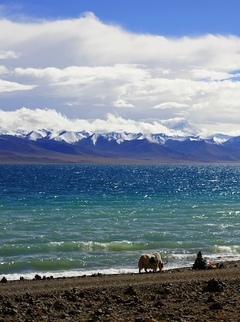
Namtso Lake Praise
The Jeweled Parasol of Auspiciousness[1]
A Brief Praise of the Sacred Site of Jikten Chötö
by Jokyab Pema Trinlé Nyingpo
Lineage holder of Rombhuguhya, heart disciple of Śākya Sengé,[2]
Who received the mandate to practice Drekpa Kundül[3] at the sacred lake of Namtso,[4]
Renowned as Palgyi Sengé, born into the Langchen clan—
Mahāsiddha, who dispatched arrogant spirits as his servants, you I recall.
In the north, the divine castle of Thanglha, king of mountains;
In the center, the palace of Namtso, greatest of all lakes;
In the east, the Ngulchu river, source of the four rivers—
To this site of secret mantra accomplishment, nurtured by these three, I pay homage!
The arrogant spirits of appearance and existence arise from the dynamic energy of my own perception.
By relying upon and accomplishing Jikten Chötö, they are bound as servants.
Thus, without impediment, they carry out whatever of the four activities is entrusted to them.
May this become the cause and condition for the victory banner of the teachings to fly high!
Though the actual sacred site lay far away, following the auspicious circumstance of completing a feast offering on the banks of the river that originates from this sacred place, this praise was composed by Pema Trinlé Nyingpo. May virtue and goodness increase!
| Samye Translations (trans. Stefan Mang), 2026.
Bibliography
Tibetan Edition
jo skyabs padma ʼphrin las snying po. “mchod bstod gnas la zur tsam bsngags pa bkra shis rat+na'i gdugs bzang.” gsung ʼbum padma ʼphrin las snying po. Edited by Karma bde chen. Vol. 1. gzu dgon rig gzhung nyams gso khang, 2010: 35–36.
Version: 1.0–20260213
Notes
-
The author composed a praise for each of the accomplishment sites of the eight Kagyé deities, with each praise named after one of the Eight Auspicious Symbols. ↩
-
Here the author establishes a lineage of accomplishment linking the vidyādhara who first revealed the respective Kagyé deity, Guru Padmasambhava—who subsequently accomplished that same deity while manifesting in a form corresponding to it—and the original Tibetan disciple who realized the practice. ↩
-
The chief deity of the Jikten Chötö maṇḍala. ↩
-
Langchen Palgyi Senge is generally said to have attained accomplishment through the practice of Jikten Chötö at Paro Taktsang in Bhutan. He is also said to have assisted Guru Padmasambhava in subduing the spirits and demons of Tibet through the maṇḍala of Jikten Chötö at various sites, including the taming of the Tenma Goddesses at Lake Namtso. ↩