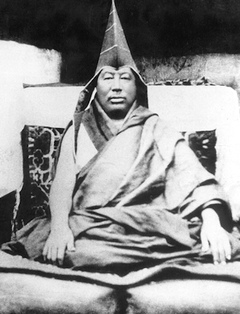
Counsel to Gonjo Lama Dechen
Counsel to Gonjo Lama Dechen
by Khenchen Ngawang Palzang
Dear Gonjo Lama Dechen,[1] you big-head,[2]
It’s not settled when I will go back home, as Rinpoche hasn’t arrived yet and I haven’t been able to ask him. As soon as I get back home, the Kangyur reading transmission will definitely happen.[3]
You’ve got so many ideas, so many preoccupations.
Life is short, and you will die, so keep reading.[4]
Striving for lofty states of meditation
Is just a campaign of self-deception.In days of yore, the teachings of Luminous Great Perfection
Were the domain of the āryas.[5]
How different now![6] Sharing them with beings in these degenerate times
Is like trying to get dogs to take an interest in the stars of heaven.[7]In light of all this, draw your mind deep inside.
If you are diligent, day and night,
In the practice of the four reorientations,[8]
If you train your mind again and again
In both analytical meditation and settled concentration—
You will turn away from all the schemes you had lined up for this life.If you don’t gain conviction
In the infallible truth of causality’s subtle workings,
There is little point in calling yourself a practitioner.
The whole point of receiving the Dharma
Is to grow disenchanted with this life and reverse your misguided ambitions.Regarding the path to liberation and omniscience,
You should be like a starving person yearning for food.
From the bottom of your heart, arouse a fervent sense of longing.
You have changed the way you dress and changed your name,[9]
So your soul,[10] too, should be different from the laypeople,
Otherwise, you’re just a monk by name
With all kinds of ideas about accomplishing things in this life.So many practitioners these degenerate days are led astray
By the clutter of countless concerns and affairs.
They talk of lofty view, but it’s absent from their mindstreams,
And their scruples about the consequences of their actions are as rare as stars in the daytime sky.
You need to become someone who can practice in solitude,
So examine closely whether your character is in harmony with the Dharma.[11]Discipline is the root of qualities to be gained on the path.
Your actions should harbor no hypocrisy—
Such discipline is what delights the victorious ones;
You should guard it like your eyes, even at the risk of your life.On that foundation, spiritual qualities,
Both of this world and transcendent—
Such as samādhi suffused with bodily buoyancy[12]—
Will come to you on their own, without any effort or striving.As a result of excellent discipline and samādhi,
Insight will dawn, realizing the absence of things’ fixed identity.
All these depend on each other;
Since causes and effects are intimately connected,
You must hold your mind accountable[13]
And constantly refine your character.
Otherwise, if you let your selfish ideas
Run loose at their whim,
There is no scheme they will not carry out.[14]Selfish ideation masquerades in all kinds of ways;
If not for it, there would be none
Of saṃsāra’s horrors and pains;
Therefore, regard the insidious demon of selfishness as your enemy
And shun the eight worldly motives as if they were poison.Faith, renunciation, and bodhicitta—
These are the path to freedom and omniscience.
This instruction condenses everything important.
If it makes sense to you, put it into practice;
If you find it faulty, do whatever you please.
May some good come from offering this playful letter!
| Translated by Joseph McClellan, 2026.
Bibliography
Source Text
mkhan po ngag dgaʼ. "go 'jo bla ma bde chen la gdams pa". In gsung ʼbum kun mkhyen ngag gi dbang po, vol. 2, pp. 132–134. Si khron mi rigs dpe skrun khang, 2017. BDRC MW4CZ364088.
Secondary Source
Khenpo Ngawang Palzang. Wondrous Dance of Illusion: The Autobiography of Khenpo Ngawang Palzang. Translated by Heidi L. Nevin and J. Jakob Leschly. Boston and London: Snow Lion, 2013.
Version: 1.1–20260819
Notes
-
This figure does not appear in the Khenpo’s biography, though he records his travels in the Gonjo region (Khenpo Ngawang Palzang, Wondrous Dance of Illusion, 187). He may have met this lama anywhere, however. ↩
-
mgo chen po can. This is said in jest. ↩
-
These sparse details are not enough to reveal exactly where and when the Khenpo wrote this letter. In general, when he spoke of "home" or "homeland" (pha yul), he meant Nyoshul, where he had his hermitage and monastery. The tone of these introductory lines suggests that the "Rinpoche" he refers to might be Katok Situ Chökyi Gyatso, his employer at Katok between 1909 and 1922, who would have been one of the few people with the stature to influence his travel plans. In the Khenpo’s biography, there are only a few mentions of the reading of the Kangyur, and no record of him giving the transmission, though perhaps he arranged for someone else to give it. Since Katok Situ died in 1925, we speculate that this letter was written around 1922 as the Khenpo prepared to move back to Nyoshul. Alternatively, around 1927–28, he returned to Katok for some months and then returned to his seat in Nyoshul (Khenpo Ngawang Palzang, Wondrous Dance of Illusion, 169–170). At that time, Katok was under the regency of Jamyang Khyentse Chökyi Lodrö. ↩
-
Here, Khenpo Ngaga uses the general verb for reading, klog pa. Thus, since the context militates against hollow intellectualization, he seems to be recommending a personal, reflective kind of reading rather than academic study. ↩
-
Āryas (’phags pa) generally connotes "noble ones," and specifically connotes bodhisattvas on the path of seeing. ↩
-
This phrase loosely renders the simple Tibetan contrastive/ablative particle las. ↩
-
For the sake of clarity, these lines loosely render what would be more literally: "For beings in these degenerate times, it is like showing stars in the sky to a dog." dus deng sang snyigs ma’i sems can la/ /mkha’i gza’ skar khyi la bstan pa. ↩
-
blo ldog chos bzhi. Commonly translated as the "four thoughts that turn the mind", these are (1) the preciousness of human life; (2) impermanence; (3) saṃsāra’s flaws; and (4) the infallibility of cause and effect. ↩
-
Here he is referring to how a monk dons robes or a ngakpa dons distinctive dress and takes on a name given by their teacher, abandoning their birth name. ↩
-
"Soul," in its colloquial sense, renders blo, one of several words for mind that connotes the mentating, judging quality that is trying to make its way through the world. In some contexts, it is close to "attitude," but also connotes the aspect of the mind that thinks and feels deeply. ↩
-
Reading rgyu as rgyud. ↩
-
"Bodily buoyancy" renders lus shin sbyangs—lit. "very refined body." This connotes a body that through yogic training or sheer mental relaxation, is utterly at ease and comfortable. ↩
-
sems ’di la mdzub mo btsugs. Literally "pointing your finger at this mind." ↩
-
mi byed bsam pa... Alternatively, "There is not motive they will not act on." ↩