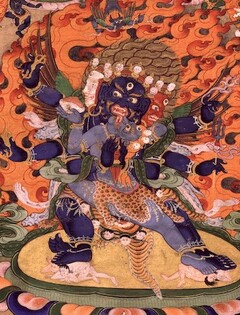
Vajrakīlaya Meditation Guide
A Meditation Guide for the Practice of Vajrakīlaya
by Kyala Khenpo Chemchok Döndrup Tsal
Namo Guru Śrī Vajrakumārāya!
When practising the yoga of the Awesome Vajrakumāra, first train your mind through the common path, receive the empowerments, and adopt the samaya commitments.
Then, at the outset, with fervent longing and devotion, pray to your root guru—the very source of all supreme and ordinary siddhis, and the blessings of the yidam deity.
Next, turn your attention towards sentient beings, who are infinite in number, and reflect:
Intoxicated by afflictions, blinded by ignorance,
Each and every step they take
Is at the edge of manifold precipices.[1]
As this says, these beings are confused about what to adopt and what to avoid, and they are tormented by the three kinds of suffering. Contemplating this, generate intense compassion. Then make the firm resolve: “Now, relying on the profound yoga of Vajrakumāra, I shall attain the state of the Awesome One, able to lead all these beings to perfect buddhahood.”
For the main yoga practice, it is essential never to separate from the three recognitions:
The recognition of all appearances as the divine maṇḍala of the palace (the support) and deities (the supported) of Vajrakumāra
All sounds as the mantra of Vajrakīlaya;
And all thoughts as the dynamic play of bliss-emptiness, the wisdom mind of the Awesome One.
In our Ngagyur Nyingma tradition in particular, we distinguish between ordinary mind (sem) and awareness (rigpa). Here we take the wisdom of awareness, which has never been stained by the phenomena of saṃsāra—conceptual thoughts and seemingly true appearances—and which fully embodies all the qualities of nirvāṇa—the enlightened qualities of body, speech, and mind of all the buddhas of the ten directions and four times—as the ground, exactly as it has been introduced. As it is said:
When the duality of subject and object is shattered with phaṭ,
You directly encounter the very essence of awareness, beyond the conceptual mind.
Likewise, by uttering hūṃ, you cut straight through dualistic thoughts and rest directly in uncontrived awareness. As all conceptual elaborations and dualistic fixations dissolve into the expanse of basic space, you recognise unfixed, unbounded awareness as the singular sphere of the dharmatā, the ultimate Vajrakumāra. From such a state, the clarity aspect of the ultimate dharmatā Vajrakumāra appears vividly as the symbolic deity of the maṇḍala of Vajrakumāra, with three faces and six arms and with its deities and palace, as brilliant as planets and stars reflected in a lake.
The wrathful maṇḍala that appears in Akaniṣṭha—the Vajrakumāra maṇḍala of the palace, the deities and the blazing charnel ground with mountains of fire—the natural display of the Awesome One’s wisdom mind, is none other than this. Here, the nature of your own awareness is inseparable from the wisdom of Guru Vajrakumāra, and in that state of meditative equipoise, wisdom itself manifests as the palace and the deities.
This is not a matter of artificially transforming this world and its inhabitants—which were not divine—into a newly constructed divine maṇḍala. Rather, it is said:
This is only a reminder of the maṇḍala’s nature
As it has been from the very beginning,
Not the creation of something that did not exist.[2]
Although the self-display of awareness, the true nature of mind, has always been present as the extraordinary, pure maṇḍala of the deities, we do not see it, as it is veiled by thoughts and karmic winds. Here, we cut through conceptual thoughts along with habitual patterns and meditate on the maṇḍala exactly as the self-display of awareness appears.
Ideally, you remain inseparable from the appearance aspect of this divine maṇḍala of the palace and deities. Yet even if the forms do not appear clearly, if you do not waver from your own awareness, which is indivisible from the bliss-emptiness wisdom of Guru Vajrakumāra’s mind, then all appearances will be recognized as the spontaneous display of Vajrakumāra’s wisdom mind. This is known as recognizing appearances as the deity. As it is said:
The nature of mantra is deity;
The nature of deity is luminosity.
In the same way, the Vajrakumāra maṇḍala arises as the mantra ‘oṃ vajrakīlaya…’. Even if it does not arise as this mantra, when everything is recognized as the self-display of wisdom and all sounds are understood as the display of Vajrakumāra’s wisdom mind—self-awareness—then it is still permissible to call this recognizing sounds as mantra.
Resting unwaveringly in a state in which you recognize the inseparability of unfixated present awareness and the bliss-emptiness wisdom mind of Guru Vajrakumāra is recognizing thoughts as wisdom mind.
It is crucial that you understand the indivisibility from the guru implied by the term Guru Vajrakumāra. In general, all supreme and common attainments arise through reliance on the guru. In particular, when you receive empowerment into the maṇḍala of Vajrakumāra, the master appears in the form of the deities and palace of Vajrakumāra inseparable from the wisdom beings abiding in Akaniṣṭha, and blesses your mindstream as the maṇḍala of Vajrakumāra. All subsequent meditation practices serve to nurture and sustain that very blessing.
Concerning the vast scope of this maṇḍala of deities, the entirety of saṃsāra and nirvāṇa is complete within the expanse of awareness and is none other than that awareness. All the impure phenomena of saṃsāra are merely imputations of thought—merely empty forms of non-existent appearances. Just as when a bile disorder is cured, the yellow appearance of a white conch naturally vanishes, so too, when the mind rests in meditation—in the inseparable state of non-conceptual awareness and the guru’s bliss-emptiness wisdom—all conceptual thoughts and deluded appearances are purified into the basic space of reality. The pure qualities of nirvāṇa—the enlightened bodies, pure realms, and all other qualities of the buddhas of the ten directions and four times—are already fully present within the expanse of self-awareness, Vajrakumāra. It is the ultimate deity of reality that manifests as the symbolic mudrā of the Awesome Vajrakumāra, the maṇḍala of the palace and deities.
Thus, all of saṃsāra and nirvāṇa are to be meditated upon as the single nature of the Awesome Vajrakumāra’s maṇḍala. The maṇḍala of the palace and the deities is not just an image, but the actual manifestation of self-awareness—the great blissful wisdom of Guru Vajrakumāra. Not only the principal deities and their retinues, but also their seats, celestial palaces, surrounding trees, and every other detail, share the nature of buddhahood, endowed with perfect abandonment and realization, and the threefold qualities of wisdom, compassion, and power.
Meanwhile, whatever arises—whether deities or demons, dreams or waking visions, pleasing or displeasing sounds, or thoughts of delightful stillness and disagreeable change—do not hope for or fear them, and do not accept or reject them. Instead, recognize everything that appears as the nature of self-awareness, the three maṇḍalas of Vajrakumāra. Blend them inseparably with awareness, and regard all appearances as the dynamic play of self-awareness—the enlightened body, speech, and mind of the Awesome Vajrakumāra. This constitutes a profound instruction for removing obstacles.
The beggar named Mati wrote this at the request of his younger brother, Tsultrim Zangpo.
| Translated by Stefan Mang and edited by Han Kop, for the Longchen Nyingtik Project, 2026.
Bibliography
Tibetan Edition
che mchog don grub rtsal. "che mchog don grub rtsal gyis mdzad pa'i phur pa'i dmigs rim". In kun mkhyen gong 'og gsung gi rgyab chos skor. Pe cin: mi rigs dpe skrun khang, 2020. Vol. 48: 409–412.
Version: 1.1–20260423