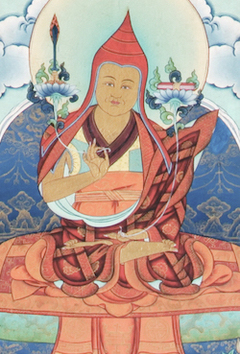
Advice to Jigme Tenpe Nyima
Translator’s Introduction
Jigme Tenpe Nyima was born in 1865 as the first son of the great treasure-revealer Dudjom Lingpa (1835–1904) and was soon recognized by the Fourth Dzogchen Rinpoche, Mingyur Namkhe Dorje (1793–1870), as the Third Dodrupchen incarnation. While there is no record of this recognition being contested, there are references in the biographies to an alternative identification. The biographer Delek Rabgye, for example, records that Jamyang Khyentse Wangpo believed Jigme Tenpe Nyima to be an incarnation of Gungtang Tenpe Drönme (1762–1823), an important Gelukpa scholar from Labrang Monastery. Akong Khenchen Lobzang Dorje (1893–1983) refers to this dual recognition in The Maṇḍala of the Sun, his extensive four-volume commentary on the Bodhicaryāvatāra:
Once, when Jigme Tenpe Nyima was in discussion with his guru, Jamgön Mipham Rinpoche, the two of them used a divining mirror to determine Jigme Tenpe Nyima’s previous incarnation. The mirror showed a lama wearing a yellow cloak with a black fold and a yellow preceptor’s hat. In the sky above his head was the word gung and below his throne, tang.[1] At this, Mipham said, “I thought you were a rebirth of Lama Dodrup Rinpoche, but it seems you might be an incarnation of Gungtang.” Staring into Jigme Tenpe Nyima’s face, Mipham told him, “Well, whoever you are, while you are in this physical form, you must do all that you can for the teaching and practice of the Ancient Translation school.”
Advice to the Dodrup Incarnation, Jigme Tenpe Nyima
by Mipham Rinpoche
With your sword you cut through the four māras’ hearts,
And your youthfulness is that of the freshest flower,
The thought of you brings bliss, O deity of wisdom speech,
Be a protector now to this one who has good fortune!
Without knowing one’s own situation, how can one speak of another’s?
And yet, like a foolish father
Telling his son whatever comes to mind,
Lovingly, I say this: may you consider it always!
The tradition of the lineage is like the banks of a divine river,
Kept to by those of fortune, as they avoid the routes
Suggested by the misleading words of the deceiving masses:
Hold to your own place and position, and cast away conceit!
When cherished philosophical ideas enter your mind,
They are hard to undermine, and you’ll hold yourself in high regard.
Eventually, with no result, you and others too will be like children[1] roaming in a desert.
You might boast, but all will be clear in the faces of those you meet.[2]
If the blazing fire is not extinguished by the wind,
At thirty-five hindrances will clear, and you’ll uphold your own lineage tradition.[3]
Let go of various thoughts and adopt the discipline of a mendicant,
Following in the footsteps of the vidyādharas.
Let go of all reliance upon tired intellectual speculation,
From the scriptural traditions of your own and others’ explanations.
And for five years meditate on instructions from the Expanse Class.
Then hindrances will clear and the sun of mental bliss will dawn.
Let the light of spontaneous activity blaze forth,
And let there be positive conviction in the secret of your mind,
Theory would only invite further impurity, so look through instruction’s eyes,
And without relying upon anyone else, be utterly decisive.
Rely upon the blissful deliverance that the king of horses brings,
Don’t settle for confused philosophical notions of what is or is not,
Born aloft at first by the noisy winds of fame and reputation.
Let the domain of wisdom be what you seek.
To take a stance and cling to a position, thinking “This is it!”
Might seem bright enough, but is like a fire of damp wood,
It doesn’t develop into the resolution of a great mind,
But only stifles intelligence, without shedding much light.
The moon itself is pure, but can be as dim as the distant stars.
All these statements come from the churning of thought.
Leave behind the analogies of foolish minds and modes of speech,
And look instead into the mind for which there can be no analogy.
When arriving at a firm decision from within,
A hundred rainbow patterns appear effortlessly in the sky,
Unconfused and precisely distinguished.
Mañjuśrī held in thought is conceptual, confused.
But rest in a state of non-thought and Mañjuśrī you’ll meet.
Now is the time to adopt the discipline of not speaking.
Do not speak, and a hundred doors to speech will open.
Say a lot and you’ll be trapped in the den of malicious talk.
Not advancing your own system and not refuting those of others,
With the discipline of an old shepherd bereft of sheep,
Let go for a time and clarity will emerge.
Be uninhibited and free, as in a simpleton’s soliloquy.
When you find yourself feeling confident about some lauded statement,
It might yield a hundred empty explanations of supposed certainty,
But when the great gateway opens in the dawning of naked wisdom,
It is unstoppable, even if you try, and pours forth from within.
Don’t tell anyone of this—that is a sacred pledge, a samaya.
O child born as a follower of the lineage of vidyādharas!
Even though you possess the treasury of the wisdom essence,
If you take a position wherein consciousness rides the karmic winds,
It will create internal strife and struggle, and in the end
You’ll be without accomplishment, weary, and ensnared by Māra’s emissaries.
But if you gain the warmth of bliss and awareness-wisdom,
You’ll be like the Lord of gods, victorious over all,
Surveying your domain with a thousand eyes, and clear in speech.
At that time, teaching, debating and composing, and acting on behalf of the teachings and beings,
Will be effortless, spontaneously accomplished, with no difficulty at all.
Rely on the reverend Tārā and Kīlaya
To liberate temporary obstacles, hindrances and dangers.
The horse’s neigh of the mighty [Hayagrīva] will suppress opposition.
And the quintessence of the peaceful and wrathful Mañjuśrī will dissolve into your heart.
Certainly you should rely too on Sitachattra.[4]
Wishes will be fulfilled and you’ll accomplish the twofold aim.
Do not show this to anyone else. Maṅgalam.
| Translated by Adam Pearcey, 2016. With many thanks to Alak Zenkar Rinpoche and Tulku Thondup Rinpoche for their kind assistance.
Bibliography
Primary source
'jam mgon mi pham. "Kun mkhyen mi pham rin po ches rdo grub sprul sku 'jigs med bstan pa'i nyi mar zhal gdams bslab bya gnang ba" in Mi pham gsung ’bum. 27 vols. Paro: Lama Ngodrup and Sherab Drimey, 1984–1993, vol. 27: 281–284.
Secondary Sources
Pearcey, Adam. Beyond the Ordinary Mind: Dzogchen, Rimé, and the Path of Perfect Wisdom. Boulder: Snow Lion, 2018.
bSod nams nyi ma. Grub rje sku phreng rim par byon pa'i rnam par thar pa 'dod 'byung nor bu'i phreng ba. Gangtok: Pema Thinley, 2002.
Tulku Thondup. Masters of Meditation and Miracles: The Longchen Nyingthig Lineage of Tibetan Buddhism. Boston: Shambhala, 1996.
Version: 1.4–20250115