History of Longchenpa Statue
The Precious Torch
A History of the ‘Looks Like Me’ Statue of Omniscient Longchenpa[1]
by Nyoshul Khenpo Jamyang Dorje
Homage to the blessed sugata Rirab Marmé Gyaltsen![2]
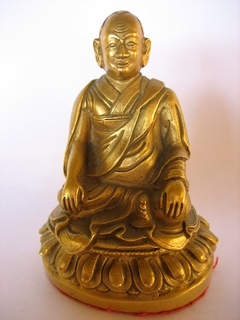
What follows is a history of the ‘Looks Like Me’ (Ngadrama) statue of Omniscient Longchenpa.
During Longchenpa’s lifetime, Kunga Rinchen of Drikung Monastery[3] had thirteen bronze statues made from red gold.[4] The Omniscient One consecrated them himself and said, “They look like me.” In addition, there was another famous Looks Like Me statue at the Omniscient One’s personal cave, the excellent chamber of Radiant Moonlight,[5] at Gangri Thökar.
It was one of the former[6] that became Rigdzin Jigme Lingpa’s support for meditative practice and which was blessed by his three direct visions of the great Omniscient One. Jigme Lingpa then gave this statue, together with the original manuscript of The Treasury of Precious Qualities (Yönten Dzö), his ceremonial hat and robes, bell and vajra and other sacred objects to his direct disciple Jigme Ngotsar. At the same time, he issued the following prophetic instruction: “Return to your home country. There, in a valley that resounds miraculously with the naturally arising sound of the Vajrakīlaya mantra, you should build your monastery. If you do so, it will benefit the teachings and beings.” Following this advice, Jigme Ngotsar returned to Kham and established his seat. This statue, which was housed in Kilung Monastery in northern Dzachukha, or Dza Kilung Monastery as it is widely known, together with the other statue mentioned above, served as the models when Khyungrampa,[7] a general in the Tibetan government forces, who was a student of Dzogchen Khenpo Shenga, sponsored the casting of many copper and gold Looks Like Me statues, all handmade by the statue-makers of Chamdo.
In addition, Adzom Drukpa Rinpoche took the Looks Like Me statue from Gangri Tökar as the model for the statues that he gave to his disciples as supports for practice, which they then kept inseparably at all times. The statues were miniature replicas produced from a four-inch mould. One of these was brought to India by Lama Chokden, Jamyang Khyentse Chökyi Lodrö’s direct disciple.[8] This then came into the possession of Kyabje Dilgo Khyentse Rinpoche from whom I borrowed it. I then had one thousand and twenty-five statues newly cast as supports for my own and others’ devotion and accumulation of merit. Inside each, as a support for the jñānasattva, we placed a pill containing the supremely blessed white and yellow shariram that issued from the Omniscient One’s brain relic.
Therefore, if those who aspire to practise the Dzogchen teachings offer prayers, they may follow the likes of the great tertön of Mindrolling Gyurme Dorje, the great lord of realization Lhatsün, the great Rigdzin Jigme Lingpa and others to whom Longchenpa appeared in his wisdom form to offer guidance and transmit ultimate realization. More recently, there have been those such as Khenchen Ngawang Palzang, who was an emanation of Vimalamitra, Nyaktö Khenchen Gendün Gyatso, and our own teacher Lungtrul Lodrö Shedrup Tenpé Nyima,[9] authentic holders of the teachings, who experienced visions of Longchenpa and directly received his blessings.
This great master [Longchenpa] was born in the region of glorious Samyé some six hundred and eighty-five years ago during the Earth Monkey year of the fifth Rabjung calendrical cycle, and he remained in this world to the great fortune of his direct students until his fifty-seventh year. During this time, he guided countless disciples, and, like a second Samantabhadra, turned the wheel of Dharma, teaching an ocean of sūtra and mantra texts in general and works of the natural Great Perfection in particular. He illuminated the sun of the teachings of the victorious one through exposition, debate and composition and through teaching, practice and activity. Finally, with a view to the students of future generations, he left behind the physical supports of the Looks Like Me statues, the five major relics and countless ringsel, and the literary (or speech) supports that replicate his own realization including the Seven Great Treasuries, Trilogy of Comfort and Ease, Trilogy of Natural Freedom, Trilogy of Dispelling Darkness, and Yangtik Trilogy.[10] He produced countless such treatises clarifying the Buddha’s teachings in general and the themes of the natural Great Perfection in particular, which are indistinguishable from the vajra content of the tantras and like the most powerful wish-fulfilling jewels. As it is said:
Although I, Drimé Özer, go to the land of liberation,
I have left the very essence of my heart in this text.
For the fortunate, I have extracted my heart and directly entrusted it.
Please implement this text with constancy and perseverance.[11]
And:
O fortunate followers of future generations
Please implement this text with constancy and perseverance.
In doing so, you and others will cross the ocean of conditioned existence
And spontaneously attain the twofold aim—that is certain.[12]
As the enlightened mind support, the true dharmakāya shrine of the luminous Great Perfection, he transmitted his own ultimate realization. As the Guru [Padmasambhava] said, “Entrust the wisdom realization to children with faith.” In keeping with this, he transmitted the blessings of the great dharma treasury of unending wisdom realization to countless disciples including Khenchen Khyabdal Lhundrup, the yogin Özer Gocha, Chödrak Zangpo of Dokham and others.
On the basis of such a legacy, the Great Perfection has continued down to the present day, complete with its ripening empowerments, liberating instructions, and lineage of essential advice. We still have the kingly cycle of transcendent resolution (ladawa), the brahminical cycle of clarification (shenjé), and the cycle of pith instructions that reveal natural freedom, the aural lineage that places buddhahood in the palm of one’s hand through direct guidance. Moreover, the external casket of explanation remains intact; the internal nectar of practice has not dissipated; and the key points of the secret instructions have not been confused. This wondrous, profound teaching, through which we can dissolve the physical body into atoms and the mind into dharmatā and swiftly attain the wisdom form of the vajra-like rainbow body of great transference, is still present, as a magnificent treasury of wish-fulfilling jewels.
This being so, let the intelligent teach and study the secrets contained in the writings of this great master and put the key points of his instructions into practice, like children following in their father’s footsteps or striving to make full use of their inheritance. These words of encouragement are a reminder for all the great holders of the teachings, wherever they may be.
In the Water Monkey year (1992) of the seventeenth calendrical cycle, with the aid and assistance of Khen Rinpoche Yeshe Sangpo who carries out noble deeds that benefit the precious teachings of the victors, his brother Khen Rinpoche Tubten Norbu, and Gyaru Nyima Gyaltsen who has enormous strength of faith and devotion, we created these new Looks Like Me statues of the Omniscient One with the intention that they might serve as a field for the accumulation of our own and others’ merit. May the virtue of this become a cause for all beings in general, ourselves and others, and especially those with whom we are connected to follow the Omniscient King of Dharma in every lifetime and attain awakening within the great circle of primordial wisdom, the expanse of realization.
By never tiring of the fragrance of the lotus of hundredfold faith,
Warm with the pure wisdom nectar of the lineage of direct realization,
May the garden of the fortunate fill with the dazzling radiance
Of the thousand-petalled lotuses of realization’s ultimate transmission.
Thus, Jamyang Dorje, who holds the title of khenpo, wrote this in the eastern land of Hong Kong. May it prove virtuous and auspicious!
| Translated by Adam Pearcey, 2026.
Bibliography
Tibetan Edition
smyo shul mkhan po 'jam dbyangs rdo rje. kun mkhyen nga 'dra ma zhes pa’i sku’i lo rgyus rin chen sgron me. [s.l.]: [s.n.], [n.d.]
Other Tibetan Source
smyo shul mkhan po 'jam dbyangs rdo rje. rdzogs chen chos 'byung. 2 vols. Kathmandu, Nepal: Samye Memorial Institute, 1996.
Secondary Sources
Bayer, Achim. The Life and Works of mKhan-po gZhan-dga' (1871–1927): rDzogs-chen Master and Educational Reformer of Eastern Tibet. (Hamburg Buddhist Studies 11) Freiburg: Projekt Verlag, 2019.
Nyoshul Khenpo. A Marvelous Garland of Rare Gems. Translated by Richard Barron. Junction City, California: Padma Publication, 2005.
Smith, Gene. Among Tibetan Texts: History and Literature of the Himalayan Plateau. Boston: Wisdom Publications, 2001.
Version: 1.1–20260204
Notes
-
This text was written in Hong Kong following the creation of one thousand and twenty-five portrait statues of Longchen Rabjam in 1992. The text does not appear in the recently published three-volume collection of Nyoshul Khen Rinpoche’s collected writings but was evidently published and distributed on a small scale by Yeshe Sangpo Rinpoche. A summary of the information contained here is to be found in the same author’s Dzogchen History at the end of the biography of Jigme Ngotsar Tendzin (see A Marvelous Garland of Rare Gems, pp. 394–395). ↩
-
This is the buddha that Longchenpa is prophesied to become. The name translates (approximately) as Meru Victory-Banner of Light and might be Sanskritized as Merupradīpadhvaja. ↩
-
On Drikung Gomchen Kunga Rinchen see Smith, Among Tibetan Texts, pp. 33–34. ↩
-
dzhaikshim ↩
-
zla ba chu shel gyis ’tsher ba ↩
-
In other words, one of the statues made by Kunga Rinchen. ↩
-
General Khyungrampa (b. 1887). ↩
-
Lama Lodrö Chokden (bla ma blo gros mchog ldan) of Nangchen was Khyentse Chökyi Lodrö’s master of ceremonies (mchod dpon). Note that the Dzogchen history misspells his name as Chöden (chos ldan) but the name is correctly spelled (as mchog ldan) in our text. ↩
-
Nyoshul Khen Rinpoche’s root teacher. He was the reincarnation of Nyoshul Lungtok (1829–1901/2). ↩
-
The Lama Yangtik, Khandro Yangtik and Zabmo Yangtik. ↩
-
Extracted from Detailed Instructions on Clear Light (’od gsal phra khrid), which is part of the Khandro Yangtik. ↩
-
From Finding Comfort and Ease in Illusion (sgyu ma ngal gso). ↩