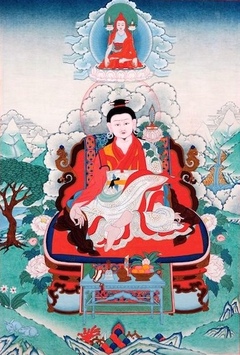
Encouragement to Pursue the Authentic Path
Encouragement to Pursue the Authentic Path[1]
by Patrul Rinpoche
I bow with my three doors in respect at the feet of
the victors, masters of the ten strengths, and their heirs—
the mahāsattvas of incomparable wisdom,
whose renown spreads throughout countless realms.
Thousands of courageous noble ones
have made the unmistaken journey to
the ocean of nectar, the source of exalted speech
that is the precious quality of the Sage’s teachings.
Therefore, it brings cooling peace to saṃsāric minds
and moistens calm minds with compassion.
This immeasurable and precious mind of awakening, bodhicitta,
is the sole wish-fulfilling jewel of both saṃsāra and nirvāṇa.
It is the subject of all sublime dharma,
the trail blazed by all victors,
the collective inheritance of bodhisattvas,
and the guru of all buddhas.
In bodhicitta, all sublime dharma taught and upheld
by the victors and bodhisattvas throughout the ten directions
is subsumed as one taste—
thus it seems that everything comes from bodhicitta.
There is no path to buddhahood other than this.
There is no path to buddhahood more exalted than this.
There is no path to buddhahood that has not emerged from this.
To find a path to buddhahood that is not contained in this would be impossible.
Thus, the sole path traversed by all the buddhas
is the precious jewel of bodhicitta.
In order to internalize it, it is necessary that
fortunate ones who desire freedom have the pith instructions of the three lineages:
the path of profound view, the path of vast conduct,
and the profound and vast Mahāyāna teachings.
Therefore, we need to rely upon the excellent teachings explained by the noble ones
on the vastness of the view, conduct, the paths and levels, samādhi,
and the profound enumerations of method and wisdom.
anything that contradicts the teachings of the two founders of the great traditions
in the noble land of India and of Longchenpa, the sole ornament of the Sage’s teachings in Tibet,
does not constitute a path to liberation.
In these degenerate times, most people who boast they are tantrikas
lack the pith instructions on bodhicitta.
Although they fill space with their lofty spiritual proclamations,
no matter how good they look, what they do is just demonic ritual.
Without having trained in the Mahāyāna tradition,
they regard the authentic teachings as an enemy—
the path of the buddhas does not exist in their mind.
How could they understand supreme bodhicitta?
If the Teacher of humans and gods
had to accumulate intellectual understanding for three countless eons
before finally teaching the excellent path of the Mahāyāna,
how could we stupid old Tibetans get it naturally, without training?
It is easy to cry from time to time
because of a kind intention or biased compassion.
But how could such emotional reactivity be real bodhicitta
if even fools exaggerate in order to be called bodhisattvas?
If we diligently recite mantras and meditate,
thinking this is the path of the buddhas,
without knowing the pith instructions of the beginning, middle, and end,
how could this be the supreme conduct of bodhisattvas?
If we lack trust in the refuge—
the precious Three Jewels, the source of qualities
and incomparable protection for even the gods—
are we really even Buddhist?
What kinds of qualities does a buddha have?
Why is it suitable to take refuge in them?
To recite the refuge prayer hundreds of thousands of times
without even a partial understanding of these issues
is certainly not the proper way to take refuge.
Buddha is the three kāyas and five wisdoms,
an inconceivable array of qualities,
a permanent source of refuge that never deceives,
the liberator of all saṃsāric ties.
The Buddha, the sublime Dharma, and the Assembly of bodhisattvas
are an infinite ocean of beneficial qualities
and a treasure trove of benefit and happiness for beings, including the gods.
They are the refuge of the wise.
Knowing the nature of the supreme qualities of the
unfathomable ocean of wisdom intent and conduct
of the buddhas and their heirs—the courageous bodhisattvas—
is the refuge of the wise, grounded in unchanging faith.
Whereas fixating on our own temporary suffering,
and washing our face with pathetic tears
without having acquired confidence in the Three Jewels
is just contrived longing—the refuge of fools.
If we do not clearly know the cause, the objects,
the way of going for refuge, and the commitments,
then how could the extraordinary qualities
of refuge arise in our mindstream?
When this knowledge is lacking, there is no support for any of the paths,
no field where the crops of beneficial qualities can grow,
no guide for walking the path to freedom,
for we are not really even Buddhist.
When it is present, we are protected by the Three Jewels,
and whatever we do leads us down the path of liberation.
We won’t be born in the lower realms, and will encounter the authentic view.
In all our lifetimes, it is certain we will encounter the excellent path.
Therefore, it is upon these precious jewels
that we can certainly rely at any time, without deception.
When, with the intention of an individual of the greatest capacity,[2]
we make them our objects of refuge,
taking refuge itself becomes the support for bodhicitta,
which rends the web of selfish mental fixation.
True bodhicitta is being motivated to attain
perfect buddhahood for the sake of others,
engaging in the six perfections, and dedicating
this virtue as did the bodhisattva Samantabhadra.
Though there are many categories of bodhicitta,
such as aspiring and engaged, relative and ultimate,
they are all contained within the singular bodhicitta—
the precious source of all qualities.
The moment we generate this intention, we become heirs of the victors,
worthy of veneration by all, even the gods.
Though its beneficial qualities are inestimable,
there are four special benefits we will definitely receive:
our roots of virtue will not wane until enlightenment,
our resultant merit will naturally compound,
bodhicitta will effectively remedy our negative deeds and afflictive
emotions,
and we will become heirs of the victors in both name and reality.
Once this intention has been well generated, our practice is to internalize
the ambrosial river of the pith instructions of the three lineages,
to the point where they are of one taste within our bodhicitta.
Then our view, meditation, and conduct will be completely pure.
The most profound view is emptiness, inelaborate suchness,
the actual teaching of the mother of the buddhas.
It is the domain of our own self-knowing resting in equanimity.
Nonconceptual certainty in this is the great Middle Way,
the pith instructions that are found in the lineage of profound view.
To settle doubts about the significance of this,
rely on the pith instructions of the lineage of profound view
found in the philosophical texts of the Second Buddha, Nāgārjuna,
and his disciple Āryadeva, whose lineage of pith instructions has not
grown sullied with personal opinion.
The samādhi of meditation is the three knowledges
derived from the eight subjects of the Prajñāpāramitā.
Meditating upon them without objectifying external objects
or practicing with an externalized object and inner subject
is non-meditation, the samādhi of equalness,
whereby through constantly abiding in equalness,
one will traverse the paths and levels.
To put the significance of this into practice,
rely on the vast and profound pith instructions
found in the scriptures of the regent of the victors,
the invincible Asaṅga, whose wise counsel for the
excellent path is not sullied with intellectual speculation.
The vast conduct is the activity of Samantabhadra,
the limitless supreme conduct of the bodhisattvas.
If we bring all of this together,
the practice is to maintain the commitments and their purity,
develop the accumulations, and dedicate our body, wealth,
and virtue throughout the three times.
To take up the pith instructions of vast conduct,
diligently hear, contemplate, and read the incomparable
Bodhisattva Śāntideva’s excellent scriptures,
The Compendium of Trainings and the Way of the Bodhisattva.
Nevertheless, the principal thing to guard against is root downfalls:
the first lineage has eighteen; the second has four.
When these are added together with the abandonment of aspiring bodhicitta, there are twenty-three.
In the end, the principal practice that develops bodhicitta is the six perfections.
There is no comparable text in India or Tibet that is so easy to understand
Yet strikes the crucial point as the Way of the Bodhisattva.
How could one become enlightened without relying upon it?
In this manner, the ambrosial rivers of the pith instructions of the three lineages
converge, as in Lake Manasarovar, in the pioneering philosophical teachings
of the Omniscient One, Longchenpa.
Unpolluted by the poison of mental defects, he left these teachings
fresh as butter produced by churning the ambrosial ocean of great learning,
to nourish future generations.
If you do not savor it with your tongue of the three kinds of faith,
do you expect the Omniscient One to serve it to you on a spoon?
His writings are general commentaries on both sūtra and tantra,
and they contain the pith instructions of the unfathomable lineages
that bring together all the Buddha’s teachings without error.
Such excellent teachings have never before been seen.
His corpus is bursting with the vitality of the Sage’s teachings.
it is expressed with precious verbal ornamentation.
Its subject is so profound that it brings ultimate bliss upon contact.
It contains all the elements of the nine yānas.
The sectarian herds of wild animals from both Nyingma and Sarma schools,
roaring with their arrogant beliefs, devour the body of their prey.
Though this sectarian path may fill their stomachs,
they will never experience the joy of the full range of the Victor’s teachings.
In our world, it was just the Omniscient Father and Son
who sang the song of the nine yānas while joining in blissful union
with the body of the celestial maiden of all the Buddha’s teachings,
in the dharma palace of the three kāyas.
In texts like this, all the teachings of the victors are complete.
other commentaries are profound in some ways,
but they are limited insofar as the crucial points of the nine vehicles are not all included.
In these degenerate times, phoney scholars butcher the teachings of the victors
and contaminate the philosophical texts.
Fraudulent treasure revealers are ruining the teachings of Secret Mantra.
So, in this time when everyone insists on doing things in their own way,
there is nothing better for us than to follow the excellent teachings of the Omniscient One,
whose transmission and logic accord with the philosophical texts of the scholars,
whose experience is of the unmistaken pith instructions of the accomplished ones,
and whose confidence is indivisible from the teachings of the victors.
If we study and teach these excellent scriptures
as if we are receiving flower garlands around our neck,
then we are fortunate to uphold the teachings
and become followers of the Omniscient Lama.
Otherwise, how ugly is it that some butcher the philosophical teachings of the wise,
while seeking to accomplish the eight worldly concerns?
How could those who steal the excellent teachings
be holders of the teachings without the authorization of their master?
It would be difficult to find fine teachings that are
inseparable from the Buddha’s teachings, like this.
If you’re conscientious, I implore you to diligently study, teach, and practice
these excellent scriptures.
If such excellent teachings as these haven’t yet occurred,
it’s sure that they will not do so in the future.
As they are a treasure trove of countless pith instructions,
we must sharpen the chisel of our intellect if we wish to reveal them.
Once we have taken up the treasure of the Omniscient Lama’s wisdom intent
with our good fortune of prajñā and the three kinds of faith,
we should practice it ourselves and diligently share it with others.
Then we become treasure revealers, true siddhas.
Otherwise, no matter how many fragmented teachings one reveals based on one’s limited experience,
or on sādhanas lacking generation and completion stages,
such things will just disappoint the scholars
and bring shame upon the teachings of the Second Buddha, Guru Rinpoche.
If, rather than confidently practicing the teachings
of the learned and accomplished ones who are like actual buddhas,
we instead put our trust in the speech of those who have more than the average share of delusion,
that is a sign that we have lost our fortune to meet the real dharma.
Practicing dharma by playing ḍamarus and bells—bing bong bing!—
and frantically counting mālā beads—click clack click!—is not the only way.
What we need is to practice the philosophical teachings in the
Three Cycles of Being at Ease and the Treasury of Precious Qualities
arising to us in the form of practical instructions.
What benefit could there be in just practicing with our mouth?
For the mind is trained by first understanding both words and meaning,
reviewing that understanding, and then blending the essential meaning with the mind.
We need to extract the crucial points for practice in meditation sessions.
If we understand this, we will become followers of the victors.
We will be able to hold the teachings of study and practice simultaneously
and gain dominion over the dharma of scripture and realization.
Before long, realization that discerns the aspects of phenomena will arise.
Otherwise, claiming to have realized the nature of phenomena
without understanding conventional phenomena itself
does not well represent the wisdom of the noble ones.
In Buddhist philosophy, you’ll never hear of a noble one
who knows the nature of things without knowing them in their multiplicity.
Therefore, the great path of the victors is the supreme bodhicitta
that draws you along more and more comfortable paths.
Its greater and lesser elements are all connected by bodhicitta.
Even if you only cultivated this, buddhahood would be in the palm of your hand.
Therefore, it is my aspiration that you and I will never be separated from
the excellent teachings of the Omniscient One,
that our mind will be liberated by the conduct of bodhicitta,
and that we will benefit beings throughout space.
Though I’m not inclined to teach a dharma that I have not accomplished myself,
like a parrot, I have taught this because there is no deception in the teachings of
the Second Buddha and the Omniscient Father and Son.
I wrote this in response to a persistent request by my amiable dharma brother. I tried to get out of it, but I failed. This frank counsel was written by Old Uncle Tatters from Upper Dza. I hope that everyone will be able to trust what I’ve said here. Virtue! Virtue! Virtue!
| Translated by Lama Chönam and Timothy Hinkle for the Light of Berotsana Translation Group. It appears in their translation of Khenpo Kunzang Palden’s biography of his master Patrul Rinpoche, entitled A Vase of Nectar to Inspire the Faithful.
Bibliography
Tibetan Editions
o rgyan ʼjigs med chos kyi dbang po. gsung ʼbum o rgyan ʼjigs med chos kyi dbang po. Gangtok: Sonam Topgay Kazi, 1970–1971. Vol. 6: 115–125
o rgyan 'jigs med chos kyi dbang po. "lam mchog tshang la ma nor ba mdzod chen bdun dang shing rta gsum bzhin slob par gdams pa/" in gsung 'bum/_o rgyan 'jigs med chos kyi dbang po. BDRC W1PD107142. 8 vols. khreng tu'u: si khron dpe skrun tshogs pa/ si khron mi rigs dpe skrun khang, 2009, vol. 8: 243–252.
Secondary Sources
Chönam, Lama and Timothy Hinkle (Light of Berotsana), trans. A Vase of Nectar to Inspire the Faithful: A Biography of Patrul Rinpoche, Orgyen Jigme Chökyi Wangpo. Ashland, OR: Berotsana Publications, 2018.
Ricard, Matthieu. Enlightened Vagabond: The Life and Teachings of Patrul Rinpoche. Boulder, CO: Shambhala Publications, 2017.
Version: 1.0–20260702
Notes
-
This title has been added by the translators. Early editions of the text were untitled, but editors of recent editions have given it the title “Advice on Training in the Supreme Path, Complete and Unerring, According to the Seven Great Treasuries and Three Chariots [by Longchen Rabjam]” (lam mchog tshang la ma nor ba mdzod chen bdun dang shing rta gsum bzhin slob par gdams pa). ↩
-
It is said that there are three types of motivation for taking refuge. Individuals of a lesser capacity take refuge out of fear of the lower realms; individuals of a middling capacity take refuge out of fear of saṃsāra and seek their own personal liberation from it; and individuals of the greatest capacity take refuge out of concern for the suffering of all beings and seek to free them all from saṃsāra. ↩