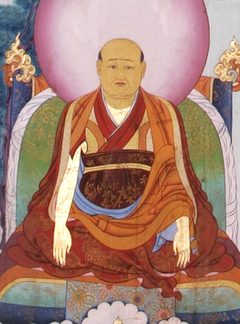
Heart Advice for Practitioners
Heart Advice for Practitioners[1]
by Patrul Rinpoche
Namo Guru
I bow to the one who can be relied upon to destroy all negativities,
the ground from which the ocean of all virtue, goodness, and qualities spring,
the Lord of Dharma, embodiment of the three refuges,
my teacher, my spiritual master.
If this beneficial advice is given to you,
connected as it is with the teachings of the Protector,
the Lord of Sages, the Sun of Dharma, the Eyes of the World [the Buddha],
I beg you, if you really love yourself, take it to heart.
Beings have long been singularly deceived
by the dance of happiness and gain that’s possible in saṃsāra;
even if you spend your whole life associating with them,
when you set out on the road of death, you’ll do so alone.
Fame and renown are like a sandcastle—
difficult to build and easily destroyed.
Even if, through exhaustive effort, you acquire these things that deceive the immature,
sooner or later their illusory faults will show.
No matter how well you treat your friends in these evil times,
it’s difficult to please them as you intend.
They don’t appreciate the nice things you do,
and, unable to handle even the slightest adversity, their aggression will show.
Even if you treat them well, with laughter and love, with pleasing conversation,
and supply them with necessary things,
when you’re down and out,
such friends will abandon you like a rotting corpse.
How could you trust them?
Don’t you see the people traveling with great difficulty between China and Tibet,
in pursuit of accumulating wealth at great peril to their lives,
ignoring the many hardships without avoiding evil deeds,
often dying of hunger or by the sword?
The lion’s share of the wealth that we horde out of our stinginess—
unable to offer to the Three Jewels, give to poor beggars,
or even enjoy for our self—will be useless when death comes.
Don’t you see how others will fight and struggle,
using many deceitful methods to carry away your things,
and leave you with the evil deeds and karmic results?
Although generally you cannot trust conditioned phenomena,
more urgently, in these degenerate times,
even parents cannot trust their children.
The best of friends can become the worst of enemies.
What you said yesterday in truth can become a lie today.
Trust someone with a secret, and that person will tell the world.
If that person praises you to your face,
they will slander you behind your back.
People even get irritated when you offer heartfelt advice.
Alas, you must be crazy to try to keep up relations
with the appalling people of these evil times.
You’ll be unable to keep it up, so just let go.
Entrust your heart to the guru—that’s all you need.
However, these days some so-called “teachers”
favor only the rich and powerful and certain high-status people.
Without anyone asking, they advertise their teachings on the oral instructions,
and chase after students, brandishing the dharma like a gift.
If a faithful student is not wealthy enough,
they forget about giving the student any dharma.
A kind glance from the lama is as rare as sunshine on a cloudy day.
If you can, think about all this and do not grow disenchanted.
You say you want the dharma, but your thoughts and deeds contradict each other,
and your faithless prostrations do nothing but kick up dust.
Lacking in devotion, you make pleasantries with the lama,
but your eyes act as spies seeking his mistaken actions.
People take gurus without checking whether they have even an ounce of dharma qualities.
Bowing and scraping, making an appearance of being humble,
they’re not satisfied with general teachings on the sūtras and tantras,
but complain that they want teachings on the development and completion stages,
and on meditation and the Great Perfection.
It’s like they are buying root downfalls of the samayas with great effort,
and intentionally flinging themselves into hell.
In the midst of dharma teachings, they seek the hidden flaws
of the teacher and ignore the samaya commitments.
What’s the point of dharma like this?
It would be better to just hang out and relax all day,
for ethically neutral actions don’t carry such risk.
Yet for issues of such grave importance,
their deepest guidance comes from the eight worldly concerns.
They’re at fault because their expectations are
for increased status or the fame of expertise.
They take up the five mistaken perceptions
of the lama as a musk deer, the dharma as its musk, and
themselves as hunters armed with bow and arrow.
The dharma they accomplish is lost with nothing gained.
In these evil times, there is just no point
in pretending to teach dharma or rely on a lama.
But it’s not too late!
If you take to solitude and pray with unwavering faith,
remembering the buddhas of the past,
like a reflection of the moon on a body of clear water,
their compassion will reveal itself.
When you meet a genuine and qualified spiritual teacher, don’t become jaded.[2]
Regard the teacher as the actual Buddha.
Don’t seek out the teacher’s mistaken actions; think positively about what the teacher does.
Don’t disrespect the teacher; hold whatever the teacher says as authentic.
Don’t shield yourself, and you’ll be able to keep the samayas.
If you act like this for your own sake,
you’ll become a vessel fit for the profound teachings—not just to impress the guru.
If you aren’t a fit vessel, both you and the teacher will be destroyed.
Who but a madman would be willing to give the secret teachings under these conditions?
Therefore, if you yearn to receive the profound Vajrayāna,
rely upon the teacher, as the tantras advise.
Once you have received the oral instructions,
it won’t do for you to be someone who grasps after teachings too high for you.
Rather, the way to practice is to apply yourself to something appropriate to your abilities.
Whatever your aims are, get clear on the crucial points of your practice.
For if you spend many months or years practicing vaguely,
it is unlikely that warmth and good signs will dawn in your being.
Whether you practice the dharma of sūtra, tantra, terma, or pure vision,
train in every part, from beginning to the end, until you achieve confidence.
Look how some meditators who think of study and contemplation as enemies
Thereby cut themselves off from the chance to attain supreme and common siddhis.
The root of all siddhi is samaya,
so you need to avoid breaking the three vows.
Therefore, guard your vows and samaya like you do your eyes.
For if you break your samaya commitments,
no matter how much you exert yourself
in generation, completion, and recitation,
your exertion will not protect you.
Rather, the Lord of Sages has said
that it will send you off to the lower realms.
The singular life force of the excellent paths of sūtra and tantra
is the union of great compassion and emptiness
that destroys the objectification of phenomena.
Don’t content yourself with a mere intellectual understanding of these.
When cultivating the generation stage,
everything from the protection sphere
to the wisdom being in the heart of the principal deity
should be visualized instantaneously,
with the support and supported arising in your mind all at once rather than sequentially.
It won’t work to let it all be hazy and unclear—
Rather, the white and black of the eyes, the shape of the lips,
the details of the hands and feet must be vivid,
and the aspects of the major and minor marks all complete.
The nine peaceful expressions, the nine kinds of wrathful dance,
the thirteen ornaments, the ten charnel-ground accoutrements of the wrathful herkuas,
each deity’s unique attributes, and the way they wear the silk ribbons and knots
must be brought into the visualization precisely as they should appear.
All this is not like a colorfully painted clay statue made of material substances—
rather, it is the expression of enlightened wisdom, love, and power.
You should visualize this as the embodiment of wisdom qualities,
such as the twenty-five forms of clairvoyance.
Whether you cultivate the elaborate or inelaborate completion stage,
you must strike the key points of the channels, winds, and bindus in the particular approach,
and bring the profound pith instructions for arousing wisdom onto the path.
In our tradition,[3] the emphasis is on the unelaborate approach,
such as the profound nondual clarity and meditation within the View.
Anyway, by relying on the skillful methods of the completion stage,
you will end fixation on the deity and conceptual characteristics, and bring forth Great Exaltation.
You must have confidence that this covers everything:
All the key points of the path spoken of in the tantras for purifying the cognitive obscurations,
joining in union with genuine wisdom, and purifying the wind-mind—
they’re not just empty words.
The unique feature of this approach
is that the skillful means
of whichever of the four types of enlightened activity you perform,
do not contradict the sharp points of the causal intention
that is the great path of the victors and the situational, temporal intention.
If you understand this,
whenever and wherever you perform these enlightened activities,
if you do not connect them with the conduct of vast samādhi,
which engages the activity of infinite victors
through skillful means in whatever way will benefit beings in countless realms,
then to open a serious mandala only to address
the trivial adversities of ordinary laypeople
is as inappropriate and sinful as assigning cleanup duty
to a king with power over the law.
The Victor has said that,
when you are invited to do pujas to help sick people or the dead,
the Secret Mantra can be of benefit
if your motivation is one of immeasurable compassion
brought together with the two stages.[4]
However, if you are arrogantly boasting
that you are clairvoyant when, in fact, you are not,
you are just lying to get the material payment.
You savor the flesh of slaughtered animals
while still prattling on about the dharma, about karma and its effects—
deceiving simpletons like this is the path to the lower realms.
Don’t befriend people like this—think about what you’re doing.
Essentially, whether you live by yourself,
or your life is very public,
constantly investigate your own mind,
for both virtue and evil deeds are your own mental creations.
It will not matter whether you succeed in pleasing untamed ordinary beings
or you are praised or insulted by such fools.
You don’t need to accomplish any dharma more than
that which will allow you to die without regrets.
When someone requested some helpful advice, I spoke whatever came to my mind. Though I may not be concerned about finding nice words or be highly skilled in composition, I pray that this may be beneficial to me and to others. Auspiciousness!
| Translated by Lama Chönam and Timothy Hinkle for the Light of Berotsana Translation Group. It appears in the book A Vase of Nectar to Inspire the Faithful.
Bibliography
Tibetan Edition
o rgyan 'jigs med chos kyi dbang po. "'di snang gi zhen pa spangs nas don gnyis sgrub tshul gdams pa/" in gsung 'bum/_o rgyan 'jigs med chos kyi dbang po. BDRC W1PD107142. 8 vols. khreng tu'u: si khron dpe skrun tshogs pa/ si khron mi rigs dpe skrun khang, 2009, vol. 8: 235–242
Secondary Sources
Chönam, Lama and Timothy Hinkle (Light of Berotsana), trans. A Vase of Nectar to Inspire the Faithful: A Biography of Patrul Rinpoche, Orgyen Jigme Chökyi Wangpo. Ashland, OR: Berotsana Publications, 2018.
Ricard, Matthieu. Enlightened Vagabond: The Life and Teachings of Patrul Rinpoche. Boulder, CO: Shambhala Publications, 2017.
Version: 1.0–20260701
Notes
-
This title has been added by the translators. Early editions of the text were untitled, but editors of recent editions have given it the title “Advice on How to Relinquish Attachment to This Life and Accomplish the Twofold Aim [of Self and Others]” (’di snang gi zhen pa spangs nas don gnyis sgrub tshul gdams pa). ↩
-
The Tibetan term mnyam ’grogs carries with it a sense of the entire narrative of an errant student’s path where, in the beginning, everything the teacher does seems magical, and everything the teacher says seems to carry great significance for the student. Eventually, however, as the student sees the teacher doing many of the ordinary things necessary in a human life, the student becomes jaded and begins to regard the teacher as a mere human. ↩
-
The Longchen Nyingtik tradition. ↩
-
That is, the stages of generation and completion. ↩