Introduction to Mārīcī
Introduction to Mārīcī
by Stefan Mang
The Buddhist goddess Mārīcī (Tib. ’od zer can ma, “Goddess of the Dawn”),[1] who emerged in early medieval India as the personification of her protective dhāraṇī, is credited with the power to provide invisibility and invincibility and to safeguard practitioners in times of danger. The first evidence of Mārīcī’s worship dates from between the fifth and seventh centuries of the Common Era and is concentrated in northwest India, a region affected by warfare and the migrations linked to the Huna presence. The deity developed as a distinctly Buddhist figure whose rituals promise not only personal safety and well-being but also the ability to evade and counter enemies and adverse forces, from disease and misfortune to defeat on the battlefield.[2]
Early Indian descriptions portray Mārīcī as the brilliance of daybreak, elusive and impossible to harm. The earliest known reference to her dhāraṇī occurs in the eighth century, when Śāntideva cites her protective incantation in the Compendium of Training (Śikṣāsamuccaya), invoking Mārīcī as a protector against all dangers.[3] While Mārīcī shares some features with other deities from surrounding cultures—including the Iranian sun deity Mithra, the Indian sun god Sūrya, and the Vedic dawn goddess Uṣas—fundamentally she has always been a Buddhist protector whose power rests on wisdom and compassion.[4]
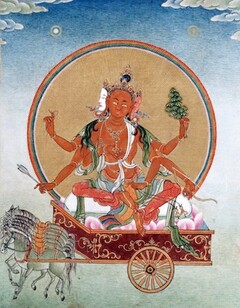
Iconographically, the earliest known forms of Mārīcī, recorded in Chinese translations of now-lost Indian texts from the sixth to seventh centuries, depict her seated on a lotus and with two arms, one holding a fan and the other making a gesture of blessing. By the ninth or tenth century, her imagery had become more elaborate in tantric contexts. She began to be depicted with three faces and six arms, holding objects such as a needle and thread, a branch of the aśoka tree, a vajra, and a bow and arrow. From the tenth century onward, she was sometimes portrayed on a chariot drawn by seven boars. Despite these more complex forms, her essential character remained unchanged: protecting by offering means to elude danger rather than confronting it violently.[5]
A substantial body of Indian ritual material developed around Mārīcī over the centuries. Central to this is the Noble Mārīcī Dhāraṇī (Ārya-mārīcī-nāma-dhāraṇī), which survives in numerous Sanskrit manuscripts as well as in Tibetan and Chinese translations, and continues to be practiced today by both monastics and lay practitioners. Twelfth-century tantric compendia such as Abhayākaragupta’s Niṣpannayogāvalī and the Sādhanamālā provide detailed visualizations and practical rites. Together, these materials indicate that Mārīcī’s cult remained active well into the late Buddhist period, even as Buddhism in India was in decline.[6]
After the thirteenth and fourteenth centuries, as large Buddhist institutions disappeared in India, Mārīcī’s cult declined locally but survived in Tibet, Nepal, China, and Japan through earlier translations. In Tibet, Mārīcī appears in ritual manuals, sādhana practices, and treasures (gter ma) recorded by numerous authors from at least the thirteenth century, and she has remained a prominent deity to the present day. In Nepal’s Kathmandu Valley, Newar Buddhists invoke her in both monastic and domestic settings, as a means of bringing success to households, merchants, and the wider community, and she is incorporated into the Saptavāra, a liturgical cycle of seven potent dhāraṇīs recited on successive days for purification, protection, and the accumulation of merit.[7] In China, Amoghavajra’s eighth-century translations introduced her dhāraṇī and ritual practices, enabling her integration into both Buddhist and Daoist protective traditions. In Japan, where she became known as Marishiten, she gained prominence from the twelfth century onward, especially among the warrior class, who valued her association with invisibility, fearlessness, and mental stability.[8]
Although her later spread across Asia enriched her role in many ways, Mārīcī’s core identity was formed in India: a goddess of dawn light who protects by helping others to remain safely out of reach, a guardian for travelers and warriors, and a Buddhist figure whose power rests in clarity, steadiness, and freedom from fear.
Bibliography
84000. The King of Ritual Manuals from the Tantra of Māyā Mārīcī's Arising (Māyāmārīcījātatantrād uddhṛtakalparāja, sgyu ma'i 'od zer can 'byung ba'i rgyud las phyung ba'i rtog pa'i rgyal po, Toh 565). Translated by Dharmachakra Translation Committee. Online publication. 84000: Translating the Words of the Buddha, 2024. https://84000.co/translation/toh565.
______. The Maṇḍala Rites of Noble Mārīcī (Āryamārīcīmaṇḍalavidhi, 'phags ma 'od zer can gyi dkyil 'khor gyi cho ga, Toh 566). Translated by Dharmachakra Translation Committee. Online publication. 84000: Translating the Words of the Buddha, 2024.
______. The Mārīcī Dhāraṇī (Mārīcīdhāraṇī, ’od zer can gyi gzungs, Toh 988). Translated by Dharmachakra Translation Committee. Online publication. 84000: Translating the Words of the Buddha, 2024. https://84000.co/translation/toh988.
Bautze-Picron, Claudine. "Between Śākyamuni and Vairocana: Mārīcī, Goddess of Light and Victory." South Asian Archaeology 1997 (SRAA 7), 2001: 263—311.
Buddha Śākyamuni. The Noble Mārīcī Dhāraṇī. Trans. Samye Translations, 2020. https://www.lotsawahouse.org/words-of-the-buddha/marici-dharani.
Bühnemann, Gudrun. "A Dhāraṇī for Each Day of the Week: The Saptavāra Tradition of the Newar Buddhists." Bulletin of the School of Oriental and African Studies 77, no. 1 (2014): 119—36.
Donaldson, Thomas Eugene. "Orissan Images of Vārāhī, Oḍḍiyāna Mārīcī, and Related Sow-Faced Goddesses." Artibus Asiae 55, no. 1/2 (1995): 155—182.
Hall, David. The Buddhist Goddess Marishiten: A Study of the Evolution and Impact of Her Cult on the Japanese Warrior. Leiden: Brill, 2014.
Hall, David. "Mārīcī." In Brill's Encyclopedia of Buddhism, Vol. II, 325—331, edited by J. A. Silk, Richard Bowring, Vincent Eltschinger, and Michael Radich. Leiden: Brill, 2018.
Hummel, Siegbert. "Notizen zur Ikonographie der Mārīcī." Monumenta Serica 37 (1986—87): 227—32.
Kim, Joo-Ho. "Emergence of a Buddhist Warrior Goddess and the Historical Development of Tantric Buddhism: The Case of Mārīcī." Journal of the International Association of Buddhist Studies, New Series, 28/29 (2012): 49—65.
Śāntideva. The Training Anthology of Śāntideva: A Translation of the Śikṣāsamuccaya. Translated by Charles Goodman. New York: Oxford University Press, 2016.
Shaw, Miranda. Buddhist Goddesses of India. Princeton: Princeton University Press, 2006.
Version: 1.0–20251126
Notes
-
This is only one of several possible English translations of her name; for a discussion of alternative renderings, see: Hall 2018, 325. ↩
-
Hall 2018, 325. See also the introduction to The King of Ritual Manuals from the Tantra of Māyā Mārīcī’s Arising on 84000. ↩
-
Śāntideva 2016, 137 fn. 24. ↩
-
.Hall 2018, 326. ↩
-
Hall 2018, 326. Kim 2012, 50—58. ↩
-
Hall 2018, 327. ↩
-
Bühnemann 2014, 120. ↩
-
Hall 2018, 328—331. ↩