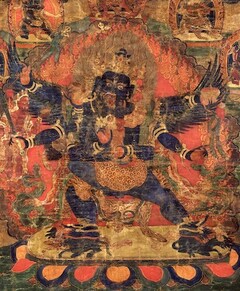
Introduction to Yamāntaka
Introduction to Yamāntaka
by Stefan Mang
Yamāntaka (Tib. gshin rje gshed), the ‘Slayer of Yama’, is a wrathful form of the bodhisattva Mañjuśrī, the embodiment of the wisdom of all the buddhas. Known also as Mañjuśrī Yamāntaka (’jam dpal gshin rje gshed), Yamāri (‘Enemy of Yama’) and, in his best-known form, Vajrabhairava (rdo rje ’jigs byed; ‘Vajra Terrifier’),[1] he is held to counter the two main obstacles to liberation: by increasing the practitioner’s wisdom and intelligence he counters ignorance, which destroys the mind, and by extending life he counters the Lord of Death, which destroys the body.[2] His practice has been cherished across the Tibetan schools. In the Nyingma tradition he is the deity of awakened body in the Kagyé, the ‘Eight Sādhana Teachings’. In the Sarma traditions the root tantras of Yamāntaka (Toh 467–475, 478)[3] belong to the Father class (pha rgyud) of the Unexcelled Yoga Tantra (yoganiruttara-tantra),[4] and in the Geluk tradition Vajrabhairava is a principal meditational deity and was the foremost personal deity of Tsongkhapa Lobzang Drakpa (1357–1419).[5]
Iconography
In early Indian texts such as The Root Manual of the Rites of Mañjuśrī (Toh 543, mañjuśrīmūlakalpa) and sculptures Yamāntaka was represented as the wrathful attendant of Mañjuśrī, a dark, pot-bellied figure in a tiger-skin garment with flaming hair, who stands beside the bodhisattva or rides a water buffalo, the mount of Yama.[6] Before long, however, as the Chanting the Names of Mañjuśrī (Toh 360, mañjuśrīnāmasaṃgīti) identifies Mañjuśrī with Yamāntaka, he came to be understood as a wrathful form of the bodhisattva, and as a yidam (yi dam), or meditational deity, in his own right.[7] In the Tibetan traditions the cycle is generally divided into the ‘black’ (Kṛṣṇayamāri), the ‘red’ (Raktayamāri) and Vajrabhairava, the most wrathful of the three.[8]
Vajrabhairava generally has a bluish-black body with nine faces, thirty-four arms and sixteen legs, and stands amid blazing fire.[9] His central face is that of a buffalo with two sky-blue horns tipped with wisdom fire, which are said to represent relative and absolute truth.[10] He tramples eight animals and eight birds, the messengers and mounts of the eight Lords of Death,[11] and bears an array of weapons and implements, among them a sword, a harpoon, a shield and a club; the brazier and the human entrails in his left hands are read as symbols of clear light and the illusory body.[12] The form is also read symbolically: the sixteen feet trample the lords of illusion,[13] crushing their apparent reality into the sixteen kinds of emptiness, the nine heads stand for the nine vehicles, and the thirty-four arms, together with body, speech and mind, for the thirty-seven practices of a bodhisattva.[14] In some practices he embraces his consort Vajravetālī, while in others he stands alone as the ‘solitary hero’ (ekavīra).[15]
Subjugation of Yama
Yamāntaka’s wrathful character is explained above all through the subjugation of Yama, the Lord of Death. The canonical Vajrabhairava cycle (Toh 468–472)[16] includes The Myth Chapter (Toh 471, gtam rgyud kyi rtog pa), in which Vajrabhairava, who has emerged from the vajras of the Blessed One’s body, speech and mind, crosses the southern ocean to the city of Yama. There he tramples the sixteen gateless iron castles beneath his sixteen legs and pounds the great central castle, whereupon Yama Dharmarāja and his followers, overwhelmed, offer him their essential life forces.[17] Each class of beings gives a syllable—Yama ya, the mātṛs ma, the rākṣasas ra, the yakṣas kṣe, the humans ṇi, the earth lords sa, the tsen (btsan)[18] tsa and the māras da—and these syllables, which form part of Vajrabhairava’s root mantra, embody the very life force of Yama and his retinue.[19] Binding them by oath, Vajrabhairava empowers Yama and his messengers as servants of liberation, and commands the residents of Yama’s city to support the activities of yogins and vidyādharas during the final five hundred years of his teachings.[20]
Origins
Yamāntaka is among the earliest wrathful figures of Buddhist tantra, appearing in the Mañjuśrīmūlakalpa as Mañjuśrī’s wrathful emissary against hostile beings and obstacles,[21] and named among the ten wrathful ones (daśakrodha).[22] The Vajrabhairava and related tantras, by contrast, are thought to have arisen between about 700 and 980 in the Śaiva and Buddhist milieu of Uḍḍiyāna, identified with the Swat region of present-day Pakistan; Tāranātha likewise placed their first revelation there.[23] According to the well-known story, the Nālandā scholar Lalitavajra (late tenth century) came across the words ‘the terrifying Vajrabhairava’ in the Chanting the Names of Mañjuśrī, travelled to Uḍḍiyāna and was allowed by the ḍākinīs to carry back only as much of the tantra as he could memorise in seven days.[24] Other accounts relate that Vajradhara taught these tantras in several settings, among them Akaniṣṭha, Bodhgaya and the ‘City of Iron Skulls,’ where he subdued the Lord of Death.[25]
The Nyingma treasure (gter ma) tradition holds that the formal revelation of the Yamāntaka teachings in the human world occurred through Guru Padmasambhava and the eight vidyādharas, as part of the Kagyé, the ‘Eight Sādhana Teachings’ that lie at the heart of Nyingma tantric practice. Of the eight Indian vidyādharas said to have received these teachings at the Śītavana charnel ground, it was to Mañjuśrīmitra that the iron casket containing the Yamāntaka teachings—concealed by the ḍākinī Karmendrāṇī in the Śaṅkarakūṭa stūpa (mchod rten bde byed brtsegs pa)—was given, making him the teaching’s original recipient and custodian.[26] Each vidyādhara then transmitted his lineage to Guru Padmasambhava, making him the unified embodiment of the entire Kagyé cycle.[27] Within the Kagyé, Yamāntaka is revered chiefly as the embodiment of enlightened body (sku), belonging to Vairocana’s buddha family.[28]
Yamāntaka in Tibet
When Guru Padmasambhava came to Tibet, he blessed eight caves, one for each of the Kagyé deities, and chose Drak Yangdzong (bsgrags yang rdzong) as the place where Yamāntaka’s blessings would especially reside. Practising there himself, he blessed the site as identical to his awakened body, and many others, among them the ‘Fifty-Five Yogis of Yangdzong’, later followed his example.[29] During the Kagyé empowerment given by Guru Padmasambhava at the cave of Samye Chimpu, the flower of Nubchen Sangyé Yeshe fell upon the maṇḍala of Yamāntaka, marking him as the karmically destined recipient of the transmission; he subsequently withdrew to Drak Yangdzong to practise and accomplish the deity at Guru Padmasambhava’s command.[30] As signs of his accomplishment he is said to have plunged his dagger into solid rock.[31] While he was at Yangdzong, the rule of Dharma began to crumble, as the lineage of King Tri Songdetsen gave way to that of King Langdarma (r. 838–842). Inspired to subdue these harmful forces through wrathful activity, Nubchen revealed from the Yamāntaka tantras the instructions on fierce spells, incantations and magic that he had gathered in India and Nepal, and with them quelled many of the conflicts of the time.[32] In the most famous episode, he invoked a huge scorpion with a mere gesture of his hand, terrifying Langdarma into sparing Tibet’s white-robed yogis.[33] Later, at the prince’s invitation, he returned to Samye to teach, continuing to uphold the lineage of Guru Padmasambhava, and is said to have passed away in a mass of light at the age of one hundred and eleven.[34]
Nubchen’s legacy was continued through the treasure revealer Gya Zhangtrom (rgya zhang khrom, born c. 1016), who was identified as his incarnation and discovered a large corpus of Yamāntaka teachings, known as Mañjuśrī, Master of Life (’jam dpal tshe bdag), preserved today in the Northern Treasure (byang gter) collection and reputedly concealed by Nubchen himself.[35] The Nyingma school preserves a vast Yamāntaka literature in its tantra collection, its Kama (bka’ ma) and its treasure cycles.[36]
Alongside these Nyingma transmissions, several lineages of Vajrabhairava were brought to Tibet during the later diffusion by the translators Ra Lotsawa Dorje Drak (rwa lo tsā ba rdo rje grags, 1016–1128), Kyo Ökyi Jungné (skyo ’od kyi ’byung gnas, 1126–1200), Zhang Chogru Lotsawa Sherab Lama (zhang cog gru lo tsā ba shes rab bla ma, tenth–eleventh century), Mal Lodrö Drak (mal lo tsā ba blo gros grags pa) and Nyö Yönten Drak (gnyos lo tsā ba yon tan grags, b. 973), of whom Ra, Kyo and Zhang became the most famous.[37] Ra Lotsawa, who trained under the Newar master Bharo Chakdum and translated the Vajrabhairava and Kṛṣṇayamāri tantras, established the Ra tradition (rwa lugs), which became the predominant Vajrabhairava lineage in Tibet and Mongolia and, in time, came to be influential in China as well.[38] Its distinctive feature is the thirteen-deity maṇḍala, and his own writings on the cycle were later gathered in the Ra Volume (rwa pod).[39] Ra acquired the reputation of a fearsome sorcerer in the Tibetan tradition.[40] His transmission was passed on chiefly in the Sakya school before entering the Geluk mainstream at a later date, while Atiśa Dīpaṃkara (982–1055) is also said to have introduced his own transmission of the Slayer of Death into Tibet.[41] It became especially prominent in the Geluk school following Tsongkhapa, who is said to have received his first Yamāntaka empowerment at the age of seven and later to have enjoyed direct visions of Mañjuśrī and Yamāntaka; in this school Vajrabhairava remains a centrepiece of tantric practice to the present day.[42]
The texts gathered in this series belong to this long history of devotion to the wrathful Mañjuśrī. They include a daily practice of Mañjuśrī Yamāntaka by Jamyang Khyentse Chökyi Lodrö, a method for pacifying epidemics and illness from Tertön Sogyal’s ‘solitary hero’ cycle, and a praise of Drak Yangdzong, where Nubchen meditated on Yamāntaka. Through them practitioners call upon the Slayer of Yama to cut through ignorance and the fear of death, to overcome obstacles and sickness, and to recognise in his wrathful form the indestructible wisdom of Mañjuśrī.
Further Reading
84000: Translating the Words of the Buddha. The Myth Chapter (gtam rgyud kyi rtog pa, Toh 471). Translated by 84000 Translation Team. Online publication. 84000: Translating the Words of the Buddha, 2025a. https://84000.co/translation/toh471.
______. The Rite of the Musk Shrew (Chucchundarakalpa, te’u lo pa’i cho ga, Toh 472). Translated by 84000 Translation Team. Online publication. 84000: Translating the Words of the Buddha, 2025b. https://84000.co/translation/toh471.
______. The Root Manual of the Rites of Mañjuśrī (Mañjuśrīmūlakalpa, Toh 543). Translated by Wiesiek Mical. Online publication. 84000: Translating the Words of the Buddha, 2025c. https://84000.co/translation/toh543.
Arguillère, Stéphane. “Yamāntaka among the Ancients: Mañjuśrī Master of Life in Context.” Revue d’Études Tibétaines 68 (January 2024): 294–380.
Beer, Robert. The Encyclopedia of Tibetan Symbols and Motifs. Boston: Shambhala Publications, 1999.
Cuevas, Bryan J. The “Rwa Pod” and Other ‘Lost’ Works of Rwa Lo Tsā Ba’s Vajrabhairava Tradition: A Catalogue of Recently Acquired Tibetan Manuscripts from Mongolia and Khams and Their Significance. Wien: Arbeitskreis für Tibetische und Buddhistische Studien Universität Wien, 2021.
Decleer, Hubert. “The Melodious Drumsound All-Pervading: Sacred Biography of Rwa Lotsawa: About Early Lotsawa rNam thar and Chos ’byung.” In Tibetan Studies: Proceedings of the 5th Seminar of the International Association for Tibetan Studies, 13–28. 1992.
______. “Bajracharya Transmission in XIth Century Chobhar: Bharo ‘Maimed Hand’s’ Main Disciple Vajra-kirti, the Translator from Rwa.” Buddhist Himalaya 6, nos. 1–2 (1995): 1–17.
______. Review of The Vajrabhairava Tantras: Tibetan and Mongolian Versions, English Translation and Annotations, by Bulcsu Siklós. Indo-Iranian Journal 41, no. 3 (1998): 290–301.
Esler, Dylan. “Yamāntaka’s Wrathful Magic: An Instance of the Ritual Legacy of gNubs chen Sangs rgyas ye shes on the Byang gter Tradition via the Figure of rGya Zhang khrom.” Revue d’Études Tibétaines 62 (February 2022): 190–215.
Linrothe, Rob. Ruthless Compassion: Wrathful Deities in Early Indo-Tibetan Esoteric Buddhist Art. Boston: Shambhala Publications, 1999.
Lo Bue, Erberto F. Review of The Vajrabhairava Tantras: Tibetan and Mongolian Versions, English Translation and Annotations, by Bulcsu Siklós. Journal of the Royal Asiatic Society, 3rd series, 8, no. 2 (1998): 290–293.
Lotsawa House. Chanting the Names of Mañjuśrī (Ārya-mañjuśrī-nāma-saṅgīti, ’phags pa ’jam dpal gyi mtshan yang dag par brjod pa). Lotsawa House. https://www.lotsawahouse.org/words-of-the-buddha/chanting-names-of-manjushri.
Ngulchu Dharmabhadra and Fifth Ling Rinpoche Losang Lungtog Tenzin Trinley. The Roar of Thunder: Yamantaka Practice and Commentary. Translated by David Gonsalez. Ithaca, NY: Snow Lion Publications, 2012.
Ra Yeshe Senge. The All-Pervading Melodious Drumbeat: The Life of Ra Lotsawa. Translated by Bryan Cuevas. New York: Penguin Books, 2015.
Samye Translations. Following in Your Footsteps: The Lotus-Born Guru in Tibet, vol. 3. Boudha, Kathmandu: Rangjung Yeshe Publications, 2023.
Siklós, Bulcsu. The Vajrabhairava Tantras: Tibetan and Mongolian Texts with Introduction, Translation and Notes. PhD thesis, University of London, 1990.
______. The Vajrabhairava Tantras: Tibetan and Mongolian Versions, English Translation and Annotations. Buddhica Britannica, Series Continua 7. Tring: The Institute of Buddhist Studies, 1996.
Version: 1.0–20261102
Notes
-
Cuevas 2021, 15, renders ’jigs byed as ‘the terrifier’; Decleer 1998, 290, translates the full name of the tantra as ‘Great Lightning Terror’. ↩
-
Dharmabhadra 2012, 27. ↩
-
For a brief overview and discussion of each of the main canonical texts of the Yamāntaka cycle, see Cuevas 2021, 16–27. ↩
-
Cuevas 2021, 14 and 14n5, who notes that the Raktayamāri in twenty-two chapters is sometimes classified as a mother tantra; Dharmabhadra 2012, 24. ↩
-
Samye Translations 2023, 53–54; Dharmabhadra 2012, 1, 22. ↩
-
Linrothe 1999, 64, 66–68, 70–71; for the Mañjuśrīmūlakalpa description, see 66–67. For a translation of the Mañjuśrīmūlakalpa, see The Root Manual of the Rites of Mañjuśrī (84000 2025c). ↩
-
Linrothe 1999, 163. For a translation of the text, see Lotsawa House, Chanting the Names of Mañjuśrī. ↩
-
Dharmabhadra 2012, 24–25; Beer 1999, 290, for Red Yamāntaka. ↩
-
Dharmabhadra 2012, 93; Beer 1999, 233. ↩
-
Beer 1999, 313. ↩
-
Beer 1999, 88, 309. ↩
-
Beer 1999, 277, 280, 284, 288, 298, 303. ↩
-
That is, the personified armies of māras and rudras, who create the notion of an individual self and veil innate buddha nature behind illusion (Beer 1999, 233). ↩
-
Beer 1999, 233. Dharmabhadra 2012, 137–138, explains the nine faces as the nine limbs of scripture. ↩
-
Dharmabhadra 2012, 2. ↩
-
Cuevas 2021, 14. ↩
-
The Myth Chapter (84000 2025a, 1.2–1.5; i.1). ↩
-
Some Tibetan scholars later questioned the authenticity of the text on account of its reference to the tsen, a class of spirits of Tibetan provenance; Tāranātha, however, regarded only that verse as a later interpolation. See Decleer 1998, 291–293, and The Myth Chapter (84000 2025a, 1.6n10). ↩
-
The Myth Chapter (84000 2025a, 1.6, 1.9; the syllables are identified as part of the root mantra at 1.6n10). ↩
-
The Myth Chapter (84000 2025a, 1.7–1.8, 1.10–1.13). ↩
-
Linrothe 1999, 26, 64–65. ↩
-
Beer 1999, 249. Linrothe 1999, 163. ↩
-
Lo Bue 1998, 290–291, summarising Siklós 1996, 3–19; The Rite of the Musk Shrew (84000 2025b, i.1); Decleer 1998, 290. ↩
-
Cuevas 2021, 28–29; Siklós 1990, 71–72; Dharmabhadra 2012, 313. Siklós suggests that Lalitavajra collected and edited this literature, then perhaps not yet Buddhist (Lo Bue 1998, 291, summarising Siklós 1996, 9). ↩
-
Dharmabhadra 2012, 312–313, from the historical account of Je Sherab Gyatso (1803–1875; see Dharmabhadra 2012, 4); the City of Iron Skulls is identified as Yama’s abode at 313n207. ↩
-
Samye Translations 2023, 53, 56. ↩
-
Samye Translations 2023, 53. ↩
-
Samye Translations 2023, 52–53. ↩
-
Samye Translations 2023, 174–176. ↩
-
Samye Translations 2023, 57, 175. ↩
-
Samye Translations 2023, 57, 177. ↩
-
Samye Translations 2023, 177; see also Esler 2022, 190. ↩
-
Samye Translations 2023, 177. ↩
-
Samye Translations 2023, 177. ↩
-
Esler 2022, 190–191; Arguillère 2024, 294–295. ↩
-
Arguillère 2024, 299, counting about 5,500 pages in the Nyingma Gyübum (rnying ma rgyud ’bum), three volumes of the Nyingma Kama (rnying ma bka’ ma), ten volumes in the Northern Treasure Compilation (byang gter phyogs bsgrigs) and a four-volume anthology of treasure cycles in the Rinchen Terdzö (rin chen gter mdzod). ↩
-
Dharmabhadra 2012, 24, 314, 316. ↩
-
Cuevas 2021, 55–56; The Rite of the Musk Shrew (84000 2025b, i.2 and glossary, s.v. Ra Lotsāwa Dorjé Drak), which gives the dates c. 1016–1128. For his life, see Ra Yeshe Senge 2015. ↩
-
Cuevas 2021, 55–58. ↩
-
Cuevas 2021, 56–57. ↩
-
Decleer 1998, 300n14; Cuevas 2021, 65–66. ↩
-
Dharmabhadra 2012, 1. ↩