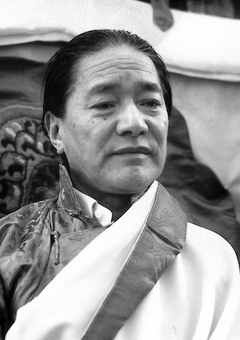
Richö – Mountain Retreat Teachings
The Alchemy of the Siddhas
Direct Instructions[1] on How to Practise the Mountain Retreat Teachings, Explained in a Manner That is Easy to Understand
by Kyabjé Dudjom Rinpoche
With the greatest devotion I take refuge and prostrate myself at your feet, glorious and noble guru, in all your incomparable kindness!
Through your blessing may a completely undistorted understanding of the profound path be swiftly born deep within the minds of myself and my followers, and may we all attain the primordial stronghold of the dharmakāya within this very life!
Now, as a result of their aspirations in previous lives, combined with their own purified karma, some fortunate individuals have arrived at a point where they have full confidence in the profound and secret Great Perfection and the guru who reveals it, and they wish to follow their practice through to the end. As an opening for them, here is the explanation, handed straight over and easy to understand, of the quintessential mountain retreat (ri chö) teachings, which are the vital directions on how to practise the most secret Great Perfection.
There are three topics to be understood: (1) the groundwork: how to cut through all entanglement in desire and attachment, turn our mind towards the Dharma, and purify and transform our basic character. (2) the main practice: how to cut off all misconceptions and doubts about view, meditation and action, and straighten out our practices; (3) continuing the practice in life: how to keep the samaya vows and precepts intact and wind up the activities of this life with the Dharma.
1. The Groundwork
Kyema! This restless flickering awareness, which we call our mind, appeared in the beginning at the very same moment as Samantabhadra. Even so, it is he who is liberated, since he knows himself, whereas we sentient beings wander astray in endless saṃsāra, because we do not recognise our own true nature.
The number of forms we have taken on in the six realms is countless, and everything that we have done up to now has been pointless and in vain. So, now that we have a human form—a one-in-a-million chance—if we do not put into practice the one and only means of avoiding birth in the lower realms of saṃsāra, then once we are dead, there is no saying where we will be reborn. However, in whichever of the six realms we might be born, we shall not have passed beyond the reach of frustration and suffering.
Yet simply to have this human form is not enough; as death could come at any time, the sincere and true practice of Dharma must be started right now. Then at the moment of death, we need to be like Jetsün Milarepa, free from even the slightest trace of guilt or shame: “The Dharma of Milarepa, my way,” he would say, “is to live and die without regrets.”
Then, should you take up the practice of Dharma, it is not enough merely to ape customary behaviour and act out the Dharma in form alone. It is vital to cut off all entanglement in the objects of desire and attachment that are bound up with the activities we focus on in this life. If that break is not made, and you have made a half-hearted start on the practice of Dharma with a dithering, hesitant mind, still attached to things such as home, money, possessions, family and friends, then these thoughts of attachment will become a cause, and the objects of attachment a contributory cause. These two are brought together and put into action through the agency of Māra, which is the obstacle; then, mixing yet again with those bent on worldly pursuits, you will end up doing things that go contrary to the Dharma.
So be a loser when it comes to food, clothing and conversation, give up attachment to the eight worldly concerns, and resolutely turn your mind towards the Dharma. You should be like Gyalwa Yangönpa, who said:
In a solitary hermitage, which is the acute awareness of death,
The practitioner, who has a deep revulsion for attachment,
Makes his retreat, which is mentally renouncing this life,
And his mind does not meet the eight worldly concerns.
Otherwise, mixing Dharma with the eight worldly concerns is like eating food mixed with poison: it is courting disaster.
In a nutshell, the essence of all these eight worldly concerns is expectation or hope and fear, which are really none other than attachment and aversion. Internally they are attachment and aversion; externally they appear in the guise of gyalpo and senmo. As long as the mind is not free from attachment and aversion, it will never be free from gyalpo and senmo, and there will be no end to the obstacles that will arise. So examine yourself again and again to see whether the eight worldly concerns, self-importance and desire for the things of this life are there, lurking in the recesses of your mind. If so, make a concentrated effort to rid yourself of such faults. Prolonging an appetite for the eight worldly concerns whilst putting on a show of spirituality, and even earning your keep by perpetrating such fraud is really a perverse way of life.
There is a saying: “By leaving home, half of the Dharma is accomplished”. So say goodbye to your home and wander without any set aim in mind to unfamiliar places. Make a good break with friends and relatives, and pay no attention should they criticise the Dharma and try to divert you from your path. Give away all your money and possessions as charity, and let your daily needs be sustained by whatever comes your way.
Recognising all things that stimulate desire as obstacles that can become addictive, strengthen your mind to be free of desire. Just like with money and possessions—as long as you cannot be content with a little, then once you have one thing you will have to have another—so with any object that stimulates desire, and then it is no problem for the seductive ploys of Māra to succeed. As for what people might say about you, do not take it to heart, as true, or bother to deny it or approve it out of hope or fear; as if they were talking about someone who was already dead and buried, let them say whatever they want!
Do not follow the guidance of anyone except a qualified guru, even of your loved ones who might advise you in all sincerity. Know your limits; do not overrate yourself. Be independent; do not give people the chance to lead you round like a pet with a ring through your nose. Cultivate a tolerant and spacious attitude towards others, and honour your friendships by being considerate and harmonious, without always “singeing people’s noses” and abusing them. Even if someone does become an obstacle to your practice, no matter how powerful or influential he may be, remain immovable, like a rock of iron tugged by a silken ribbon. It will not do at all to be unstable and easily swayed, like grass on a hillside that bends to and fro whichever way the wind blows. From the very beginning of your practice, whatever it might be, until you reach the end, carry it through exactly as you had originally intended, vowing not to break your promise, no matter what happens—whether a bolt of lightning strikes you from above, the sea engulfs you from below, rocks drop on you from all sides, or death itself comes upon you.
Right from the start, don’t fall into bad habits but progressively build up a disciplined routine with regular periods of practice, sleep, relaxation and mealtimes. In particular, in any practice, however elaborate or simple, allow no opportunities for irregularities, and pursue the practice without any breaks, at an even pace, and without wasting a single moment.
For the retreat itself, the door of your hut can be sealed with clay; if it is not, do not meet others face to face, lose your silence, or spy out and look for activity. Let the restless wandering mind calm down, then breathe out the stale air, and take up the correct posture. The mind must be firmly centred in mindful awareness, like a stake hammered into a field, and you should be able to remain there without even an instant’s distraction. The outcome of outer, inner and secret retreats, if strictly observed, will be that all the signs of attainment and realisation will swiftly appear.
You might think: “Now that so-and-so has turned up on very important business, I’ll go to meet them, and have a word with them. Once they’re gone, I’ll get back to my strict routine again.” If you make an exception of this sort, you are throwing away the intensity and power of the practice; it will get more and more loose, sloppy and careless. On the other hand, if you decide from the very beginning to stand firm with the utmost determination, your practice will become more and more disciplined, and it will not be swept away by obstacles.
Though there are numerous ways of recognising the special characteristics of a place for a hermitage, generally speaking any place that has been empowered by the presence of siddhas of the past like Guru Rinpoche, that is not the haunt of samaya-breakers, where necessities are easily come by and where conditions are favourable for one’s physical and mental health, is eminently suitable.
Going into the cemeteries and wild terrifying places where malicious local spirits dwell, if you can subdue them through your spiritual strength, this will speed up the fulfilment of outer and inner auspicious conditions (tendrel), and give a tremendous impetus to your meditation. If, on the other hand, you cannot subdue them, there will be many obstacles. When you can transmute them within the vast expanse of realisation, all hostile circumstances appear as friends and helpers. Then there is nothing better than performing your secret practice in places like cemeteries.
Generally, refrain from any noise and busyness, whether outside or within the mind, and simply remain perfectly at ease, effortlessly. This is the true, essential solitude or hermitage.
The actual purification of our basic character is effected, in the ordinary preliminary, by the four causes of renunciation of saṃsāra, and in the extraordinary preliminary by: taking refuge, the generation of bodhicitta, purifying defilements and obscurations (Vajrasattva practice), and accumulating merit and wisdom (the maṇḍala offering). Following the instructions on ngöndro preliminary practice, apply yourself to each of these in turn until you have personally experienced the truth of them.
In particular, it is vital to put all your energy into the guru yoga, holding onto it as the life and heart of the practice. If you do not, then your meditation will be very dull, and even if you make a little progress, there will be no end to obstacles, and no possibility of true, genuine realization being born within the mind. Therefore, by fervently praying with uncontrived devotion, after a while the direct blessing of the guru’s wisdom-mind will be transmitted, empowering you with a unique realisation, beyond words, born deep within your mind. Lama Zhang Rinpoche[2] declared:
Sustain stillness, sustain the flow of inner experience, sustain samādhi meditation—though there are many such words of advice, yet rare indeed is that realisation born within through the guru’s blessing, invoked by the power and strength of devotion.
So a full understanding and realisation of the true essence of the Great Perfection depends entirely on these preliminary practices (ngöndro). For as Jé Drikungpa said, “Other teachings stress the profundity of the main practice, but here we stress the profundity of the preliminaries.” And that is just how it is.
2. The Main Practice: How to Cut Off All Misconceptions and Doubts About View, Meditation and Action and Straighten Out Our Practices
The View, Which is Knowing the Actual State of Things As They Are
The true nature of our mind is the nature of everything, the absolute truth. When freed of all mind-made concepts and conditioning, this is established to be pure awareness, or rigpa. With this, the innate natural wisdom of rigpa dawns, nakedly:
No words can describe it.
No example can point to it.
Saṃsāra does not make it worse.
Nirvāṇa does not make it better.
It has never been born.
It has never ceased.
It has never been liberated.
It has never been deluded.
It has never existed.
It has never been non-existent.
It has no limits at all.
It does not fall into any kind of category.
To put it briefly then, since it never existed, from the very beginning, as an entity with any characteristic features, its essence is pure from the beginning (kadak): vast, all-pervasive emptiness which encompasses everything. Yet since the self-radiant energy of emptiness is unobstructed and unceasing, the whole infinite range of phenomena of saṃsāra and nirvāṇa manifests out of it of its own accord, like the rays of the sun from the sun, and it is not an empty emptiness, a nihilistic void. So its nature is wisdom, rich in noble qualities which are vast and spontaneously present (lhundrup).
This rigpa, the indivisibility of appearance and emptiness, is the embodiment of the three kāyas, and the natural condition of the primordial state. Recognising it, exactly as it is, is the view of the Great Perfection, which is beyond the mind. For, in the words of the great Guru Padmasambhava, “The truth of everything is the dharmakāya, which goes beyond the intellectual mind.”
How wonderful to realise that we can actually grasp this enlightened mind of Samantabhadra, so directly! This is the very heart of the 6,400,000 tantras of the Great Perfection, which are in turn the ultimate meaning of all 84,000 sections of the Buddha’s teachings. This is it! There is not even a fraction of an inch to go beyond it, and upon this you should make all your decisions, with regard to Dharma, with absolute certitude.
Meditation
Now, once you have eliminated all doubts and misconceptions about this view from deep within yourself, abiding by this view continuously is what is called meditation. All other kinds of meditation which have some aim or reference to meditate on are mind-made, fabricated meditations, and we practitioners of Dzogchen don’t touch that kind of stuff.
Without losing the steadfast integrity and stability of the view, allow all your sensory perceptions to settle into their natural condition, and just relax. Don’t say: “Oh, this is meditation!” and try to meditate. If you ‘meditate’, that is only the mind; there is nothing to meditate on. Yet, at the same time, you should not let yourself be distracted for even a split second. For being distracted from resting within your own mind like this, is actually what delusion is. So do not be distracted! Whatever thoughts arise, let them arise; don’t follow them or try to stop them.
“What are we supposed to do then?” you might ask. Whatever perceptions arise, you should be like a little child going into a beautifully decorated temple; she looks but grasping does not enter into her perception at all. So, you leave everything fresh, natural, vivid and unspoiled. When you leave each thing in its own state, then its shape does not change, its colour does not fade and its glow does not disappear. Whatever appears is unstained by any grasping, so then all that you perceive arises as the naked wisdom of rigpa, which is the indivisibility of luminosity and emptiness.
Now, people who are not so very intelligent can make neither head nor tail of the huge number of teachings which are all said to be extremely profound and very vast. So to point out the main point, neatly and tangibly, for their benefit:
When one past thought has ceased, and a future thought has not yet risen, in that gap, in between, isn’t there a consciousness of the present moment, fresh, virgin, unaltered by even a hair’s breadth of concept, a luminous, naked, awareness? Well, that is what rigpa is!
Yet it does not stay in that state forever, because another thought suddenly arises, doesn’t it? This is the self-radiance of that rigpa.
However, if you do not recognise this thought for what it is, the very instant it arises, then it will turn into just an ordinary thought, as before. This is called the “the chain of delusion,” and is the root of saṃsāra.
If you are just able to recognise the nature of the thought as soon as it arises, and leave it alone without any follow-up, then whatever thoughts that arise all automatically dissolve back in the vast expanse of the dharmakāya rigpa and are liberated.
This is actually the main practice that brings together the view and meditation of Trekchö. In the words of Garab Dorje:
When, from out of the primordially pure dharmadhātu,
Suddenly rigpa arises, and with it there is an instantaneous recognition,
It is like finding a precious jewel in the depths of the ocean.
No-one has created it; it is just the dharmakāya.
So this is what you have to practise and get used to, day and night, undistracted, and with all your energy. Without leaving emptiness as mere intellectual speculation, let your realization pile up upon rigpa.
Action
Next is how to bring that meditation to realization in action, integrate it into our everyday being, and strengthen it by straightening out the practice.
The main point, as was explained above, is to consider that the guru is actually the Buddha, and without losing this recognition for even an instant, to pray to him or her with fervent and intense devotion from the depths of your heart. Devotion is likened to a panacea that cures all illnesses, since there is simply no better method for removing obstacles and speeding up your realisation. With it, you will progress along all the paths to realisation with tremendous force and momentum.
Now, as for the faults and pitfalls in your meditation: if it becomes dull, sluggish and dim, then arouse the rigpa and stir it up; if it is scattered, wild and agitated, then relax your awareness from deep within your mind. Generally, don’t try too hard to concentrate, being always on edge and making many changes of mind. Simply be mindful not to forget to recognise your true nature, and maintain this presence uninterrupted in whatever you do—eating, sleeping, walking or sitting still—and in or out of meditation.
Whatever arises—happy thoughts, sad thoughts, or negative emotions—do not react with hope or fear, acceptance or rejection, or by trying to get rid of them by applying some antidote. Just leave them as they are, essentially just feelings of happiness or sorrow, naked, sparkling and vivid. All this boils down to just one main point, so do not confuse yourself with too much thinking: it’s useless. Whenever a negative thought or emotion, which is normally seen as something to abandon, arises, there is simply no need to apply an antidote to it by meditating specially on emptiness. You don’t have to resort to any such device. For as soon as your rigpa recognises what is to be abandoned for what it is, there and then it will be self-liberated spontaneously, like a snake uncoiling its own knots.
This is the ultimate, hidden meaning of the path of luminosity of Dzogchen, known as the Vajra Essence. Plenty of people know how to talk about this quite glibly, but they do not know how to practise it, and it is just something they recite like a parrot saying its prayers. How fortunate are we who do the practice!
Now think well here; there is more to understand. From beginningless time, through countless lives, up until the present, our deadliest enemies, which have kept us tied to saṃsāra, are the grasper and the grasped—subject and object. But now that the gracious guru has kindly introduced us to the dharmakāya nature and we have recognised it, these two are completely burned away, like feathers in a flame, leaving no trace at all. Isn’t this deeply satisfying? So since we have received these profound instructions for this way to rapid accomplishment, if we fail to take them to heart and practise them, they will be like a wish-fulfilling gem kept in the mouth of a corpse. What a waste! So don’t let their essence rot inside your heart; practise them instead.
As a beginner, you will find that gross, heavy thoughts take you over, and your mind becomes distracted. Then little, subtle thoughts will creep in even more, unnoticed and multiplying speedily, until suddenly a fresh presence of mind returns, and you think, “I have been distracted!” and feel sad. At this juncture do not do anything like trying to chase the previous thought, or feel guilty about having been distracted. Simply continue that fresh, present state of mind you have arrived at, just as it is. That is quite sufficient.
“Do not reject thoughts, because they are the dharmakāya,” goes a famous saying. However, if the strength of the vipaśyanā experience has not been perfected, and you remain in a blank state of śamatha, thinking, “Everything is dharmakāya,” you run the risk of drifting into the indeterminate (lungmaten), an undiscriminating even-mindedness where you cannot tell what is what.
Instead, from the start, whatever thoughts arise, just look at them with bare attention, and without any analysing or thinking at all; simply rest in the recognition of the thoughts and leave it there, without giving them the slightest importance, like an old wise man watching a child at play.
When you remain like this, if you are able to leave your mind in a state of absence of thoughts but then suddenly destroy it, in that instant the wisdom which is beyond mind will arise, naked and vivid.
Whilst you are practising, your practice will, to some extent or another, inevitably be mixed with an experience of bliss, clarity or absence of thoughts. However, if you remain without any trace of a reaction like smugness, conceited attachment, hope, fear or doubt, then this will keep you from going astray.
Constantly abandon all distraction, and practise with one-pointed, alert awareness. This is very important.
If you drift into erratic, half-hearted practice and theoretical understanding, you will just become self-satisfied about some vague śamatha practice, and without having clarified your experiences or really experienced the practice, you will just be clever at talking about it, which is of no benefit at all. As is said in Dzogchen: “Theories are like patches: one day they will just wear off,” and “experiences are like mist: they will evaporate.” That is how even a tiny good or bad circumstance can trip up a so-called great meditator, and many are those who have been deceived by circumstances. Even though meditation may have really touched your basic being, if you do not continue the practice constantly, then all the profound instructions you have received will just be left on the pages of your notebooks; your mind becomes stubborn, your Dharma becomes stubborn, your practice becomes stubborn, and there will never come a time when real meditation will be born in your mind. You old great meditators with your practice still in its infancy, there is a danger of your dying a sad death, your heads encrusted with salt, so beware!
Practising continuously for some time, as meditation begins to gradually assimilate into your being, there will come a time when, as a result of devotion or some other fortunate circumstance, experiences will bubble up to inspire realization, and you will see the naked, resplendent rigpa. That moment is like taking a hood off your head. What boundless spaciousness and relief!
This is the supreme seeing—seeing what was not seen before. From then on, thoughts will arise as meditation, and both stillness and movement will be simultaneously liberated. At first, liberation will occur simultaneously with the recognition of arising thoughts, like meeting an old friend. In the middle, all arising thoughts are self-liberated, like a snake uncoiling its own knots. Finally, arising thoughts are liberated, bringing neither benefit nor harm, like a thief in an empty house. These realisations will happen progressively.
Then a deep realization and overwhelming certainty will arise in your mind that all phenomena are but the miraculous display of your own rigpa. With this, a great wave of emptiness and compassion will surge up. There is no choosing left between saṃsāra and nirvāṇa; you realise that there is no difference, of good and bad, between buddhas and sentient beings. Whatever you do, you will always be content and joyful, because you are in an unwavering state of dharmatā. You will be pervaded by this feeling day and night, for as it is said in the Dzogchen teachings: “Complete realization is like the sky: it is unchanging”.
Though a yogin like this may look outwardly like an ordinary person, since his mind has been liberated into dharmakāya, he is free of activity and research, and, residing in that state of realization, he can traverse all the stages and paths without any effort. Eventually, all thoughts will be exhausted, all phenomena will wear out, and like the space in a breaking vase merging with the whole of space, the body dissolves into minute particles, and mind dissolves into dharmatā. This is what is called ‘the realisation of the space of the primordial ground through the inner luminosity of the youthful vase body’. Now this is the ultimate accomplishment and conclusion of view, meditation and action, and it is known as ‘the actualisation of the fruit or result which is unobtainable’. The stages on the path one traverses to obtain experience and realization could occur either one by one, or without any particular progression, or all together, depending on the capacity of the individual. Yet when you actually realise the fruit itself, there is no difference at all.
3. Continuing the Practice in Life: How to Keep the Samaya Vows and Precepts Intact and Wind Up the Activities of This Life With the Dharma
Although you may do your best to take the view, meditation and action to heart, if you are not skilful in your behaviour in everyday life, you will lose your precepts and corrupt the samaya. Then not only will there immediately be many interruptions and obstacles blocking the levels and paths to realization, but also eventually you will, without any doubt at all, be reborn in the Hell of Unrelenting Torment. Therefore, it is extremely important to be constantly aware and mindful, without any mistake as to what is to be adopted or abandoned. In the words of the great Master Padmasambhava:
Though my view is as spacious as the sky,
My actions and respect for cause and effect are as fine as grains of flour.
So give up impulsive, thoughtless ways and pay meticulous attention to the cause and effect of your actions. Guard against even the minutest impairment of your samaya vows or precepts, and stay untainted by any faults and downfalls of samaya.
To sum up all the many different samaya vows of the Secret Mantrayāna, they all fall into the samaya of the body, speech and mind of the root guru. It is said that to consider the guru as an ordinary person for even a split second is to put any attainment or siddhis months and even years away. “Why so?” you might ask. Because, and this is a crucial point, the guru is the most powerful deciding factor. As it is said: “For the vajra holders,[3] attainment or siddhis come only from the master.”
So whoever you may be, at the outset, until you have made a connection with a guru, you are your own master. Yet once you depend upon a guru, and you have established a link through receiving empowerments and oral instructions, from then on you are not free to disregard the samaya vow. At the conclusion of the four empowerments, one prostrates before the guru, considering him or her as the chief of the maṇḍala, and says: “From this moment on, I offer myself to you as a servant. Please take me as your disciple and make use of every bit of me”. With a promise such as this, whatever your rank or power, aren’t you putting yourself completely in the guru’s hands? Similarly, one says, “I shall perform every single thing that the guru demands of me”. After such a vow, you don’t have a great deal of choice but to do everything the guru says, do you? Failing to carry out your own promise does not deserve to be called anything other than ‘breaking the samaya’, unpleasant though that might sound.
Another thing to bear in mind is that nowhere does it say that when the guru is very important and has a large entourage, tremendous wealth, authority and prosperity, you should keep the samaya exceptionally well, but there is no need to keep the samaya with a guru who is humble and not so well-known, like the yogins who live as beggars. Whoever they are, the essential point you need to grasp is what you have to gain or lose, otherwise you won’t get anywhere if you just stay as dumb and confused as an old horse. Is this need to keep the samaya for the guru’s benefit or for your own? Think about this seriously, like someone methodically grinding up medicine. For if it is for the guru’s benefit, then you can dispense with it right away, but if not, it’s no use pouring cinders over your own head.
The samaya towards Dharma brothers and sisters involves, generally speaking: respecting all who have set out on the path of Buddhadharma, training in purity of perception, and rejecting any kind of sectarian bigotry and criticism. More specifically, since all those who have received teachings from the same guru in the same maṇḍala, are vajra brothers and sisters, you must avoid any feelings of contempt, competitiveness, jealousy or deceit, and relate to them as close friends, with all your heart.
All sentient beings have been our very own parents and shown us such great kindness. Atsama! Now they are oppressed by the intense suffering of saṃsāra, from which there is no release. If we do not help and protect them, then who will? Spurred on by this unbearable thought, train your mind in developing compassion. With actions, words and thoughts, in whatever way you can, do only what is beneficial for others, and dedicate all the merits for their well-being.
There are only three things that you need to keep continually in mind: the Dharma, the guru, and sentient beings. Apart from them, do not look for anything else on which to contemplate or practise.
There is no need to vie with those who bear the title or outward appearance of yogins (tokden) or monks; keep your mouth shut and your mind under control. This is a very important point, so don’t play the fool. Fundamentally, if you just think of your own well-being in lives to come, then you will see that the person who needs to practise this Dharma is you. Though you might put all your hope in the merit gained by other people after your death, you may well actually find that it is very difficult for it to be of any help.
Therefore, turn your mind inwardly; the groundwork is to generate a deep and heartfelt revulsion for saṃsāra, making an enthusiastic resolution to integrate your life and your practice, and make them one. With this as the basis, then the main practice is to hit the essential point of taking to heart and practising the profound view and meditation. Finally, in everyday life, since in your actions there is no confusion as to what to accept and what to reject as regards the samaya vows and precepts, then understanding, with all its noble qualities, will have simply no option but to be born within you.
This is why the Great Perfection is a path through which even the most hardened criminal can directly and speedily attain Buddhahood.
It is because the Great Perfection is so very profound that there will be obstacles, just as making a great profit entails a great risk. The reason for this is that all the negative karma accumulated in the past is churned up by the potency of the oral instructions, and as a sign of this, it arises externally as obstacles and apparitions created by Māra:
In the place where you practise, spirits will display their forms; they will call out your name; they will disguise themselves as your guru and make predictions.
All kinds of terrifying hallucinations will appear in your experiences and dreams.
Physically, people may attack you, argue with you and rob you; you may fall ill; and all kinds of other hazardous predicaments may occur.
In your mind, for no apparent reason at all, you will experience intense suffering, sadness and depression, and you will want to break down into tears.
Turbulent emotions will boil up inside you; devotion, the urge towards enlightenment (bodhicitta) and compassion will all dwindle.
Your thoughts will ‘arise as enemies’, making everything turn hostile and driving you to the verge of madness.
Any helpful advice you will distort and misunderstand.
You will long to leave your retreat and to break your samaya promises.
You will develop perverse and wrong views of the guru, and doubts about the Dharma will eat you up.
Apart from these, all sorts of unwanted circumstances may befall you, outer and inner; for instance: you will be wrongly blamed for things you did not do, you will somehow get a bad name, and your friends will turn into enemies.
Now, these are all testing points, and you should recognize them as just such. This is the borderline where you can either win or lose. If you can deal with these obstacles with the essential point of the practice, then they will be transformed into attainments and siddhis. On the other hand, if you let them overwhelm you, they will become just stubborn blockages.
In such situations as these, keep your samaya pure, and with strong-willed, unwavering devotion, put all your trust in the guru and leave your heart in his or her hands; pray to him or her fervently, with complete and utter confidence. For, by treating adverse circumstances as if they were actually welcome, and practising as hard as you can, after a while the solidity of these very circumstances will cave in by itself, and your practice will progress by leaps and bounds. Appearances themselves begin to become less solid and substantial, like mist. There will arise an even greater trust, confidence and certainty in the guru and his or her instructions than ever before. Even should problems arise again in the future, you will have found a deep security of mind, and be able to think: “Oh! That’s all right.” Now this is the key to the whole matter; if you can bring all circumstances into the path, then you have solved the crucial issue. Alala! This is just what we old fathers need! So build up the strength of your mind, and don’t act like a fox that wants to devour a human corpse, but only dares slink around it, quaking at the knees.
There are those who are poor in their accumulation of merit, and lax in their samaya vows and precepts, who excel in wrong views and harbour many doubts, who make high-sounding promises but whose practice is feeble. Such people, whose hearts stink like farts, actually request the guru’s instructions to sit on their bookshelves and gather dust. Clutching unfavourable circumstances tightly by the hand they follow them off, and are an easy prey for Māra, who finds their weak point and ushers them down the path towards the lower realms. Akha kha! Pray to the guru that this will not happen to you.
Whilst it is comparatively easy to deal with adverse situations that arise along the path, much more difficult are the good circumstances. There is a big danger that, if you pride yourself on your lofty realization, you will concentrate only on ways of achieving greatness in this life, and you will end up the servant of Devaputra Māra, the demonic force of complete distraction; so be very careful! You must understand that this is the borderline between going up or down, and it is here that the great meditator is gauged.
As long as the energy of the qualities of inner realization has not been fully perfected, it is not right to go reeling off stories to all and sundry about your experiences. So keep your mouth closed. Also don’t brag about however many years and months you have spent in retreat, but put all your energy into taking the practice to heart, for as long as you should live. Don’t look down on the relative and the gaining of merit through cause and effect, whilst conning yourself with words about emptiness. Don’t spend too long in busy places, earning your keep by performing ceremonies in villages, like subduing ghosts, and so on. Reduce all pointless activity, unnecessary talk and unhelpful thoughts. Don’t trick people with deceit and cunning and the like, which are all contrary to the Dharma. Don’t earn your living in a negative way, flattering and deviously dropping hints, driven by desire for things that you want. Don’t keep company with people who are habitually doing harmful things or whose outlook and behaviour are not compatible with yours. Admit your own failings, and don’t discuss the hidden faults of others.
Since it is said that all kinds of smoking are the manifestation of damsi samaya-breaking demons, they should be wholeheartedly abandoned. Alcohol, however, should be used as a samaya substance, provided that it is not consumed mindlessly so that you end up drunk.
Some people may respect you and treat you well, whereas others who don’t will speak ill of you and cause trouble. Whatever their relationship with you, good or bad, make it part of the path and, without any distinction, accept them all with pure and good wishes.
At all times, inwardly let rigpa be very high and spacious, without losing courage, whilst outwardly behave with modesty and humility. Wear simple, old clothing. Put everyone, good, bad and in-between, before yourself. Live frugally, on the bare essentials, stay in your retreat hermitage and set your sights on the life of a beggar. Take the lives of the great siddhas of the past as your model. Without blaming your past karma, make your Dharma practice pure and flawless; without blaming your present circumstances, stay firm, whatever happens.
In short, make your mind its own witness, devote your whole life to the Dharma, and then when death comes there will be no regrets or self-reproach, nor anything left undone. In this lies the essential point of all practice. Then, when the time does come for you to die, give away all the money and possessions you have, without being attached to even a single needle. At the moment of death, the best practitioner will be full of joy, the middling practitioner will have no fear or apprehension, and the ordinary practitioner will die without regrets.
If the luminosity of realization pervades continually, day and night, then there is no bardo state, and death is but the destruction of the physical body. If not, if you have the confidence that you will be liberated during the bardo, whatever you do is all right. Otherwise, practise and become thoroughly familiar beforehand with the transference of consciousness (phowa), and when the time comes, put it into action, directing your consciousness into whichever buddha realm you wish, where you will complete the remaining stages and paths and attain Buddhahood.
So, in this precious lineage of ours, this is not just ancient history, for today as well just as in the past, there are those who through the path of Trekchö and Tögal have attained the final realization, and have dissolved their gross material body into the rainbow body of radiant light.
Don’t throw away such a precious jewel as this, and then look round elsewhere for semi-precious stones. Now that you have had such great good fortune as to have met this profound teaching, the very heart-blood of the ḍākinīs, your mind should be uplifted, and you should practise with tremendous inspiration and joy.
As for this little book, may my disciples treasure it in their hearts, and it may bring them tremendous benefit.
The main cause of its being written was to be a guide in the practice of retreats for the meditators of Omin Pema Ö Ling. The contributory condition was the request of that dedicated practitioner Rigzang Dorje, who possesses the jewel of unshakeable faith and devotion.
This was spoken from the heart by Jigdral Yeshe Dorje, in the form of naked oral advice. May it be the cause for the wisdom of realization to be born instantly and directly within the minds of all fortunate individuals!
| Translated by Rigpa Translations, 2004. Revised with permission and first published on Lotsawa House, 2026.
Bibliography
Tibetan Edition
'jigs bral ye shes rdo rje. "ri chos bslab bya nyams len dmar khrid go bder brjod pa grub pa'i bcud len." In bdud 'joms 'jigs bral ye shes rdo rje'i gsung 'bum dam chos rin chen nor bu'i bang mdzod, Vol. 13: 443–467. Kalimpong: Dupjung Lama, 1979–1985.
Secondary Sources
DiValerio David M. Mountain Dharma: Meditative Retreat and the Tibetan Ascetic Self. New York: Columbia University Press, 2025.
Garry, Ron. Wisdom Nectar: Dudjom Rinpoche’s Heart Advice. Ithaca: Snow Lion, 2005.
His Holiness Dudjom Jigdrel Yeshe Dorje. Extracting the Quintessence of Accomplishment: Oral Instructions for the Practice of Mountain Retreat Expounded Simply and Directly in their Essential Nakedness. New York: Yeshe Melong, 2015.
______. Advice for Mountain Retreat entitled Extracting the Essence of Accomplishment through Direct Instructions that are Easily Understood. Translated by Lama Chönam and Sangye Khandro. Ashland, OR: Light of Berotsana, 2014.
Ricard, Matthieu. On the Path to Enlightenment: Heart Advice from the Great Tibetan Masters. Boulder: Shambhala Publications, 2013.
Wallace, Alan B. The Vital Essence of Dzogchen: A Commentary on Düdjom Rinpoche’s Advice for a Mountain Retreat. Boulder: Shambhala Publications, 2025.
Version: 1.3–20260202