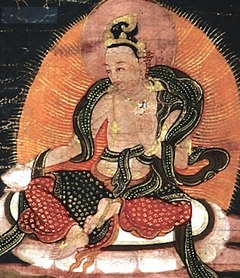
Khandro Nyingtik Catalogue
The Light of Day
A Catalogue to the Printed Edition of the Khandro Nyingtik
by Jigme Losal Özer[1]
Namo guru padmākarāya!
Your nature is utterly pure like space and devoid of all change—pure, everlasting, blissful and sublime dharmakāya;
Its expressions are unceasing like the sun and its rays—the splendour of the sambhogakāya with its seven aspects of union;
And you possess infinite nirmāṇakāya manifestations—craft, birth and supreme—like hundreds of reflections in the pools of beings’ minds;
Padmākara, universal embodiment of all the victorious ones, I rely on you as a refuge for all lifetimes: care for me auspiciously!
The sugata essence pervades all beings yet the imagined ground has the features of saṃsāra;
And the relative reality of all that appears, animate and inanimate, through the thick habits of the dependent,
When perfected through familiarity with the path of the two stages, arises as actual ultimate reality, the fruitional mode of the deity’s mudrā—
I offer reverence to Samantabhadra and consort, Vajrasattva and the maṇḍala of the infinite hosts of yidam deities, peaceful and wrathful.
Like a lord of nāgas,[2] who from the heavenly canopy of the supreme great secret vehicle
And the heavy vaporous clouds of the path of the four visions
Brought down a gentle rain of the four kāyas,
Garab Dorje arose as the splendour of teachings and beings.
With material forms matured as pure illusory bodies,
Śrī Siṃha, Jñānasūtra and Vimalamitra and the rest,
Vidyādharas of India and Tibet with the six features
Of mind-direct, sign and aural lineages, may you prevail!
And those who transformed this dark and snowy land
With the clear white moonlight of benefit and happiness—
Translators, scholars, ārya and ordinary bodhisattvas and adepts,
Remembering your kindness, I joyfully fold my hands in devotion.
Above all, when the dharma sun of the pinnacle of vehicles
Was overshadowed by the clouds of intellectual speculation,
Longchenpa brought fresh winds of experience and realization
To banish gloom and reveal the sun of accomplishment once more!
When possessing a wish-fulfilling jewel that brings liberation in a lifetime
One does not hanker after mere trinkets.
This tradition of Ancient Translations in which sons emulate their fathers
Is rightly praised as an ornament that beautifies the teachings of the victors.
Who but the ruler of Derge could ever rival
In activity the ancestral dharma kings of yore,
Those courageous guardians of the teachings
Who carried the burden of discernment?
Thus, in their sun-like splendour, this line of sovereigns
Has brought upon the lotus garden of sūtra and mantra
A gentle rain of Dharma in many magically printed copies
To grow the seed of the four kāyas in beings’ minds—how marvellous!
With these few verses of homage as a prelude, let us turn to the main subject. All that the Conqueror taught in accordance with the dispositions, faculties and temperaments of beings to be trained is included within the categories of (1) the transmitted teachings and (2) the realised teachings. The sacred Dharma of realization is that which is expressed. The Dharma of transmission, which is the means of expression, has many subdivisions, but is fundamentally of three kinds: (1) the transmission of karmic balance, (2) the transmission of the wisdom deities, and (3) the transmission of perfect non-action. The first of these is intended for those of inferior capacity. The final two were taught for the sake of those of intermediate and superior capacity. Within these categories, there are the generation, completion and non-dual stages, among which we are concerned with the latter.
In general, in the noble land of India, those who followed our Teacher mainly practised the three piṭakas, which is why the sūtras were better known. The mantra teachings were practised in secret only by fortunate disciples of the very highest capacity. When these practitioners gained accomplishment they were able to guide others, and they were generally referred to as “mantra holders, great wielders of the vajra.” The Dzogchen teachings, in particular, were highly restricted and were shared with no more than a few fortunate ones at a time.
Here in Tibet, the land of snows, through the combined efforts of the Abbot, Master and Dharma King, both sūtra and mantra spread widely. The twenty-five disciples, in particular, displayed many signs of accomplishment in mantra. As this tradition continued without interruption, plenty of distinctions came into being, such as the labels of Ancient (Nyingma) and New (Sarma) Secret Mantra, based on the period in which the lotsāwas translated the texts. Even within the Nyingma, there are traditions with the four criteria of validity[3] that have not been interrupted, such as the transmitted instructions (kama), treasure revelations, and pure visions. Among these, the Vima Nyingtik was translated by the great paṇḍita Vimalamitra and the lotsāwa Kawa Paltsek and hidden as a treasure for future generations in the Zha’i Lhakhang in Uru, where it was discovered by the elder Dangma Lhungyal. The key instructions on the Great Perfection from Padmasambhava, the master of Oḍḍiyāna, were brought together as the Khandro Nyingtik, which was transmitted to Yeshe Tsogyal, foremost of ḍākinīs, in the assembly hall of Drakkar Tedro and entrusted with the seal of aspiration to Princess Pema Sal at Chimpu. This collection was then hidden as a treasure and extracted from Tramo Drak in the Dang Valley in Dakpo by Pema Ledrel Tsal, the princess’s emanation. These two collections are known as the two mother Nyingtiks. The Lama Yangtik represents a distillation of the themes of the first collection; whereas the Khandro Yangtik is an extensive elaboration upon the second. The Zabmo Yangtik is a clarification of both the mother and child Vima Nyingtik. These five great volumes contain the sublime concentrated essence of all sūtra and mantra teachings.
In general, all vehicles correspond exclusively to the true path. However, Atiyoga or the Great Perfection, which is the summit of all, involves the direct realisation of primordial wisdom, and is therefore the actual fruition shorn of all expectation and anxiety concerning true paths. As the great Jamgön Sakya Paṇḍita said, “The view of Atiyoga is primordial wisdom; it is not a vehicle.”
In general, the mantra teachings as a whole are mostly entrusted to the hosts of ḍākinīs. And it is the ḍākinīs—whether pureland-born, mantra-born or spontaneously born—who facilitate their dissemination. That is why they have also spread extensively within this kingdom and why to this very day there has been an uninterrupted line of practitioners who have gained accomplishment.
In the past, when Jampa Kunga Sangye Tenpé Gyaltsen,[4] the Sakyong, dharma king and lama of Derge, who was the epitome of learning and accomplishment and had acquired vast knowledge, ascended the royal throne, so that benefit and happiness might accrue for the teachings and beings, power and dominion expand, and the ruler’s life and lineage increase and multiply, Tsewang Lhamo[5] had the mother and child Nyingtiks written out in gold and arranged for the Lama Yangtik and Khandro Yangtik to be printed. Regarding the continuation of such efforts, it is as The Wish-Fulfilling Vine[6] says:
Therefore, the habits from previous lives,
To which all living beings are accustomed,
Are constantly stitched together by threads
Of constant delight and do not cease to be.
As this suggests, the Sakyong and Dharma king’s son Prince Damtsik Dorje or Jigme Kunga Chemchok Choklé Nampar Gyalwé Dé,[7] possesses prodigious wisdom, both innate and acquired, regarding the precious teachings of the victorious ones, as demonstrated by his commissioning of this publication of the Khandro Nyingtik.
As already stated, through the timely maturation of the the dharma king Tri Songdetsen’s magnanimous resolve and aspirations, the great master of Oḍḍiyāna was invited to this land, and the extent to which the secret mantra spread here during the earlier and later periods was unprecedented even in the noble land India, as the glorious Jowo Atiśa observed. Within the Great Perfection in particular, through the special heart-essence of the likes of Padmasambhava, Vimalamitra, the great translator Vairotsana and the dharma king [Tri Songdetsen], there have been many, not only in India but also here in Tibet, who have dissolved their physical aggregates into bodies of light. There have even been several great accomplished masters from other traditions, such as the Sakya, Geluk, Kagyü and Drukpa, who have, aside from any nominal distinctions, practised these teachings directly and indirectly. This is something the intelligent may discern by reading such masters’ own biographies.
Conditions conducive to the spread of this teaching were provided by the supreme victor Longchen Rabjam, who was the immediate reincarnation of the original custodian Tertön Pema Ledrel Tsal. The fact that the tradition did not diminish thereafter is also due to the likes of the father and son of the Northern tradition, the omniscient lord of victors Ngawang Lobzang Gyatso,[8] the successive Zhabdrungs of Dorje Drak, Ming Terchen and his brother, and the all-knowing Sherab Özer, who was an emanation of Vairotsana. These masters securely established this tradition through their own practice and through their extensive teaching.
Here in the Kham region, the tradition has continued until today through the successive throne-holders of Katok, such as Dampa, Tsangtönpa and Jampa Bum,[9] and their students, and, above all, the lords of siddhas known as the Dzogchenpas of Kham, the successive incarnations for whom the name of the teaching was applied to the individual. Together with their heart-sons, who are likened to the sun, moon and stars, they have spread the Dzogchen tradition far and wide, ensuring that it has not diminished, by bestowing all the necessary empowerments, reading transmissions and instructions, the teachers guiding their students as if pouring the contents of one vase into another.
List of Contents
Here, this extraordinary set of teachings known as the Heart-Essence of the Ḍākinīs is arranged as set out in the inventory. Still, to facilitate the location of individual printed texts and make it easier to understand how the sections are arranged they are listed below in alphabetical sequence:[10]
ka) Inventory of the Heart-Essence of the Ḍākinīs
kha) History of the Lineage of Gurus
ga) Six Tantras of Liberation Through Wearing
nga) Commentaries on the Six Tantras of Liberation Through Wearing
ca) History of the Heart-Essence of the Ḍākinīs
cha) The Illuminating Torch Commentary on the Immaculate Essence Tantra of Essential Liberation Through Wearing
ja) Three Testaments of the Buddhas
nya) Essential Instruction on Liberation Through Wearing
ta) Outer and Inner Practices of the Sugatas of the Five Families
tha) Lamp Clarifying the Meaning of the Ripening Empowerment
da) Bright Jewelled Lamp Instruction on Empowerment
na) Structural Commentaries on the Three Higher Empowerments
pa) Appendix to the Empowerment for the Five-Ḍākinī Actualization
pha) Offering Rite for the Five Families
ba) The Garland of Principal Practice Manuals for the Ḍākinīs
ma) Empowerment Practice and Vase Practice Together with the Pure Maṇḍala
tsa) Supplement Clarifying the Meaning of Empowerment
tsha) Sequence of Empowerments and How to Bestow them as Thematic Guidance
dza) Lamp of Awareness Commentary
wa) Five Tögal Empowerments
zha) Sequence for the Ḍākinī Torma
za) Feast Offering of the Ḍākinīs
’a) Supplement to the Empowerment
ya) Notes on the Empowerments
ra) Addenda to the Secret Empowerment
la) Addenda to the Wisdom Empowerment
sha) Vital Essence of the Ḍākinī
sa) Identification of Key Time for Ḍākinī Practice Together with the Vitality-Stone Rite
ha) Treasure Vase Wealth Practice
a) Instructions on the Theme of Tögal
ki) Instruction: Mirror Illuminating the Essence
ku) Garland of Citations Supportive Instruction
ke) Practical Instruction: Mirror of Crucial Points
ko) Treatise on Signs and Treatise on the Measures of Progress
khi) Root Text of the Supplement to the Great Heart-Essence
khu) The Mirror: The Innermost Secret Heart-Essence
khe) The Yoga of the View
kho) The Yoga of Meditation
gi) The Yoga of Conduct and the Yoga of Fruition
gu) The Golden Garland of Nectar: Questions and Answers
ge) Secret Fragments of Advice[11]
go) Five-Part Crucial Instruction
ngi) Ḍākinī Path and Result Cycle
ngu) Garland of Crucial Instructions
nge) Crucial Essence of the Ḍākinīs
ngo) Vajra Fluid Imbibing
ci) Character of the Path of the Peaceful Bardo
cu) Torch of Key Points: The Wrathful Bardo
ce) The Sequence of the Signs of Absorption of the Elements During the Bardos
co) The Bardo of the Moment of Death and the Qualities of the Bardo of Dharmatā
chi) Special Tummo
chu) Chülen (Essence Extraction) Using Stones
che) Tantra of Razor Execution
cho) Sādhana of Sokdrup Nakmo
ji) Guru Yoga
ju) Outer, Inner and Secret Guru Yoga
je) Vast Openness Free from Extremes: An Introduction to Trekchö
jo) Creativity Empowerment
nyi) Separation of Pure and Impure Essences and the Means of Establishing the Family Line
nyu) Introduction to the Bardo and Direct Introduction
nye) Explanation of the Bardo’s Characteristics and the Causes of Places of Rebirth
nyo) Commentaries on the Six Minor Tantras of Liberation Upon Contact
ti) Hayagrīva Body Maṇḍala
tu) Practice of the Solitary Ḍākinī
te) Key to the Ḍākinī Mantra
to) Nectar Hand Offering[12]
thi) Guide to Signs and Progress
thu) Secret Heart Fragment: Combined Ḍākinī Practice
the) Great Ḍākinī Body Maṇḍala
tho) Pema Ledrel Tsal’s Successive Lives and Prophecy
di) Treasure Inventory and Prophecy
du) Practical Sequence for the Khandro Nyingtik
de) History Composed by Gyalwa Yungtön
do) Homage (etc.) Spoken by Yungtön
ni) Yung’s History
nu) Transference
ne) Sādhana of Dang Lha
no) Prayer
pi) Prophecy Concerning Lineage-Holding Students
pu) Long-Life Practice of the Five Goddesses
pe) Prophecy Concerning Tulku Lekpa
po) Torma Empowerment of Sokdrup Nakmo
phi) Practical Guide to the Khandro Yangtik Empowerment and Guide to Drawing the Khandro Nyingtik Maṇḍala
phu) Precious Garland History
The efforts made to publish such wish-fulfilling jewels of Dharma are extremely beneficial. As the Teacher said:
The merit of preserving the sacred Dharma
Is such that even if all the buddhas
Were to describe it for ten million aeons
Still they would not convey its full extent.[13]
The following verses are for the sake of dedicating such merit towards perfect awakening. Svasti śrīyām siddhir bhavatu!
Talk of connections to the primordial essence of enlightenment
Resounding above existence and quiescence during the summertime
Amid the cloud banks that heralds the gentle rains of liberation
Derives only from the nāga lord of the Three Precious Jewels.
With the eyes of a wisdom that is freed from the darkness of doubt,
Skilled in the means of realizing the fundamental nature of all things,
How could one ever fail to cherish this excellent approach,
The path travelled by past scholars and adepts from India and Tibet?
Numerous are the sources of light in this world,
But none can rival this treasury of illumination.
Compared to Mahāsandhi, all the other vehicles
Offer temporary freedom; few touch the genuine.
Thus, the alchemical substance of the Pith Instruction Series
Turns the base metal of beings’ minds into shimmering gold.
This is not merely designated as uniting ground and fruition.
Remember, one’s own body is transformed into its subtle essence.
With the wish-granting jewel that is this excellent path
Mounted atop the victory banner of this printed edition,
Followers of this Dharma who possess the sharpest faculties
Will undoubtedly bring a rain of siddhis for twofold benefit.
On this pile of jewel-like teachings of scripture and realization
The one who has the wisdom to proclaim the essence—
Hanumantha Samaya Vajra—[14]
Has arisen as the splendour that brings joy to the sincere.
By this cause, may the wild unruly horse of beings’ minds
Enter śamatha’s enclosure and thence proceed to vipaśyana,
And with the strength needed to reach the city of liberation,
Become a support for traversing the paths and bhūmis!
May the sunlight of the Dharma of the Illusory Prince,
Which is drawn into the nooks of individual minds
By all the philosophical systems that vary by name,
Become one vast and abiding source of illumination.[15]
Unattached to the trifling powers and riches of the world,
But with vast, sky-like knowledge of hundreds of traditions,
And support for the Supreme Essential vehicle in particular,
May the Sakyong increase their spiritual and temporal power.
May the suns with myriad rays of explanation, debate and composition
That shine upon the lotus garden of the teachings of sūtra and mantra,
Those holders of the doctrine in the sky of the teachings and beings,
Never decline, but remain resplendent for at least a hundred aeons.
May those who have made a connection through copying or carving
Or proofreading and editing these texts while using threefold analysis
Not simply aspire for the fruition of this most excellent of paths
But obtain for themselves and savour the very highest happiness.
With the ills of this world’s five-hundred period relieved,
May we celebrate a new golden age of happiness and joy;
And with noble wishes of Dharma king and prince fulfilled,
May we welcome every form of auspiciousness and fortune.
In short, through the truth of the Three Jewels
And the unchanging nature of the dharmadhātu,
The ultimate and infallible virtue, may all be fulfilled
According to our aspirations, for the sake of the teachings and beings.
When the Great Perfection’s Heart-Essence of the Ḍākinīs was published through the vast magnanimity of the precious crown prince who governs according to the Dharma and he issued the command that I should assist by editing the collection and composing its catalogue, I wore this instruction like a diadem upon my crown. And, accordingly, I, an idler called Jigme Losal Özer who claims to follow the Ancient Translation teachings, wrote this in my room at the dharma centre of Shechen Tennyi Dargyeling. Sarva maṅgalam!
| Translated by Adam Pearcey with the generous support of the Tsadra Foundation, 2026.
Bibliography
Tibetan Edition
'jigs med blo gsal 'od zer. "mkha' 'gro snying thig par du sgrubs tshul gyi dkar chag nyin mo'i snang ba." In kun mkhyen klong chen rab 'byams kyi gsung 'bum. dpal brtsegs bod yig dpe rnying zhib 'jug khang nas bsgrigs. Mes po'i shul bzhag 111. Pe cin: Krung go'i bod rig pa dpe skrun khang, 2009. Vol. 6: 287–297 (11 pages)
Other Tibetan Sources
dil mgo mkhyen brtse. "'od gsal theg rtse'i snying thig bi ma la dang / pad 'byung gi bka' srol snying thig ma bu'i smin grol rgyab brten bcas thob tshul ngo mtshar nor bu'i do shal" in gsung ʼbum rab gsal zla ba Delhi: Shechen Publications, 1994. vol. 25: 56a–76a
Secondary Sources
Ronis, Jann. "Derge Queen Tsewang Lhamo," Treasury of Lives, accessed August 13, 2025, https://treasuryoflives.org/biographies/view/Tsewang-Lhamo/13187
Tenzin Dickie, "Tamdrin Wangmo," Treasury of Lives, accessed December 22, 2025, https://treasuryoflives.org/biographies/view/Tamdrin-Wangmo/13615.
Version: 1.1–20260122
Notes
-
This is the name given in the text’s colophon. In his record of teachings received, Dilgo Khyentse ascribes this text to Pema Namdak of Shechen (zhe chen pa pad+ma rnam dag). See ’od gsal theg rtse’i snying thig bi ma la dang / pad ‘byung gi bka’ srol snying thig ma bu’i smin grol rgyab brten bcas thob tshul ngo mtshar nor bu’i do shal p. 71b. ↩
-
Reading glu dbang as klu dbang. ↩
-
Valid scripture (lung tshad ma), valid commentaries (bstan bcos tshad ma), valid teachers (bla ma tshad ma) and valid experience (nyams myong tshad ma). ↩
-
This was his ordination name. He is better known as Tsewang Dorje Rigdzin (b. 1786) ↩
-
The queen who was Tsewang Dorje Rigdzin’s mother. ↩
-
dpag bsam ’khri shing (Bodhisattvāvadānakalpalatā, Toh 4155) by Kṣemendra, a collection of stories of the Buddha’s previous lives. ↩
-
1811–1852/53 ↩
-
The Fifth Dalai Lama (1617–1682) ↩
-
dam gtsang byams gsum. Katok Dampa Deshek (kaḥ thog dam pa bde gshegs, 1122–1192), Tsangtön Dorje Gyaltsen (gtsang ston rdo rje rgyal mtshan, 1137–1226) and Jampa Bumpa (byams pa ’bum pa, 1179–1252). ↩
-
All the following title translations are provisional. ↩
-
Reading gsang dam as gsang dum ↩
-
phyag mchod usually means homage and offering. On this occasion, however, phyag is the honorific term for the hand. In other words, this is an example of the practice also known as lag mchod. ↩
-
From The Secrets of the Realized Ones (Tathāgataguhya, Toh 47) ↩
-
That is, Prince Damtsik Dorje of Derge. ↩
-
The translation of this verse is tentative, as the Tibetan of the only available edition is seemingly corrupt. ↩