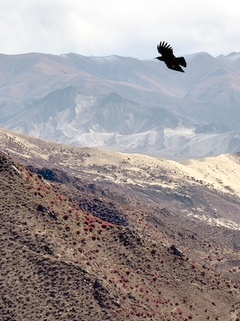
Samyé Chimpu Praise
The Blossoming Lotus of Auspiciousness[1]
A Brief Praise of the Sacred Site of the Awakened Speech
by Jokyab Pema Trinlé Nyingpo
Guided by Nāgārjuna, heart disciple of Pema Gyalpo,[2]
Who received the mandate to practice Mighty Lotus[3] at Chimpu’s Wentsa cave,
Renowned as Gyalwa Chokyang, born into the Ngenlam clan—
Mahāsiddha, who proclaimed the horse’s neigh from his crown, you I recall.
The palace of the mighty Heruka appears as a blossoming lotus;[4]
A hermitage that captivates the mind at first sight and never grows wearisome;
A sacred ground of boundless qualities, fulfilling all who connect with it—
To this source of an ocean of accomplished masters, the king and disciples, I pay homage!
The nine gaits of the nine vehicles are the distinct expression of the thirteen paths and ground.
The qualities of greatness are the qualities of the green-horse-headed one.
The Great Glorious Mother is the expression of the individual yogas.
The three neighs of ground, path and fruition are the natural sound of dharmatā.
Temporarily, may I gain mastery over long life, good health, and the ten powers.
Ultimately, may I gain mastery over the enjoyments of Sukhāvatī.
May I attain the bhūmis, traverse the paths, and master the three horse neighs.
May I become a sovereign who spreads benefit and happiness for the teachings and beings!
An aspiration prayer by Pema Trinlé Nyingpo, composed at glorious Samyé Chimpu after the completion of the feast offering on the twenty-fifth day of the fifth Monkey month. Virtue!
| Samye Translations (trans. Stefan Mang), 2026.
Bibliography
Tibetan Edition
jo skyabs padma ʼphrin las snying po. “gsung gi dben gnas la cha tsam bsngags pa bkra shis padma rgyas pa.” gsung ʼbum padma ʼphrin las snying po. Edited by Karma bde chen. Vol. 1. gzu dgon rig gzhung nyams gso khang, 2010: 28–29.
Version: 1.0–20260211
Notes
-
The author composed a praise for each of the accomplishment sites of the eight Kagyé deities, with each praise named after one of the Eight Auspicious Symbols. ↩
-
Here the author establishes a lineage of accomplishment linking the vidyādhara who first revealed the respective Kagyé deity, Guru Padmasambhava—who subsequently accomplished that same deity while manifesting in a form corresponding to it—and the original Tibetan disciple who realized the practice. ↩
-
Hayagrīva. ↩
-
A word play on the deity’s name. ↩