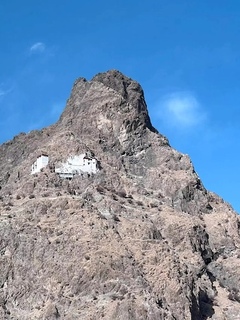
Yarlung Sheldrak Praise
The Nectar-Filled Vase of Auspiciousness[1]
A Brief Praise of the Sacred Site of the Awakened Qualities
by Jokyab Pema Trinlé Nyingpo
Heart disciple of the vidyādharas Vimalamitra and Padmasambhava,
Who received the mandate to practice Amṛtakuṇḍalī at the sacred Sheldrak cave,
Renowned as Jñānakumāra, the monk from the Nyak clan—
Mahāsiddha, who drew forth amṛta from solid rock, you I recall.
The upper regions are permanent snow-capped mountains, like a pride of snow lions.
The lower regions are mighty rivers flowing continuously, like the graceful movements of turquoise dragons.
The middle regions are meadows and gardens, a vibrant array of flowers.
To this sacred site, brimming with outer auspicious signs, I pay homage!
Here the ancestral land formed—the sunny and shaded slopes, the upper and lower reaches of Yarlung.
Here the ancestral people were born—the children of the monkey and the rock-ogress.
Here the ancestral king, Nyatri Tsenpo, descended—
To this sacred site, converging with inner auspicious signs, I pay homage![2]
Here the first castle, the Yumbu Lhakar fortress, was built.[3]
Here the first supports[4] arrived and were named “Great Mystery.”[5]
Here the first teaching—the six-syllable mantra[6]—was bestowed and spread—
To this sacred site, where darkness was dispelled and dawn first broke, I pay homage!
A land resembling the realm of gods in its formation;
A sacred place resembling Uḍḍiyāna in its distinction;
A region resembling the nāga realm in its glory and wealth—
To Yarlung Sheldrak, the very centre of this sacred land, I pay homage!
The three sites bearing the handprints and footprints of Lha Thothori Nyentsen, Songtsen Gampo, and Tri Songdetsen,[7]
The three supports of buddhas, bodhisattvas, and immortal vidyādharas,[8]
The three caves of Padmasambhava and Jñānakumāra, Vairotsana, and Rechungpa—[9]
To this field of merit for all beings of the Land of Snows, I pay homage!
Aho! Outwardly, a site of accomplishment—a perfectly arranged rock palace.
Inwardly, a celestial palace flawless in dimensions and characteristics.
Secretly, Akaniṣṭha, where the Three Roots gather like billowing clouds—
To this site of accomplishment, blazing with a hundredfold rays of blessing, I pay homage!
By merely seeing it, the four empowerments are naturally bestowed.
Accumulating merit and offering prayers here brings down a rain of siddhis.
Any connection with this site—inseparable from Guru Padma of Uḍḍiyāna—becomes beneficial.
To this site where wisdom actually manifests, I pay homage!
Liberated right upon arising, phenomena are exhausted like the rising of the stainless moon—
Fifty-five yogis realized this, the Great Perfection, at Yarlung Sheldrak.
It is the maṇḍala of the mighty Chemchok, the universal splendor of saṃsāra and nirvāṇa,
The maṇḍala endowed with the eightfold union and the sevenfold union.[10]
May we actualize the nectar of the Dharma, the realization of the equality of saṃsāra and nirvāṇa.[11]
May we actualize the nectar of substances, the equal taste of pure and impure, rejection and acceptance.
May we actualize the nectar of meaning, the realization that the five poisons are the nature of wisdom.
May we actualize the nectar of signs, the five aggregates, the five families, and the five kāyas.
May the Golden Age, where even the names of illness, strife, and famine are unknown, blossom.
May we perfect the two accumulations and shine with the six wealths.[12]
May all our thoughts be pure bodhicitta, the qualities of the paths and bhūmis.
May all our actions never be mixed with negativity, but become the conduct of the six pāramitās.
Having actualized these within our minds, may we ascend the throne of omniscience,
And may we guide all beings wandering in the ocean of existence to the isle of liberation.
May the virtuous signs of this effortlessly pervade all of saṃsāra and nirvāṇa.
May all the Victorious Ones and their heirs bring these words of truth and this prayer of aspiration to fulfillment!
At Yarlung Sheldrak, following the excellent completion of an extensive feast offering on the occasion of our Teacher’s birth,[13] when karma and constellations were in harmony, Pema Trinlé Nyingpo, who is deeply devoted to Padmasambhava, composed this aspiration prayer at the long-standing request of the supreme tulku and the recent urging of Karma Bidza. May virtue and goodness increase!
| Samye Translations (trans. Stefan Mang), 2026.
Bibliography
Tibetan Edition
jo skyabs padma ʼphrin las snying po. “yon tan dben la cha tsam bsngags pa bkra shis bum bzang bcud ldan.” gsung ʼbum padma ʼphrin las snying po. Edited by Karma bde chen. Vol. 1. gzu dgon rig gzhung nyams gso khang, 2010: 31–33.
Version: 1.0–20260212
Notes
-
The author composed a praise for each of the accomplishment sites of the eight Kagyé deities, with each praise named after one of the Eight Auspicious Symbols. ↩
-
The Yarlung Valley is a sacred and historically significant region in central Tibet, closely associated with Tibetan origin narratives, including the myth of the monkey and the rock-ogress, the progenitors of the Tibetan race, as well as the first King of Tibet Nyatri Tsenpo (c. 127 BCE), who is said to have descended from the sky. ↩
-
Yumbu Lhakar is believed to have been the first ever constructed building in Tibet, which served as Nyatri Tsenpo’s residence. ↩
-
The supports of body, speech and mind. ↩
-
Twenty-seven generations after Nyatri Tsenpo, King Lha Thothori Nyentsen (c. 374–493), received sacred texts and relics said to have fallen miraculously onto his palace, including a golden stūpa, The Basket’s Display (Kāraṇḍavyūha Sūtra) and the six-syllable mantra of Avalokiteśvara. This event marks the traditional introduction of both scriptural and material Dharma to Tibet. However, the king not knowing what these relics were named them Great Mystery (gnyan po gsang ba). ↩
-
The six-syllable mantra of Avalokiteśvara. ↩
-
Traditionally regarded as the three kings who introduced the Dharma to Tibet, they are revered as emanations of the bodhisattvas Samantabhadra, Avalokiteśvara, and Mañjuśrī, respectively. ↩
-
The three supports or three stūpas are Takchen Bumpa (rtag spyan bum pa), Göntang Bumpa (dgon thang bum pa) and Tséchu Bumpa (tshe bcu ‘bum pa), each of which houses immeasurably precious relics. ↩
-
Padma Shelpuk, Vairo Phuk (bairo phug) and Rechung Phuk (ras chung phug). ↩
-
The sevenfold union is (kha sbyor bdun): 1. complete enjoyment (longs spyod rdzogs pa); 2. union (kha sbyor); 3. great bliss (bde ba chen po); 4. no self-nature (rang bzhin med pa); 5. completely filled with compassion (snying rjes yongs su gang ba); 6. uninterrupted (rgyun mi chad pa); and 7. unceasing (’gog pa med pa). ↩
-
The practice of Chemchok Heruka aka Amṛtakuṇḍalī is traditionally presented as the knowledge of nectar (amṛta), as indicated in this verse. ↩
-
The six wealths are: long life, great power, auspiciousness, majesty and attractiveness, large retinue, and wealth. ↩
-
The anniversary marking Buddha Śākyamuni’s birth. ↩