Translator’s Introduction
Pakpa Lodrö Gyaltsen (1235–1280) was the fifth patriarch of the Sakya school and spiritual advisor to Kublai Khan. He was also a prolific author, inventor of what came to be known as the Pakpa script, and author of the first full-fledged abecedarian poem in the Tibetan language. One unique work among his oeuvre is a short poem “In Praise of the Sacred Yak” which, as its title suggests, pays homage to the most iconic animal of the Tibetan plateau. What makes this praise unique is that, at least on the surface, it is not especially Buddhist. In fact, it does not contain a single word of Buddhist terminology. Nor does it employ any Indic imagery or aesthetics. As such, it is an exemplary instance of truly indigenous Tibetan writing.
Despite Tibetan literature’s great breadth and depth, ranking as the third largest classical literature in Asia after India and China, it is occasionally denigrated as only containing works of Buddhist thought. But what makes a text Buddhist after all? Treatises on Buddhist philosophy obviously fit the bill, but other writings are less clear, the songs of Milarepa being a good example. In “Kyangpen Namkha Dzong,” Milarepa mostly describes a picturesque landscape, singing what is, in essence, a song about nature. Yet, in the final line, he declares that all the inspiring elements of the natural environment are “aids to meditative experience,” and, all of a sudden, it is a “Buddhist” poem. We can see a similar move in Pakpa Lodrö Gyaltsen’s “In Praise of the Sacred Yak.” Ultimately, though, the question of whether a Tibetan work is Buddhist is somewhat beside the point, because the language and culture of Buddhism became so ubiquitous that even works dealing with purportedly non-Buddhist topics like medicine or, in this case, a yak, reflect a larger Buddhist worldview.
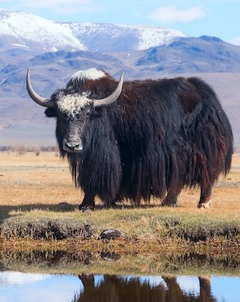
The word gön yak (mgon g.yag), translated here as sacred yak, literally means “guardian yak” and, in some contexts, can refer to yaks that have been freed through life-release practices and saved from slaughter. The poem eulogizes the sacred yak and his physical prowess from horn to hoof through metaphors rooted in the natural world. The descriptions are at once both awe-inspiring and terrifying, as they paint a picture of the yak as resembling a dark storm descending on the plateau, his eyes resembling the sun and moon. The effect is to portray the yak as an almost mythic being that is at one with the Tibetan landscape. Yet, just as he inspires awe for the yak’s noble bearing, Pakpa Lodrö Gyaltsen also instills in us a fear for the might of this otherwise docile creature by employing language of violence and destruction.
Once the reader has become intrigued by this “most marvelous of four-legged animals,” Pakpa Lodrö Gyaltsen allows us to identify with the yak by acknowledging his intelligence, stating that “Even among two-legged humans,/ There are few who rival his intelligence.” It is at this moment that, in the final couplet, Pakpa Lodrö Gyaltsen makes the aspiration that the yak might always evade the weapons of heartless men who would take his life. The reader cannot help but feel compassion for this creature who, just as we do, cherishes his life above all else. In this way, Pakpa Lodrö Gyaltsen introduces his readers to a direct and raw form of compassion without being didactic or moralizing. By eschewing the formulaic language of “limitless compassion for all beings,” the sentiment that is evoked here is somehow more real, less contrived. Therein lies the beauty and the power of this short praise.
Version: 1.0–20260204
In Praise of the Sacred Yak
by Chögyal Pakpa Lodrö Gyaltsen
His body is a mass of black clouds
Swirling violently in the sky.
Steam rises from his nostrils and mouth,
Like billowing storm clouds.
His tongue flickers like lightning
While his grunts resound like thunder.
When his dark, sapphire-like hooves
Stomp, the entire earth shakes.
The mighty thrust of his horns
Could topple even the loftiest of mountains.
The sun and moon of his eyes
Dart about between clouds in the sky.
His tail, a veritable tree trunk,
Seems capable of wiping the clouds
Out of the sky as it sways back and forth.
His grunts utterly overwhelm
Even the voices of all singers.
He is the most marvelous of four-legged beasts
That inhabit this snowy land of Tibet.
Even among two-legged humans,
There are few who rival his intelligence.
May the sacred yak always triumph
Over the blades of heartless men.
| Translated by Lowell Cook, 2026.
Bibliography
Tibetan Source
ʼgro mgon chos rgyal ʼphags pa. “mgon g.yag la bsngags pa.” In sa skya bkaʼ ʼbum. Vol 15. Kathmandu: Sachen International, 2006, pp.574–5. BDRC: MW00EGS1017151_079E1A.
Secondary Sources
Drogön Chogyal Phagpa. “Praise to the Lord Yak.” Translated by Lhamo Kyab. Yeshe: A Journal of Tibetan Literature, Arts and Humanities 3, no. 1 (2023).
ʼPhags-pa Blo-gros-rgyal-mtshan. “Exaltation of Guardian Yaks.” In At the Court of Kublai Khan: Writings of the Tibetan Monk Chogyal Phagpa, translated by Christopher Wilkinson. Cambridge: Christopher Wilkinson, 2015.
Version: 1.0–20260204