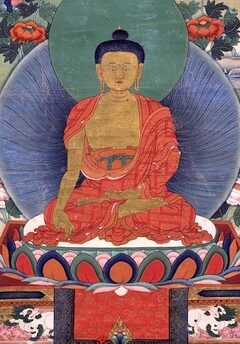
Dispelling the Anguish of Sincere Seekers
English | Français | Italiano | བོད་ཡིག
Dispelling the Anguish of Sincere Seekers
The Words of the Guru, the Gentle Protector on How to Accomplish the Yogas of Śamatha and Vipaśyanā
by Dilgo Khyentse Rinpoche
Namo guru śākyamunaye![1]
When training in the yogas of śamatha and vipaśyanā by focusing on the form of our Teacher, Lord Buddha, first embrace precious bodhicitta—the aspiration to attain buddhahood for the benefit of all sentient beings—and reflect as follows:
“Now that I have attained a well-favoured human life—this precious support of the freedoms and advantages—and encountered the Tathāgata’s teachings, I will relinquish all worldly activities—pursuits that yield only bitter fruit. Though making offerings to the Tathāgata’s form and similar practices do indeed generate immeasurable merit, such accumulations of merit based on material wealth were advised by the Tathāgata primarily for householders. For renunciates following in his footsteps, Buddha praised a far superior path—that of discipline and genuine inward resting. Therefore, in accordance with the Tathāgata’s words, I will practice these to the best of my ability.
“In particular, since time without beginning, we have been disturbed by conceptual constructions, like ever-shifting wind, clouds, and ocean waves. Day and night, without cease, these thoughts have agitated and undermined us, so that not only have we failed to attain a single excellent quality, but we have been plagued by endless suffering.
“Now, I will do whatever it takes to break free from this cage of conceptual constructions, which beset me from within and without. Taking as my focus the Tathāgata’s form—an object of such great merit and meaning that even a single moment’s focus upon it is transformative—I will properly cultivate the yogas of śamatha and vipaśyanā.”
With a fierce resolve and one-pointed intent, pray, “Guru, victorious ones and your heirs, grant your blessings so that I may succeed!” First of all, remove yourself from the clamour of activity. In a place free from the thorns of meditation, such as the bustle of people during the day and din at night, sit on a comfortable seat and assume the meditation posture. Take the preliminary practices deeply to heart.
Then place before you a beautiful and captivating image of the Tathāgata, the King of Śākyas. The image should be produced by a skilled artist according to traditional proportions and so on, and should be a handspan high, or whatever size is comfortable to gaze at.
Filled with devotion, recall the Tathāgata’s blessings and consecrate the image by reciting the Essence of Causation mantra. Place the image neither too near nor too far away, but at a distance that allows you to rest your gaze comfortably slightly below eye level.
Look upon the image as if it were the Tathāgata in person, and think, “The Tathāgata appears in the world as a result of boundless, inconceivable accumulations of merit and wisdom—his appearance is as rare as that of the uḍumbara flower. Since the Tathāgata is perfectly adorned with the thirty-two excellent marks and the eighty excellent signs, there is nothing displeasing in beholding him.
“In the world of gods and men, the rūpakāyas appear with a vivid, steadfast clarity and are seen in common by all the sentient beings of that time as they teach the Dharma and display a great array of miracles. For the benefit of those to be trained, they display various modes of conduct, such as walking, travelling, standing, and reclining, thereby bringing countless beings’ sources of virtue to fruition.
“Our teacher, Buddha Śākyamuni, Lion of the Śākyas, was born into the royal line of Śākyas and later attained enlightenment, after which, at Vulture Peak and other places, he taught the Dharma to vast assemblies of bodhisattvas, śrāvakas, and ordinary beings.”
Bringing to mind these extraordinary qualities and attributes, think, “This is what this Tathāgata looks like—this is the shape and appearance of his form. The Tathāgata is the embodiment of discipline, samādhi, insight, complete freedom, the realization of the wisdom of complete freedom, and so on. He possesses inconceivable immaculate qualities—qualities so vast they overflow even the boundless reaches of space.”
Embracing us all with great love, for our benefit he undertook countless hardships, as you should learn about from the supportive teaching for The Treasury of Blessings,[2] which tells, for instance, of how as Brahmin Samudrarāja he generated bodhicitta, and so forth. Thus, over three countless aeons, by training in the six pāramitās he gathered inconceivable and indescribable accumulations of merit and wisdom. In this way, he freed himself from all obscurations, conquered the four māras, completely perfected all awakened qualities, and achieved the kāya of great omniscient wisdom.
Thus, he became the unsurpassable refuge, protector, and friend of all sentient beings until the end of time. The virtue created by recalling the Blessed Buddha, paying homage to him, uttering his name, beholding his form, resting your mind one-pointedly upon it, and so on, however slight it might be, will become the cause for supreme awakening. Think, “This is all thanks to the power of the Tathāgata’s past aspirations and inconceivable wisdom—how incredibly fortunate we are!” And generate within yourself tremendous faith by recalling Buddha in this way.
Then, with mindfulness and vigilance intact, anchor your mind upon the appearance of the Tathāgata’s form. Do so gently—neither too tight nor too loose—maintaining a continuous flow of awareness.
Distancing yourself from every thought but this, your chosen object of focus, settle your attention exclusively upon Buddha’s form. Continue training like this as much as you can, until you can rest one-pointedly without cease. In short, persevere until you attain, step by step, the nine stages of resting the mind and achieve the one-pointed mind of the desire realm.
You can gaze upon and focus on Buddha’s body as a whole. Alternatively, direct your attention to specific parts of his form. For instance, to obtain noble qualities and remedy dullness, focus on the uṣṇīṣa (crown protuberance), whose limit cannot be seen. To attain concentration and remedy agitation, concentrate on the glorious knot of enlightened mind at Buddha’s heart centre. To accumulate great merit and gain happiness, focus on the appearance of the coil of hair between Buddha’s eyebrows, white as snow, white as a conch, and curling to the right. To make the melodious sound of Dharma pervade the whole world, and to benefit sentient beings through teaching the Dharma, focus your mind on Buddha’s throat, the source of the sixty qualities of melodious speech, the conch of Dharma marked by three lines. Thus, focus on whichever part of Buddha’s form inspires you.
When you begin to focus your mind like this, it is like trying to catch a snake—the mind is incredibly wild and unruly. As such, this first stage of meditation is called the experience of movement and is likened to a waterfall. At this point, you have the impression that your mind is in constant motion. As Buddha taught in The Tantra of Subāhu’s Questions:
The mind is like lightning, clouds, and the wind;
It is similar to waves upon the great ocean.
It is deceptive and delights in desirable things;
It wavers and wanders and needs to be tamed.[3]
Spur yourself on, thinking, “All sentient beings are held in the grip of an utterly distracted mind. Therefore, I will not succumb to laziness, but will persevere, come what may. For if one perseveres, there is nothing one cannot achieve.” Thus, train diligently, maintaining your focus for as long as you can.
By persevering in this way, the monumental, coarse, unruly thoughts that once raged so fiercely will gradually begin to subside. Yet there remains a flux of diverse thoughts, a churning stream of restless mental activity. This is known as the second meditative experience of attainment, likened to a river flowing through a narrow canyon. This example is used because, although such a river is still turbulent and loud, it moves more slowly than a waterfall.
If you do not let your diligence wane but continue to practice, your thoughts will seem to settle and your focus will appear steady. However, if you look more closely, you will discover a continuous stream of subtle thoughts. This is the third experience of familiarisation, likened to a gently flowing river. For when you look at such a river from afar, it seems to be still and you cannot tell that it is moving, but when you get up close you see that it is flowing and rippling a little.
From this point on, if you do not let your diligence wane but continue to strive, you will be able to progress with far less hardship than before. Therefore, exert yourself unceasingly. By practicing in this way, even the movement of subtle thoughts will be quelled, and so long as you maintain the intention, you will be able to sustain your focus for as long as you wish. However, you are not yet impervious to circumstances. This is the fourth meditation experience of stability, likened to an ocean free from waves. For at this point, the mind is still and stable.
Once you have reached this point, if you sustain it, you will arrive, without much difficulty, at the fifth meditative experience of perfection, likened to a mountain. This is the state of effortless engagement. Here, the mind naturally merges with its object and, without the need for effort, naturally remains steady for as long as you wish. Thoughts no longer have the power to unsettle the mind. With this, the one-pointed mind of the desire realm is attained.
At this point, various experiences born of such stillness will arise. As you become habituated to this state, body and mind attain what is known as “suppleness.” Once they have become pliable in this way, you may settle your attention upon any object and remain for days on end without the slightest sense of physical or mental fatigue. The body becomes as light as cotton wool, and the mind is suffused with the bliss of vivid clarity.
At first, this suppleness is coarse and heavy, with a sense of solidity. But with familiarity, such heaviness fades, and there arises an unwavering śamatha—extremely subtle and clear, like a shadow—resembling the main part of practice. This kind of meditation attains the name “śamatha,” since it is a mind endowed with suppleness. It also corresponds to the capable preparatory stage of the first meditative absorption. There is nothing that this form of meditative concentration cannot accomplish—be it meditation with a conceptual focus or without concepts, as in meditations on emptiness and the like.
While there are many ways to enumerate the aspects involved in accomplishing śamatha, such as the four mental engagements and the six powers, they are all essentially contained in the following maxim: anchor the mind, as best you can, upon the focal object with mindfulness and vigilance, and as you familiarise yourself with this, the five meditation experiences will naturally unfold. When śamatha is mastered in this way, the power of the mind’s pliancy transforms the body, imbuing it with a radiant complexion, vitality, and ease, making it comfortable and strong. The mind, too, becomes limpid and luminous, and can be directed effortlessly to any object. Both body and mind are suffused with boundless joy and bliss, the afflictions fade, and one experiences a delight that mirrors the exquisite joy of inner solitude.
By the strength of the merit of practicing in this way, taking Buddha’s form as your focal object, and through Buddha’s blessings, you will come to behold Buddha, receive Dharma teachings, and so on, whether in actuality, in meditative experiences, or in dreams. In this way, all manner of excellent qualities will take birth in your mind.
Once you have accomplished śamatha in this way, you should begin the practice of vipaśyanā. When first practicing śamatha, you settled the mind using an image of Buddha’s form as a support; or, in the absence of such a support, you settled the mind upon a mental image of his form. Regardless of the method chosen, once śamatha is truly accomplished, Buddha’s form will appear vividly before the mind—even without a physical support—as a manifestation of meditation.
At first, this form appears vividly and steadily within the mind, like a reflection in a mirror. As you become more deeply familiarized with it, it appears before your very senses as if physically present. If you continue to familiarize yourself with it, the image becomes perceptible to the senses of others as well. Thus, it is said that clarity first arises as a mental object, secondly as a sensory object, and thirdly as an object of touch—just as taught in the manuals on approach and accomplishment of the Early Translation school.
You should begin the practice of vipaśyanā once you have accomplished the first level of clarity. Consider how Buddha’s form, endowed with the awakened marks and signs—beautiful, captivating, vivid, and steadfast—now appears as a mental object, as if actually present. This is merely the manifestation of habits imprinted in your mind. It has not come from anywhere, nor does it go anywhere. When examined, it is empty; it is not found anywhere at all, neither inside nor out. It depends on the mind and appears entirely through the interdependence of habitual imprints, nothing more. Furthermore, the mind to which it appears, when examined, is not found anywhere, neither inside nor out; when mind itself is devoid of any basis or origin, what need is there to speak of what appears to it? Thus, this appearance of Buddha’s form lacks even the slightest trace of true nature.
In the same way, buddhas appear in this world through the interdependent power of two factors—the virtue stemming from beings’ pure intentions and the great aspirations made by the buddhas of the past—just as a reflection appears in a clear mirror. Yet, although this appearance is infallible within the experience of worldly beings, the Tathāgata possesses not even a trace of ordinary aggregates, elements, or sense-sources. For he is the utterly unfathomable wisdom kāya, equal to the dharmadhātu, the basic space of phenomena. From The Ornament of the Light of Wisdom Sutra:
Through virtue inexhaustible, the Thus-Gone One
Appears as a reflection of the truth; yet, in truth,
There is no “thusness,” nor any Thus-Gone One.
Throughout the world, they appear as reflections alone.
And from The Samādhi of the Direct Presence of the Buddhas:
The Buddha is a projection of awakened mind;
Mind itself is pristine and innately luminous.
Stainless and unmingled with the world of wandering beings,
Whoever knows this shall awaken into supreme buddhahood.
We must examine these truths with insight and come to understand them. Having done so, we will see that just as it is with the Tathāgata, so too it is with all the phenomena of appearance and existence—everything contained within the aggregates, elements, and sense-sources. Though they appear and are experienced through the power of interdependence, they are mere appearances arising solely from the interaction of their respective causes and conditions. When examined, not so much as a single atom of inherent nature can be found. Like a magical illusion or the phantasms of a dream, there is in reality no coming or going, no arising or ceasing, and so on whatsoever.
Nevertheless, childish ordinary beings cling to appearances as though they were real. Having relinquished discernment, they perceive arising, ceasing, and all the rest as truly existent. Just as a person with clouded vision has no sense that the floating hairs they see are merely adventitious and should be removed, our minds have been tarnished since time without beginning by the cataracts of ignorance. Consequently, we remain blind to the way things genuinely are.
From the perspective of those who have realised the way things genuinely are, however, there is no need to abolish appearances. For they can see that while things appear, they possess no inherent reality whatsoever. Seeing this, they realise that all phenomena are naturally and primordially unborn. From The Questions of the Nāga King Anavatapta:
That which arises from conditions is unborn —
It has no intrinsic essence of arising.
That which depends on conditions is taught to be empty.
One who understands emptiness is heedful.[4]
From the Mother of the Victorious Ones, The Perfection of Wisdom:
All phenomena are like dreams and illusions. Nirvana too is like a dream and illusion. If there were any phenomena superior to nirvana, that too would be like a dream and illusion.
From The King of Samādhis Sūtra:
Just like optical illusions and fata morganas,
Just like dreams and just like illusions,
When their attributes are meditated on, their nature is empty.
Know that all phenomena are like that.[5]
And from The Root Stanzas of the Middle Way:
Like a dream and like a mirage,
Like a city of gandharvas,
So arising and abiding
And cessation have been taught.[6]
Thus, no matter how Buddha’s form appears to the mind, every act of focusing upon it is primordially devoid of inherent existence. All phenomena are the same, ourselves included. Whatever is our own true nature is the nature of the buddha; and whatever is the nature of the buddha, that is the nature of all phenomena. From The Ornament of the Light of Wisdom Sūtra:
Phenomena, permanently unborn, are the Tathāgata.
All things are like the Sugata.
But those with childish minds, who grasp at signs,
Dwell in a world of things that do not exist.
From The Condensed Prajñāpāramitā:
Know all beings to be as you are yourself;
Know all things to be as all beings are.
To conceptualize neither birth nor non-birth—
This is the practice of supreme Prajñāpāramitā.
And from The Root Stanzas of the Middle Way:
Those who have conceptions of the Buddha,
Who, beyond conception, is unbounded,
Are blinded by those very concepts;
They do not behold the Tathāgata.The nature of the Tathāgata
Is the nature of this world of beings.
The Tathāgata is without intrinsic being;
This world of beings is without intrinsic being.[7]
In the ultimate nature of things, all phenomena are equal within the dharmadhātu—the basic space of phenomena that transcends every web of conceptual complexity, such as the notions of birth and non-birth. From The Questions of Sāgaramati Sūtra:
This Dharma is immaculate, pure, virtuous, and naturally luminous.
It is space-like and primordially unmanifest.
It is unborn, non-arising, baseless, and unceasing.
Thus is the unwavering, immaculate seal of the victors.[8]
From The Mahāvaipulya Sūtra “A Multitude of Buddhas”:
The path of the great sages is subtle, difficult to understand,
Inconceivable, beyond concepts, and difficult to reach.
It is clearly known by those with expert knowledge.
Its nature is peace; it is without cessation or origination.Its nature is empty, tranquil, nondual, and unending.
It is liberation from existences, the attainment of equality.
It has no middle or end; it cannot be described in words.
It is liberated from the three times and is the same as space.
In the words of Noble Rāhula:
Beyond words, beyond thought, beyond description is the Prajñāpāramitā,
Unborn, unceasing, of the nature of space,
To be experienced as the wisdom of our own awareness—
Homage to the mother of the buddhas of past, present, and future!
As the protector Nāgārjuna taught:
It is not known through other sources; it is peace;
And not through mind’s construction can it be constructed;
It is free of thought; undifferentiated:
This describes the character of suchness.[9]
Accordingly, the practitioner who has gained certainty in thusness, which transcends every description, conceptual web, and point of reference, should first train in the samādhi that perceives all phenomena as illusions. Meditating on the illusory nature of the Tathāgata’s form, they should gaze upon Buddha’s body and, while listening to the Dharma and so forth, train in the magical display of these illusory experiences.
If the practitioner then rests in ineffable equanimity—the emptiness to be realized by one’s own natural awareness—they will attain that receptivity to reality which is in perfect accord with the Dharma. Owing to this, there is no doubt that before long the practitioner will manifest the wisdom of the path of seeing. This is clearly explained in the pith instructions for internalizing the meaning of The Samādhi of the Direct Presence of the Buddhas and the Single Array Samādhi.
Even those who are unable to practice in such a profound manner should constantly engage in the yoga of recollecting the Teacher, the Lord of Sages, as taught in The Treasury of Blessings: A Practice of Buddha Śākyamuni. Vividly bring to mind the visualization for taking refuge and generating bodhicitta, and with a steadfast pledge rooted in certainty, recite these lines three times:
In the Buddha, the Dharma and the Supreme Assembly
I take refuge until I attain enlightenment.
Through the merit of this meditation and recitation,
May I attain buddhahood for the benefit of all beings.
After cultivating the four immeasurables, rest in the illusory union of emptiness and interdependent appearances, and recite, “Āḥ! As the union of unborn emptiness…” and so forth.
Clearly evoke the visualization described in the liturgy. With unwavering faith and the conviction that Buddha is present before you, engage in the practice by which bodhisattvas, expert in skilful means, gather the accumulations of many eons in a single moment of mind—the seven branches of homage and the rest that distil the key points of accumulation, purification, and increase. To avoid squandering your hopes, supplicate Buddha with confidence and pray for the fulfilment of your wishes, as taught in the main text.
Then, with one-pointed faith in the Buddha Bhagavāns, bow before them with bodies as numerous as the atoms of the world and offer every appropriate gift. With whole-hearted aspiration, thinking, “Until I attain unsurpassable enlightenment, I and all sentient beings take refuge in you,” recite Buddha’s names—“Supreme Teacher, Bhagavān…”—as many times as you can.
Finally, as you recite the dhāraṇī to invoke the Tathāgata’s wisdom-mind, imagine that brilliant rays of light stream forth from his body, filling the entire expanse of space. As this light dissolves into you and all sentient beings, envision that all obscurations and sufferings are cleared away, and you are filled with every happiness. All the noble qualities of the Mahāyāna path—faith, retention (dhāraṇī), samādhi, eloquence, insight, wisdom, and so forth—arise in full within your mindstream. You are thus transformed into one destined for awakening, traversing the levels of non-return until you reach consummate, unsurpassable awakening. Recite the mantra as many times as you can.
From The Teaching on the Effulgence of Light, the eleventh chapter of The Heap of Jewels:
I have achieved those various lights
Since I have abandoned delusion
Through the causes and conditions
Of inconceivable virtuous actions.[10]
And:
In the same way, I fulfil the wishes of beings
In accordance with their inclinations,
By manifesting lights of countless colours
Through the power of nonaction.[11]
From a single ray of light, two colours appear, multiplying exponentially until a limitless variety of light rays stream forth. Among them are those named Pristine Shining Cloud, and Pure Eye, Pure Ear, and so on, through to Pure Mind. Likewise, there are the rays of Pure Form and so on, through to Pure Phenomena; Pure Earth through to Pure Space; as well as those of Pure Aggregates and so on, Pure Truth and so on, and Pure Eloquence and so on. Some are known by their colours, such as White and Yellow; others bear names of majesty, such as Supreme Virtue, Nāga’s Splendor, Elephant’s Splendor, Flourishing Lion, and Flourishing Supreme Nāga. There are the rays Nāga-Subduing, Yakṣa-Taming, and the like; Vajra-Strength, Emptiness, and others; and the ray of Perfected Primordial Virtue—each one beaming forth distinctly.
The light ray known as Dharmatā causes tens of millions of buddhafields to tremble. The ray named Subduer of Māra strikes terror into the demonic hosts. Merely to hold in mind the name of the Victory Banner of Merit is to cast off all harm; to hold the name of the Victory Banner of Might is to vanquish every foe; and to hold the name of the Victory Banner of Perfect Peace is to relinquish all desire, and so on.
Indeed, simply recollecting these names is enough to abandon sexual misconduct, distorted discipline, and all other faults. Merely remembering any of these light-rays is enough to perfect discipline and concentration, dispel the darkness of delusion, and bring all afflictions to an end. In this way, one attains lasting happiness and freedom from anguish, transcends all conceptual complexity, and awakens noble qualities, such as the primordial wisdom that knows the three times.
Each light ray, such as Sorrowless, is accompanied by a further retinue of eight thousand billion. It is taught that through this vast array of light rays—more numerous than the atoms of the universe—the Tathāgata brings sentient beings to full maturity and perfectly fulfils their every hope.
From The Collected Teachings on the Bodhisattva:
The radiance of the buddhas is limitless,
An inconceivable net of rays
Spreading in all ten directions
Throughout the endless sea of fields.[12]
Furthermore, you should reflect upon the points taught in the Avataṃsaka Sūtra and the “Bhadraśrī” chapter of the The Dhāraṇī of the Jewel Torch Sūtra, and similar texts.
In this present context, by engaging to the best of your ability in the yogas of śamatha and vipaśyanā as taught above, you will accomplish at least an approximation of genuine śamatha and vipaśyanā.
As you bring your sessions to a close, offer maṇḍalas, praises, and supplications, dedicate the virtue, and make whatever aspirations are fitting. There is no need to request Buddha to depart or to dissolve the visualization, for wherever you focus upon Buddha’s form, he is truly present. Within the space-like kāya of equanimity, there is no coming or going, no waxing or waning. Thus, you may recollect Buddha at any time and in any place.
Between sessions, exert yourself in the wellsprings of virtue as much as you can—reading the various sūtras, performing prostrations, making offerings, circumambulating, and so on. Even if you are unable to do these, remain mindful of Buddha and contemplate, again and again, the truths of impermanence, suffering, emptiness, and no-self, as well as the perfect peace of nirvāṇa.
When lying down to rest, continue your practice for as long as you remain awake. As you drift into sleep, visualize the luminous presence of Buddha’s form pervading all of space, and let your mind rest in the perception of light.
From The Dharma Instruction “Distinctly Ascertaining the Meanings”:
“Among those, bhikṣus, what is the cultivation of samādhi that, once it is practiced, cultivated, and repeated, brings about the obtainment of the vision of awareness? Here, bhikṣus, a bhikṣu has well and properly grasped the perception of light…. Just as, indeed, bhikṣus, during the last month of summer, at midday on a cloudless day free of any impediment to light, everything appears very clearly, bright and luminous, and untouched by darkness, in the very same way, bhikṣus, a bhikṣu has well and properly grasped the perception of light; he has placed it well in the mind, practiced it well, and thoroughly penetrated it. He cultivates a mind sustained by the perception of daylight, with the same brightness: as by day, so by night; as by night, so by day; as in front, so behind; as behind, so in front; as below, so above; as above, so below. Thus, with an open and unbound mind sustained by the perception of daylight, he cultivates a mind with the same brightness. This is the cultivation of samādhi that, once it is practiced, cultivated, and repeated, brings about the obtainment of the vision of awareness.”[13]
In this way, persevere as much as you are able in the practice of recollecting the Lord of Sages, and with wholehearted sincerity dedicate every root of virtue to the attainment of unsurpassable, perfect awakening.
By exerting yourself in this manner—resting in the union of illusory relative appearances and ultimate freedom from complexity—your mastery of śamatha and vipaśyanā will bring forth the extraordinary qualities of the path, such as beholding Buddha, hearing the Dharma, and so on. Even those who engage in a mere semblance of this practice will receive an array of blessings and accomplishments, and in their dreams, such auspicious signs as seeing the Tathāgata will arise.
Moreover, the auspicious and inauspicious signs that appear in dreams are discussed in The Noble Sūtra of the Fourfold Accomplishment, where Mañjuśrīkumārabhūta explains to the god Śrībhadra:
“These four dreams are consequences of the bodhisattvas’ obscurations: seeing a dirty well yet still seeing the moon at the bottom; seeing a muddy pond, pool, or well yet still seeing the moon at the bottom; seeing the moon although the sky is cloudy; and seeing the moon although the sky appears shrouded in wind, dust, and smoke.
“These four dreams are consequences of the bodhisattvas’ karmic obscurations: seeing oneself fall from a high cliff into an abyss; seeing a road with highs and lows; seeing oneself set out on a narrow roadway; being lost in the dream and seeing many terrifying things.
“These four dreams are consequences of the bodhisattvas’ afflictive obscurations: seeing someone convulsing due to a strong poison, hearing the call of a large pack of vicious predators, seeing oneself living among rogues, and seeing one’s body and clothing covered with filth.
“These four dreams are consequences of the bodhisattvas’ attaining dhāraṇī: seeing a great treasure chest filled with many jewels, seeing a pool filled with blooming lotus flowers, seeing oneself finding a bundle of white cloth, and seeing a god with a parasol being held over his head.
“These four dreams are consequences of the bodhisattvas’ attaining absorption: seeing an attractive girl with beautiful jewellery who offers worship by scattering flowers, seeing a flock of pure white swans flying in the sky and calling out, seeing the hand of the luminous Thus-Gone One being placed on the top of one’s head, and seeing the Thus-Gone One seated on a lotus and engaged in concentration.
“These four dreams are consequences of the bodhisattvas’ seeing the Thus-Gone One: seeing a moonrise, seeing a sunrise, seeing a lotus flower opening, and seeing the lord of the Brahmā realms in the posture of utter quiescence.
“These four dreams are consequences of the bodhisattvas’ particular characteristics: seeing a great sāla tree that is full of brilliantly coloured leaves, flowers, and fruits; seeing a metal bowl filled with gold; seeing the sky filled with parasols, banners, and standards; and seeing a great universal emperor.
“These four dreams are consequences of the bodhisattvas’ taming Māra: seeing a great champion overcome all of the enemy’s champions, raise a standard, and advance; seeing a great hero defeat an army and then advance; seeing a king being consecrated; and seeing oneself sitting at the seat of awakening and taming Māra.
“These are the four corresponding dreams that are signs of the bodhisattvas’ non-regression: seeing a white diadem affixed on one’s head, seeing oneself making unstinting offerings, seeing oneself seated on a great Dharma seat, and seeing the Thus-Gone One sitting at the seat of awakening and teaching the Dharma.
“These four dreams are consequences of the bodhisattvas’ attainment of the seat of awakening: seeing a vase; seeing oneself surrounded by blue roller birds; seeing that wherever one goes, all of the trees first reach upward, then bow and pay homage; and seeing a bright golden light.”[14]
Having understood the auspicious and inauspicious signs of dreams as described, rely on the skilful means for clearing away faults and accomplishing excellent qualities.
In The Seal of the Dharma, it is taught that signs of genuine purification through remorse include seeing Buddha appear, feeling him touch the crown of your head, rays of light radiating out, and seeing flowers, and so on. Other sūtras likewise teach that if you see lotus flowers in your dreams, your aim has been accomplished.
The Sūtra on Liberation explains that the dream signs of having purified misdeeds include wanting to cross a vast river and then crossing over a bridge, being bathed by others, and rain falling upon your body. These are all signs of complete purification. Joining and sitting among a great assembly of ordained saṅgha, and entering a stūpa or temple and seeing images of the buddhas and bodhisattvas are signs of following in the footsteps of the Buddha and Dharma. And if you dream of finding and eating fruit, you will accomplish excellent qualities in this very life.
It is taught that even a single such dream signifies the purification of one of the five evil deeds of immediate fruition, while five such dreams indicate the purification of all five. This should also be understood in light of the “The Teaching on Dreams” chapter from The Heap of Jewels, and other such texts.
While the sūtras teach various practices for bodhisattvas at the time of death, such as the eleven perceptions, the essential points are contained in The Noble Sūtra of Wisdom at the Hour of Death. There it is taught that, as death approaches, a bodhisattva should meditate upon this wisdom in the following way: whenever the thought arises, “I am dying,” visualize the guru, the Lord of Sages, upon the crown of your head and arouse a fierce and powerful faith. Then reflect as follows: “It is not I alone. All sentient beings are subject to the law of death; none are exempt. Though we have wandered through countless births and deaths in saṃsāra, we have gained nothing but suffering. All those deaths were utterly without purpose—but now I will ensure that this death of mine is imbued with meaning.”
Having reflected thus, consider how there is not a single conditioned phenomenon—whether internal or external, of the past, present, or future—that is not subject to impermanence, whose nature is not to arise and cease in each passing moment. Within the realm of the conditioned, there are phenomena that vanish in a heartbeat, like bubbles on water or a flash of lightning in the sky, and there are those that endure for eons, such as the universe, and only cease to be after a long period of time. Yet whether they remain for a fleeting moment or an age, all conditioned things must eventually cease; none of them are eternal.
The entire universe—the environment and its inhabitants—is destined to disintegrate. If even the Tathāgata demonstrated death by passing into nirvāṇa, what need is there to speak of beings like us?
As the Tathāgata proclaimed, “Everything conditioned is impermanent.” Failing to understand this, sentient beings recoil from death and separation while delighting in birth and gathering. Thus, they continue to circle in saṃsāra again and again. But as for me, I shall take this death as a virtuous spiritual friend. From the very depths of my heart, I will realize the impermanence of all conditioned things; I will resolve this with absolute certainty.
At the hour of death, dwell earnestly upon this thought: “In all my future lives, until I reach the heart of awakening, may the recognition of impermanence free me from all attachment to the conditioned world. Guru, Lord of Sages, victorious ones and your heirs, I supplicate you: grant your blessings that this may be so.”
Then, as taught in The Noble Mahāyāna Sūtra “Wisdom at the Hour of Death":
“Since all phenomena are naturally pure, One should cultivate the clear understanding that there are no entities.
“Since all phenomena are connected with the enlightened mind, One should cultivate the clear understanding of great compassion.
“Since all phenomena are naturally luminous, One should cultivate the clear understanding of nonapprehension.
“Since the mind is the cause for the arising of wisdom, Do not look for the Buddha elsewhere.”[15]
Using one’s own death as the catalyst, first consider how all sentient beings throughout the infinite reaches of space take the impermanent to be permanent and the sorrows of saṃsāra to be happiness, and thus endure the cycle of death and rebirth and limitless shades of suffering. Generate a heart of great compassion and think, “To liberate them all from the sufferings of birth, ageing, sickness, and death, and to establish them in unsurpassable, perfect awakening, may I become a protector of the three worlds, a buddha bhagavan! May I free all beings from their endless suffering!” In this way, cultivate great compassion imbued with bodhicitta.
In the same way, using this death as your exemplar, examine all phenomena and you will find that their very nature is empty. It is only through the power of our conceptual constructs—through mere mental projection—that we create joy and sorrow, benefit and harm. In the ultimate state, there is no such thing as death or suffering. Resolve with certainty, “All phenomena are unreal!” and dwell in that reflection.
Likewise, all these phenomena, including death, have no established identity whatsoever, yet they appear unceasingly in all manner of ways—an array of illusory manifestations. When scrutinized, they are inexpressible, transcending the extremes of existence and non-existence. By nature, they are ungraspable and luminous.
Therefore, one’s mind—neither an entity nor a non-conceptual thing—is primordially luminous. In present direct awareness, all the phenomena of saṃsāra and nirvāṇa are of equal taste. Resolve, therefore, that the wisdom-mind of the Teacher, Lord of Sages, and your own mind are indivisible within the state of self-existing wakefulness—the true nature of the mind.
If you sustain that state without distraction, and thus gain confidence and certainty in it, that is the realization of the true nature of your own mind. Beyond this, there is no other so-called “Buddha” to be found.
In this state, there is neither death nor birth. Death and the like are mere concepts; in the innate nature of mind, free from concepts, birth and death are not established in any way. If you pass away while resting in this state, you will be reborn in a buddhafield without experiencing the delusion of the intermediate state.
If you do not have that level of confidence, however, but remain mindful of the guru, the Lord of Sages, at the time of death and throughout the intermediate state without forgetting, that alone will be enough to ensure your rebirth in a pure realm.
Moreover, no matter what terror or suffering you encounter in this life, if you remember Buddha, you will certainly be freed from all adversity. Whatever happiness and good fortune you enjoy, know it to be the great kindness of Buddha and, visualizing your enjoyments as an ocean of Samantabhadra’s offering clouds, offer them to him.
Constantly reflect on the meaning of the three liberations, the six pāramitās, and other profound points Buddha taught. With great compassion for all sentient beings, generate bodhicitta, and train to the best of your ability in the way of the bodhisattvas.
Thus to recall the Teacher is of utmost importance, for it is by recalling Buddha that we first set out upon the bodhisattva paths. The benefits are beyond measure, as it is this that gives rise to all the noble qualities of the path.
In these times, when most people are preoccupied with the rituals and liturgies of their own particular schools, few truly revere the Teacher, the Lord of Sages. Yet those who have entered this path and still fail to recognize the Teacher as supreme surely lack discernment. Why? Because it is solely through the Teacher’s compassion in demonstrating his enlightened deeds for us wandering beings of this degenerate age that any of these teachings have appeared at all. This includes not only the three piṭakas, but all the teachings, up to and including the Secret Mantra Vajrayāna, through which the unified state of no-more-learning may be realized in a single, short lifetime in this degenerate age. Furthermore, it is only through his compassion that the holders of these teachings exist—the noble saṅgha of realized beings who have entered the gates of sūtra and mantra.
Had the Teacher not radiated the light of the Dharma in this realm at this time, we would not be able to hear even the name of the Three Jewels—let alone practice the paths of sūtra and mantra. Therefore, whichever tradition we follow, whether of the New Schools or the Old, to maintain intense and unwavering faith that regards the Teacher as supreme is indispensable at all times. We must, therefore, remain deeply devoted to the Teacher and persevere in this practice.
Some people might think, “If we feel devotion for Buddha in another form—perhaps as a renunciate free from attachment, or as a peaceful or wrathful yidam—what difference does it make?” In essence, there is no difference, since all buddhas are the wisdom-kāya of perfect equality, and there is no distinction in their qualities of abandonment and realization. Yet, from the perspective of mere relative appearances, it was solely through the Teacher’s compassion that the practices of the peaceful and wrathful deities, and the various paths of the different schools emerged in the first place.
Thus, just as Lake Mānasarovar is the source of all the waters of the world, so the appearance of all the sūtra and mantra teachings is, without a doubt, the result of our Teacher’s compassion. Therefore, just as supplicating one’s own root guru brings a greater stream of blessings than supplicating others—because of the power of your personal connection—so too, supplicating the Lord of Sages brings swifter blessings than supplicating another buddha.
You may then wonder, “Does that mean I must focus solely upon the Lord of Sages and stop supplicating other buddhas?” No, it is not like that. Whichever yidam you choose to supplicate, understand that in reality they are not distinct from the Teacher, for it is taught that all buddhas are one in the dharmakāya. You must realize that the supreme Teacher manifests in the diverse forms of this or that deity to serve as a refuge and friend to us wandering beings in this degenerate age. If, however, you perceive the Teacher and your yidam as separate—casting the Teacher aside while clinging to a yidam you believe to be different—you will find that the accomplishments are difficult to attain.
In a similar vein, within the tradition of Unsurpassable Secret Mantra, the guru who serves as your Vajra Master is in essence inseparable from all the buddhas of the three times. Yet in manifestation, the guru is of even greater kindness. For without the guru, although the buddhas may be present throughout the universe, you could never receive their blessings or accomplishments. Thus, to make an offering to a single pore of the guru’s body is far more exalted than making offerings to all the buddhas of the three times.
All the vajra tantra scriptures state repeatedly that simply by succeeding in pleasing the guru, you will please all the buddhas of the three times and receive their blessings. For these reasons, the guru is known as the complete embodiment of the Three Jewels, or as the Fourth Jewel. Understand, therefore, that the guru is more powerful than the buddhas of past, present and future.
You may wonder if there is any practice superior to guru yoga. Indeed, there is not. Though the tradition of Secret Mantra offers no path more profound than guru yoga—no swifter gate through which blessings may enter—the guru who teaches us the secret mantra is in fact an emanation of the Teacher, the Lord of Sages. As Buddha taught in the Nirvāṇa Sūtra:
Ānanda, don’t feel sad.
Ānanda, don’t lament.
In future times, I will
Take the form of spiritual teachers,
To bring benefit to you and others.
Since they have practiced the paths of sūtra and mantra born of the Teacher’s compassion, the gurus are the offspring of Śākyamuni’s speech. A guru endowed with experience and realisation is a heart-son—or heart-daughter—of Buddha into whom the blessings of the Teacher’s relative and absolute bodhicitta have been poured.
Thus, whichever guru yoga you practice, you must realize the guru to be inseparable from the Teacher, the Lord of Sages. Furthermore, you must understand that the guru is one with the yidam, and the yidam is one with the guru. They are not separate from one another, nor are they separate from any of the buddhas of the three times. In those who harbor notions of relative superiority or inferiority, or who seek to adopt one buddha while abandoning another, accomplishments will not arise.
Recognize the immense kindness our Teacher has shown us and hold him in supreme devotion. Once you realize that your gurus, yidams, and all other deities are inseparable from Buddha Śākyamuni, whatever visualization or recitation you engage in—whether focused on the guru or the yidam—it is certain to bring great accomplishments.
Thus, when practicing the recollection of the Lord of Sages with this visualization and recitation, you should do so with a heart of devotion rooted in this understanding: not only the sublime gurus who reveal to us the teachings of sūtra and mantra, but all the Three Jewels of the three times, are embodied within Buddha. While, in this sūtra context, simply recollecting Buddha is of primary importance, it is perfectly appropriate to meditate upon him as indivisible from your guru. Yet this is not absolutely necessary, for simply recalling Buddha is sufficient to accomplish the aim.
When reciting his names, we address Buddha as the “Supreme Teacher” or “Supreme Guru,” for he is indeed the guru of the three worlds. Thus, it is an appropriate name for Buddha. However, if you understand it as a sign that Buddha is indivisible from whichever guru you have faith in, that too is perfectly alright.
In any case, even if you practice this in the manner of guru yoga in which the guru, the source of the unsurpassable secret mantra tradition, appears in the form of the Lord of Sages, proceed as explained above. Since the guru is the essential embodiment of all the buddhas, there is no contradiction in meditating upon any buddha in any form. It is the nature of things that blessings arise in accordance with one’s devotion.
These instructions were extracted from Jamgön Mipham Rinpoche’s The White Lotus—the supportive teaching for the Treasury of Blessings—without corrupting either the words or the meaning. It is said that for those who do not know how to correctly practice Mahāmudrā and Dzogchen, to practice in accord with these teachings is of great benefit. This was heard from Rigdzin Tekchok, a direct disciple of the omniscient guru.
May virtue and excellence abound.
| Translated by Laura Swan in 2008, and revised and edited for Lotsawa House in 2016. Further revised by Laura Swan in 2026 at the request of Ka-Nying Shedrub Ling, with grateful acknowledgement to Adam Pearcey for his valuable input.
Bibliography
Tibetan Edition
dil mgo mkhyen brtse bkra shis dpal 'byor. "zhi gnas dang lhag mthong gi rnal 'byor sgrub pa'i tshul 'jam mgon bla ma'i zhal lung drang srong yid kyi gdung sel". In skyabs rje dil mgo mkhyen brtse rin po che'i bka' 'bum, Delhi: Shechen Publications, 1994. Vol. 22: 196–217.
Version: 2.2–20260514
Notes
-
Homage to Guru Śākyamuni! ↩
-
Mipham Rinpoche’s The White Lotus: Background Teachings on The Treasury of Blessings (thub chog byin rlabs gter mdzod kyi rgyab chos pad+ma dkar po). ↩
-
The Tibetan Classics Translators Guild of New York, trans., The Tantra of Subāhu’s Questions (84000: Translating the Words of the Buddha, 2022), 3.6. https://84000.co/translation/toh805. ↩
-
Dharmachakra Translation Committee, trans., The Questions of the Nāga King Anavatapta (84000: Translating the Words of the Buddha, 2024), 1.191. https://84000.co/translation/toh156. ↩
-
Peter Alan Roberts, trans., The King of Samādhis Sūtra (84000: Translating the Words of the Buddha, 2018), 9.19. https://84000.co/translation/toh127. ↩
-
Nagarjuna, The Root Stanzas of the Middle Way: The Mulamadhyamakakarika, trans. Padmakara Translation Group. Shambhala, 2008. Chapter 7, verse 34. ↩
-
Nagarjuna, The Root Stanzas of the Middle Way: The Mulamadhyamakakarika, trans. Padmakara Translation Group. Shambhala, 2008. Chapter 22, verse 15–16. ↩
-
Dharmachakra Translation Committee, trans., The Questions of Sāgaramati Sutra (84000: Translating the Words of the Buddha, 2020), 3.19, with minor edits by the translator. https://84000.co/translation/toh152. ↩
-
Nagarjuna, The Root Stanzas of the Middle Way: The Mulamadhyamakakarika, trans. Padmakara Translation Group. Shambhala, 2008. Chapter 18, verse 9. ↩
-
Dharmachakra Translation Committee, trans., The Teaching on the Effulgence of Light (84000: Translating the Words of the Buddha, 2022), 1.4. https://84000.co/translation/toh55. ↩
-
Dharmachakra Translation Committee, trans., The Teaching on the Effulgence of Light (84000: Translating the Words of the Buddha, 2022), 1.8. https://84000.co/translation/toh55. ↩
-
The Norwegian Institute of Palaeography and Historical Philology, trans., The Collected Teachings on the Bodhisatva (84000: Translating the Words of the Buddha, 2023), 4.6. https://84000.co/translation/toh56. ↩
-
Dharmachakra Translation Committee, trans., Distinctly Ascertaining the Meanings (84000: Translating the Words of the Buddha, 2021), 1.41. https://84000.co/translation/toh317. ↩
-
Dharmachakra Translation Committee, trans., The Fourfold Accomplishment (84000: Translating the Words of the Buddha, 2020), 1.43–1.52, with minor edits by the translator to accurately reflect the author’s edited quotation. https://84000.co/translation/toh252. ↩
-
Tom Tillemans’ class in the University of Vienna’s program of Buddhist Translation Studies, trans., The Sūtra on Wisdom at the Hour of Death (84000: Translating the Words of the Buddha, 2016), 1.10–1.12 and 1.14. https://84000.co/translation/toh122. ↩