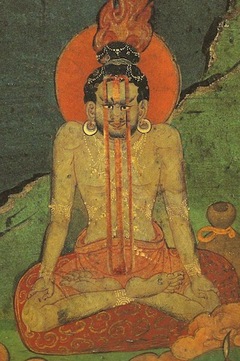
Instructions on Tummo

This text contains instructions on the yogic practices of channels and winds (tsa-lung) from the Longchen Nyingtik tradition. If practised incorrectly and without supervision, these practices can cause serious physical and mental problems, and therefore these texts have traditionally been kept secret and restricted to practitioners—and this is still the case today. After careful consideration and in consultation with the lineage holders of the Longchen Nyingtik, these texts are now being published online, for the benefit of serious practitioners who have received the appropriate transmissions and are practising under the guidance of a qualified teacher. Given their nature, please treat these texts with respect and do not reproduce them on any social media platforms.
Practical Instructions for Inner Heat
from the Heart-Essence of the Vast Expanse
by the First Dodrupchen, Jigme Trinle Özer
With great devotion I pay homage at the immaculate lotus feet of the supreme guru, the embodiment of the Three Roots. Bless me with your enlightened body, speech, mind, qualities and activity!
When putting into practice the instructions on inner heat (tummo) from the Great Perfection Heart-Essence of the Vast Expanse, there are three parts: (1) the preparation, (2) the main practice and (3) the conclusion.
1. The Preparation
A yogin whose mindstream has been ripened through the four empowerments and who abides by the samayas should know that the purpose of inner heat is not merely to generate physical warmth, so that you only need to wear light clothing. Rather, by transforming the impure elements of the channels, winds and bindus into the nature of the victorious ones’ three secrets, signs on the path such as bliss and warmth, the ten signs and the eight qualities will arise in accordance with the degree of your perseverance.
Yogic Skirt
At the outset, gather the necessities for the yogic practice, such as the yogic skirt (ang-rak). There is no single fixed size for the yogic skirt; it must be tailored to fit your own body. Because a single strip of woollen cloth between the legs will not protect you from the impacts and pounding of the yogic falls (bep), you must firmly sew a pair of woollen cords starting from the top of the pleated section at the back. Over the ‘secret place’ (genital area), position a piece of felt shaped like the pouch of a sling right where the cords cross. Bring the two front ends around like a belt, securing them tightly from the top of the pleats so they will not come loose. By securely padding the reproductive organ with this felt pouch, you will be entirely protected from any injury caused by the pounding of the yogic falls.
Cushion
A soft meditation cushion is absolutely indispensable. On top of it, you should lay a smooth, perfectly even leather mat.
Belt
The meditation belt (gomtak) is made of two pieces of red woollen cloth joined together. Alternatively, a single piece of cloth may be folded in half and sewn together, with the seam on the inside so that it rests comfortably against the flesh. The belt should be long enough to wrap four times around the head, with one or two spans of extra length remaining.
Other Considerations
During the practice of the channels and wind (tsalung), there is a tradition of wearing a white cotton shawl, so you should try to get one; otherwise, a shawl of fine fabric (ardi) will suffice.
The duration of the practice of the channels and wind can be a hundred days, fifty days or one month, without interruption. At the start, there is a tradition of washing the body with warm water, applying powder and warming oneself in the sun. But whether or not this is done varies, so it may also be omitted.
The wind-practice enclosure (lung-ra) refers to a secluded place where you cannot be seen by others—a fenced-off area, a dark room or a walled enclosure. All these preparations are important, so do not be content with a superficial approach but make sure to prepare thoroughly.
2. The Main Practice
The First Session
Go to the wind-practice enclosure and present offerings such as the Offering to the Eight Classes or the Torma in Three Sections.[1] Since you must start in the evening, the time of magnetising, combine it with the afternoon session. Take your seat and engage in the inner heat practice.
Before the practice of the ripening and liberating instructions begins, the guru bestows the empowerment of the Three Roots upon those students who are about to undertake the inner heat practice, thereby ripening their minds. Then the instructions on inner heat are transmitted to them. The Wish-Fulfilling Jewel: The Scroll of the Whispered Lineage for the Wind-Based Perfection Stage of Bliss and Emptiness says:
First, rise briskly from your bed.
On an empty stomach, when winds and awareness are clear,
Perform the general preliminaries,
And in particular, apply the vital point of guru yoga.
With fervent devotion, receive the four empowerments.
Thus, upon waking from sleep, you immediately start with the daily practice of the preliminaries. When your retreat is focused on the practices of the channels and winds alone, you need to recite the entire preliminary practice at the beginning of every session. Then continue with:
For the main practice, the key point of the body is to hold the posture straight.
I am the vidyādhara Vajradharma, semi-wrathful…
And so forth, recite the visualization until you are familiar with it and have gained proficiency. When expelling the stale winds:
Through the rasanā and lalanā, the karmic winds
Are expelled alternately from the right and left nostrils, seven times each.
Exhale seven times from each nostril, making fourteen times in total. Alternatively, exhale the winds of the three poisons nine times, three times through the right, left and both nostrils, considering that they are grey, dark red and dark blue in colour.
The poisonous winds that depend upon
The five emotions and the five elements are expelled completely.Imagine that the interior of the channels is free of flaws.
Then exhale with a “ha” sound.
Rest and relax the mind in the natural state.
Practise according to these instructions. Everything up to this point constitutes one practice session; do this for about three days. Between the sessions, leave the mind free from conceptualization; this applies throughout. Here it would be excellent if at the beginning of each session you expelled the stale winds and at the conclusion trained in the yantras.[2]
The Second Session
Then go through the practice from
In the centre of my heart, within an orb of maroon light…
Until:
…Applying the key points of the oral instructions,
After expelling the stale winds, inhale the wind. Here it is better not to use specific elements [such as fire], because you might make mistakes about which elements to adopt and which to abandon by confusing the inter-elemental relationships of mother and child, friend and enemy.[3] The element of space is always beneficial, and so while you inhale, visualize as follows. Imagine that from the space in front of you all the compassion, power and wisdom, empowerments, blessing and siddhis of the victorious ones and their heirs, and all the vital essences and glorious qualities of the five elements are gathered in the form of wind, blue in colour and indivisible from space, like water drawn through a channel. About twelve finger-widths in front of you, this wind divides in two and, like incense smoke, enters your two nostrils. When it reaches the lower tip of the central channel, it swiftly rises upward through the central channel and dissolves into the syllable A at the heart of Samantabhadra.
One cycle of breath (lung-khuk) is defined as the duration from when you begin to hold the breath—with the key points of the four applications—until you release it. Nāropa explains the four applications as follows:
The four applications are inhaling, filling,
Lightly pressing[4] and shooting like an arrow.
If you do not know these four applications,
There is a danger that qualities turn into faults.
Inhale as just explained, filling the belly, while making sure the winds do not stray into the upper part of your body. When you are unable to hold the breath any longer, while maintaining the same posture, rotate your right elbow three times, then your left elbow three times and then both together three times.[5] Then, opening and raising the two nostrils slightly, exhale slowly without making any sound. While exhaling, dissolve the winds into the syllable A with the same visualization as before. Follow the text from:
In each session do one hundred, seventy or thirty cycles of breath…
Until:
… It is the result of all vehicles of Secret Mantra.
The way to measure your practice is as follows. While seated in cross-legged posture, resting in meditative equipoise and holding the breath, another person, with the right hand, taps their right knee, their left knee, their forehead and then snaps their fingers, all at an appropriate pace. This counts as one. One hundred of these constitutes a ‘great vase’. Half of that is called the ‘small’ or ‘medium vase’, though this designation is difficult to identify precisely. Up to here is one practice session.
The Third Session
The Yoga of the Warmth of Blazing and Dripping
From the Wind-Based Perfection Stage of Bliss and Emptiness
Igniting the Inner Heat
With the three channels just as before…
And so forth, up through:
…The oral instructions from the whispered lineage of blazing and dripping.
First there is the blessing of the channels.[6]
Clearly visualize the central channel—empty, luminous and open like a skylight. Inside, at the upper tip, is Samantabhadra with consort, with their heads just protruding from the central channel. Below them are, in succession: Vajrasattva, Garab Dorje, Śrī Siṃha, Mañjuśrīmitra, Jñānasūtra, Vimalamitra and Padmasambhava. To his right is the lord, King Tri Songdetsen; to his left is the subject, Vairotsana; in front of whom is the companion, Yeshe Tsogyal. Below them are Longchenpa and Jigme Lingpa.[7] Visualize them stacked one upon another. [Then recite the lineage prayer:
Emaho! In the heavenly realm, free from all dimensions and extremes….[8]]
Then pray sincerely, not just paying lip service, and recite however much you can:
Emaho! In the city of the infinite purity of the central channel…[9]
Finally, following the oral instruction text, the gurus successively dissolve into light and the fire of the inner heat is ignited.[10] This is one practice session.
The Fourth Session
Then practise the bodhicitta descending from above[11] with the melting of the haṃ syllable, gathering blessing and power. This is one practice session.
The Fifth Session
Then the white nectar descends from the [haṃ syllable] and fills the chakra of great bliss at the crown, offering nectar to Vairocana. This is one practice session.
Sessions Six to Nine
Then, as the nectar descends in stages to the throat, heart, navel and secret place, offering nectar to Amitābha, Akṣobhya, Ratnasambhava and Amoghasiddhi respectively, together with their consorts and retinues, it pleases them, and you receive empowerments and accomplishments. It is customary to practise one session for each chakra. At this point, visualize the bliss-sustaining chakra at the secret place with its twenty-eight channel-spokes.
The Tenth Session
At the lower tip of the central channel, where the rasanā and lalanā enter, there is the a-stroke. As nectar pours onto the a-stroke, the fire and the nectar become inseparable, filling your entire body—this is one practice session, the tenth and final one.
3. The Conclusion
This is merely a summary of the practical instructions. For more extensive explanations, you need to consult the root texts. Except for the first session of the ninefold expelling of the stale winds, you need to strike the vital points with the twenty yantras in all subsequent practice sessions, after the visualization—they are the supreme skilful means for removing obstacles. Then follow the text from:
Then, at the confluence of the three channels…
Until:
… Rest in empty luminosity.
At this point, after focusing on the yantras as just explained, for removing obstacles:
Remove obstacles with the ha-shake and small smacks…
And so forth up to:
… Is the ground in which all phenomena are liberated. Samaya.
This completes the practice.
If you wish to train in the winds for one month, then for about twenty days, practise as explained above; for the remaining ten days, two or three times a day, hold the vase breath and do as follows. First, while in cross-legged posture, gently press the channels at the neck[12] with the fingers of both hands. Second, hold the winds and press strongly. Third, while holding the winds, press on [the channels at the neck] while doing a small yogic fall. Fourth, while holding the winds, press while doing a big yogic fall. Train so that you strike the essential points. Then recite many times the verse beginning with:
With the afflictions, wind and mind—the nature of cyclic existence…
Finally, rest in the meditative equipoise beyond expression. When you arise from this, seal the practice with dedication and aspiration prayers. In all activities, focus your mind on the a-stroke at the navel. At mealtimes, bring to mind the meaning of the indivisibility of bliss and emptiness and partake of the meal as an offering or feast. Alternatively, view the a-stroke as the embodiment of all the deities, and enjoy the meal in the manner of a fire offering.
This was composed by Jigme Trinle Özer as a supplement to the Longchen Nyingtik. Let it be virtuous! Virtuous! Virtuous!
| Translated by Han Kop and reviewed by Matthias Staber, 2026, for the Longchen Nyingtik Project, based on the explanations of Lama Jigme Namgyal.
Bibliography
Tibetan Editions
rdo grub 'jigs med phrin las 'od zer. "klong chen snying thig gi gtum mo'i gdams pa lag len la 'debs tshul". In kun mkhyen gong 'og gsung gi rgyab chos skor. Pe cin: mi rigs dpe skrun khang, 2020. Vol. 64: 387–402.
rdo grub 'jigs med phrin las 'od zer. "klong chen snying thig gi gtum mo'i gdams pa lag len la 'debs tshul". In 'jigs med rnam rgyal, rdzogs pa chen po snying thig gong 'og las/rlung dang thig le'i rdzogs rim phyogs bsgrigs. Private publication, pp. 184–200.
Version: 1.0–20260921
Notes
-
This usually refers to the Restorative Offering to the Eight Classes by Nubchen Sangye Yeshe and the Torma in Three Sections by Minling Terchen Gyurme Dorje. ↩
-
Yantra (’phrul/’khrul ’khor) — yogic exercises that combine physical movements and postures with breath control and visualization, practised in the context of the perfection stage practices of the channels and winds (tsa-lung). Khenpo Ngakchung explains that “the purpose of these yantras is to purify all defects of the channels in the body—such as being crooked, twisted, crippled, or dried out—and to make the channels pliable.” In a collection of texts, some of which are based on the teachings of Drakpa Gyaltsen, found in the collected works of Kunga Drolchok (kun dga’ grol mchog, 1507–1566), a Sakya master from Mustang who also received many Kagyu teachings, we find the following explanation of the term yantra: “The term trulkhor is the Tibetan translation of the Sanskrit word yantra. For example, as explained in the context of Yamāntaka, when one draws a pacifying or enriching yantra on a leaf of birch bark, and then recites the mantras of the deity’s approach phase, directing the practice through visualization—such as when an epidemic in a city is pacified, or when a royal lineage proliferates and expands—these are widely known as pacifying and enriching yantras. Likewise here, the yogin’s own vajra body, free of defects, symbolizes the ground surface that serves as the basis for drawing. The knots of the channels that exist in physical form symbolize the yantras that are to be drawn. The essence-drops that pervade them and the winds that circulate throughout symbolize the yoga of recitation. Thus, when the yogin takes the inner triad of channels, essence-drops and winds as the path of yantra, it is said that boundless enlightened activities manifest—such as being able to capture the sun and moon and to reverse the flow of rivers.” See “rje rin po che kun dga’i mtshan can gyi bka’ shog” In dpal ldan stag lung pa’i gsung rnams nor bzhi bang mdzod. khun men: nor bzhi bstan rgyas tshogs pa, 2007, vol. 46: 296–297. BDRC: W1PD166109. ↩
-
These are concepts that derive from Chinese and Tibetan astrology. The child of each element is the one immediately following it, and the mother of each element is the one preceding it. The friend of each is the one after the next, and the enemy of each is the one before the preceding element; for example, the enemy of fire is water. ↩
-
The term gzhil ba means to press or push, yet it has a different meaning depending on the context. 1) In the context of the practice of the channels and winds, it means to press and gather the winds in the central channel. 2) In the context of inner heat, it means to disperse the heat throughout the channels. 3) In the context of the yantra exercises, it means to slide or rub. ↩
-
This sentence is somewhat obscure and also puzzled our informants. However, Khenpo Ngakchung details a similar movement in his commentary. ↩
-
These are the first lines of the Notes on Blazing and Dripping Through the Power of the Fierce Wisdom. ↩
-
At this point additional lineage masters are added according to one’s lineage. In one of our Tibetan editions, a supplementary note adds the following masters: [First] Dodrupchen (1745–1821), Jewön, the bodhisattva Kunga Nyingpo, Padma Vajra (c. 1807–1884), Khyentse Wangpo and Lama Gyaltsen. ↩
-
This line appears in some editions of the text, but not all. It refers to The Continuous Shower of Blessings, A Prayer to the Lineage of the Great Perfection’s Heart-Essence of the Vast Expanse, which can also be found in the preliminary practice of the Longchen Nyingtik Ngöndro compiled by the First Dodrupchen. ↩
-
The Vajra Verses: A Prayer of the Fierce Inner Heat. At this point, only the first three verses are recited. ↩
-
In other words, they dissolve into the a-stroke. ↩
-
There are the two stages: the bodhicitta descending from above (yas babs) and the bodhicitta being borne up from below (mas brtan). ↩
-
Tib. rtse’u chung ↩