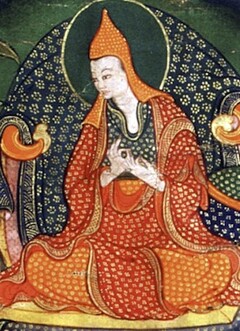
Vima Nyingtik Karchak
Translator’s Introduction
The first text in the first volume of the 26-volume edition of Longchen Rabjam’s collected writings published in China in 2009 is not a work by Longchenpa himself; it is a catalogue written by a master who lived five some centuries later, Shechen Öntrul Tutop Namgyal (1787–1854). Shechen Öntrul is an significant figure in the history (or prehistory) of what has come to be known as the Rimé Movement. At Shechen Monastery in the early nineteenth century, he was a teacher to three key figures associated with that movement, Patrul Rinpoche (1808–1887), Jamgön Kongtrul Lodrö Thayé (1813–1899) and Jamyang Khyentse Wangpo (1820–1892).
The Maker of Day
A Catalogue to the Vima Nyingtik
by Shechen Öntrul Tutob Namgyal
The ultimate view, unconveyable in conventional terms,
The Ati vehicle, a path transmitted through blessings—
May the teacher Samantabhadra and consort, as well as Vajrasattva,
And the gurus of the lineage of direct transmission provide lasting refuge throughout all our lives.
The reality of dharmatā transcends the effort of ordinary speech.
Fundamental reality is thus communicated through signs, bringing instantaneous realization and liberation—
Garab Dorje, Śrī Siṃha, Mañjuśrīmitra,
And Vimalamitra, protect me until I awaken!
The distillation of the six million four hundred thousand scriptures,
The seventeen great tantras were received through aural transmission—
To Chetsün, Dangma and all the siddhas who appeared in Tibet,
Gurus of the Nyingtik lineage, in devotion I repeatedly prostrate.
To those who, through the merit of beings and the teachings in Tibet,
Were invited as guests, when the Abbot, Master and Dharma King
Caused the sunlight of the sūtra and mantra teachings to shine,
Dispelling saṃsāra’s darkness, I offer heartfelt homage.
As a brother to the Bhagīratha[1] of scripture and realization,
The lineage that unfolds to cleanse the bones of thorough affliction
Flows in three channels to merge in the heart of Jahnu—[2]
To the guru of threefold kindness, I bow down.
This golden land of the vajra vehicle of the Ancient Translations
Is maintained through the force of power and strength
As a domain of fourfold well-being and tenfold virtue—
Who could the rulers of this dharma kingdom be but King Jaḥ?
All you haughty ones, so proud of the eight worldly dharmas,
In your petty kingdoms which you take to be real
And your castles of the apparent riches of this world,
Look with the eye of tenfold virtue upon this sublime dharma kingdom.
The seed of twofold accumulation well performed throughout all lives
Has granted dominion here and now over this land of greater Tibet,
And this wondrous tale of unwavering service to the teachings
Has brought great fortune to the world.
The topic of discussion is as follows. Here, in this Sahā world, the fourth of the thousand guides to appear in this fortunate aeon is known as the victor Śākyamuni. Although he is included among the twelve Dzogchen teachers, when he completed the twelve deeds through taming beings universally in the four ways, completing the three turnings of the Dharma wheel, he prophesied the appearance of secret mantra. Accordingly, the Lord of Secrets (Vajrapāṇi) turned the wheel of Dharma for the five excellent ones of sublime nobility[3] on the peak of Mount Malaya, through the blessings of which, King Jaḥ experienced wondrous indications in his dreams. Volumes of Mahāyoga tantras rained down. The Anuyoga tantras fell in Siṃhala. At that time, in the western land of Oḍḍiyāna, the great teacher Garab Dorje received the tantras of the Great Perfection directly from Vajrasattva.
From the mantra vehicle’s own perspective, the secret mantra was extant even during the time of the Buddha, and there were some siddhas in India who practised secret mantra and guided fortunate disciples. Nonetheless, the aforementioned prophecy was not widely known. Here, in Tibet, the Dharma-king Tri Song invited the abbot [Śāntarakṣita] and master [Padmasambhava], built temples, and extensively propagated the sūtra and mantra teachings. In accordance with the prophecy of Nyang Tingdzin Zangpo in particular, the master Vimalamitra was invited, and Lotsāwa Kawa Paltsek translated several Dzogchen teachings, which the Dharma-king, the princes and others studied. Moreover, in consideration of disciples of later generations, these teachings were hidden as treasures in the temple of Zha in Uru, where they were subsequently revealed by Dangma Lhungyal and became known as the Vima Nyingtik, Vimalamitra’s Heart-Essence. The Dzogchen cycle taught by Padmasambhava was hidden at the White Rock of Tidro, then revealed by the Tertön Rinchen Tsuldor, becoming known as the Khandro Nyingtik, Heart-Essence of the Ḍākinīs. These two are referred to as the two mothers. In addition, the encapsulation of the former is known as the Lama Yangtik (Quintessence of the Guru); while the further elucidation of the latter—akin to the development of shoots, stalks, leaves, fruit and flowers—became the Khandro Yangtik (Ḍākinī Quintessence). These two are known as the two child collections. Together, all four comprise the Fourfold Heart-Essence, Nyingtik Yabzhi. Further clarification of the meaning of both the mother and child of the Heart-Essence of Vimalamitra is contained in the Zabmo Yangtik (Profound Quintessence) by the omniscient Longchen Rabjam. Unlike with the secret mantra in general, practising these teachings will bring attainment of the rainbow body of great transference, through which we can benefit beings until the end of the aeon, like the victorious lord Padma and Vimalamitra. There are many accounts of masters gaining such realization in India and Tibet, and there is no need to repeat them here.
The Nine Vehicles
It is worthwhile noting that although the mantra teachings were not divided into ancient and modern in India, such a distinction came to exist here in Tibet on account of the waxing and waning of the teachings. Both systems agree that the mantra is divided into outer and inner and that the Unsurpassed Yoga is the highest of the inner tantras. Still, the Nyingma tradition goes further by distinguishing Anuyoga and Atiyoga to make nine successive vehicles. The Great Perfection with which we are concerned is the sovereign of all vehicles. From its perspective, the eight lower vehicles employ temporary concepts and a mind that has never been real to mentally fabricate and transform what is unchanging. They employ antidotes to correct and reject what need not be rejected. Out of a wish to eliminate, they regard as faults what need not be eliminated. They bring about hopes and fears regarding the attainment of something external to be attained where there is nothing to be attained. The great delusion of applying effort towards what is beyond effort and exertion obscures naturally abiding wisdom, preventing any contact with the genuine nature of reality.
Thus, for the selflessness that is realized by the śrāvaka and pratyekabuddhas of the lower vehicles, consciousness and material particles are asserted to be the ultimate. The proponents of consciousness assert that self-knowing, self-cognizing consciousness is the ultimate, the perfect nature. Such assertions do not surpass the level of the mundane mind and mental states.
Similarly, the followers of the Middle Way employ the principle of the two truths and the four great logical arguments to show that there is no arising, no cessation, no existence, no non-existence and so on. They thus establish the truth of cessation, freedom from extremes, freedom from conceptual elaboration, and so on, advocating a space-like emptiness.
Among the lower tantras, Kriyā proposes that siddhis are attained through pleasing the deity of threefold purity by means of ritual cleanliness and the like. Upayoga involves clinging to characteristics since it partakes of the higher and lower forms of view and conduct.[4] Yoga involves regarding the ultimate blessing as the deity and focusing on the yoga of the four mudrās. Mahāyoga asserts that primordial wisdom arises by means of the generation stage and the perfection stage in which one applies the crucial points of the channels, wind-energies and bindus. Anuyoga involves viewing space and wisdom as that which is generated and the maṇḍala of deities as the means of generation.
In short, every stage up to and including Anuyoga constitutes a system based on the intellectual mind. They all involve thinking that such-and-such does not exist or is empty or is true. They mistake conceptual ideas and the conceptual mind for dharmatā reality, as a result of which they preclude any seeing of the genuine nature as it is. They involve mental creation and modification. Conceptual mind, with its eight modes of consciousness, is something impure to be discarded. The Natural Great Perfection, by contrast, transcends mind. It involves the nature of mind, the wisdom of naturally arisen awareness, which is luminous and uncompounded, and in which enlightened qualities are spontaneously present. Since it is naturally free, there is no reliance on the causal process of generation or any external conditions. It shows how the space-like nature is present, beyond transition or change, and is not created. Even the original protector Samantabhadra is enlightened through the natural realization of naturally present wisdom and does not resort to external factors such as study and contemplation or the accumulation of merit. Root Verses on Middle Way Wisdom (Chapter 15 verses 1–2) says:
It is unreasonable that intrinsic nature
Would arise from causes and conditions.
What arises from causes and conditions
Must be called a fabricated nature.How could such a thing be possible?
Intrinsic natures should be uncontrived
And not dependent on external factors.
These words directly convey as a song of realization the natural state, uncompounded wisdom that is beyond causes and conditions, in the tradition of the Great Perfection.
Here, “ati” means superlative, supreme, best, finest, peak and innermost. Atiyoga is thus the ultimate of all forms of yoga. It is the essence of all perfection stage practices, so there is nothing that might surpass it. To indicate that it leads directly to unborn, space-like dharmatā, which is exceedingly profound and difficult to analyze, it is referred to as great. The Blessed One said, “The teaching of the space-like inconceivable Dharma is exceedingly great.” This statement relates to the definition given here.
Regarding this nature of the Great Perfection, therefore, the Sugata taught extensively in the intermediate turning of the Wheel of Dharma on the inconceivable, fundamental nature (gnas lugs) by showing how it is beyond the reach of conceptual elaboration. Still, he did not reveal its basic mode of abiding (gshis kyi bzhugs tshul). It was in the final turning of the Dharma Wheel that he revealed the basic mode of abiding, but still he did not teach the authentic path for realizing it. It is the Great Perfection, therefore, that brings together without contradiction the ultimate intention of the two great chariots—the vision of the intermediate turning as interpreted by the sublime and noble Nāgārjuna in his Collection of Reasoning, as well as his Praise to the Dharmadhātu and other works, and the vision of the final turning as explained by the regent Maitreya and noble brothers Asaṅga and Vasubandhu. Why? Because these masters do not assert anything other than the profound natural state of phenomena, and the Great Perfection is not established as anything else.
The Great Perfection is divided into three.
1. The Mind Series (Semdé)
The essence of the Mind Series is the transcendence of the conditioned path of truth with its tightly bound conceptions of successive vehicles, the two truths, the six perfections, two stages, and so forth, within the great expanse that is completely free from aspects of cause and effect, virtue and non-virtue, acceptance and rejection—the nature of the genuine bodhicitta of the wisdom great purity and equality, the dharmadhātu free from elaboration, the ultimate truth itself. Some narrow-minded observers of this profound teaching have forcefully objected that the Great Perfection discards the aspect of method and denies the law of karmic cause and effect. Although it is true that those with childish intellects fear profound points, this teaching speaks of the wisdom realm beyond conceptual consciousness, the ultimate truth of the unconditioned dharmadhātu. This does not pertain to the three realms or the worlds created through wholesome and unwholesome actions, but what is completely free from them. It is thus uncreated through causes and conditions, as may be understood from the quotations given earlier.
If you accept this, then as the master Nāgārjuna says in the Root Verses on Middle Way Wisdom:
Actions and afflictions derive from thought.
Their further proliferation
Is arrested through emptiness.[5]
This makes clear that all the causes and effects of wholesome and unwholesome actions proceed from conceptual notions and are pacified through the emptiness that is free from such conceptualization. As for the method of pacification:
It is otherwise unknown, peace,
And not produced through constructs.
Such is the definition of suchness.[6]
And the same text also says:
Afflictions, karma and bodies,
Agents and the effects of action
Are like cities of gandharva, mirages,
Hallucinations, the moon’s reflections.[7]
The same author’s Middle Way Passing Beyond the Mundane World (dbu ma srid pa ’pho ba) says:[8] says:
Not conceiving of anything, empty,
Not mentally active, beyond birth and death,
Illusory in appearance, without virtue or vice,
Devoid of emptiness and compassion, saṃsāra and nirvāṇa,
Illusory clarity and emptiness, inexpressible—
The clear dharmatā is free of concepts.
Thus, as previously stated, realizing the ultimate truth of dharmatā means that all conditioned actions, wholesome and unwholesome, neither bind nor liberate, but are realized to be of great equal taste beyond good and bad. At this stage, one arrives at the dharmatā reality in which the nature of all phenomena is characterized by wishlessness.
There are seven subdivisions to the Mind Series: (1) the perspective that holds the result to be the mind’s point of origin, (2) the perspective of the transcendence of deviation and obscuration, (3) the perspective of the collapse of the foundation of logical reasoning, (4) the perspective of avoiding limitation or partiality, (5) the perspective concerning limited philosophical tenets, (6) the transcendence of partiality regarding that which is beyond the mind, and (7) the claim that everything is an aspect of mind.
2. The Space Series (Longdé)
The essence of the Space Series is that in the broad expanse of Samantabhadra, the dharmatā, self-originating wisdom, all apparent phenomena are simply the adornments of a self-manifest array. They do not exist as the bound and liberated or as the arisen and the producer of arising. It is therefore not claimed, as it is in the Mind Series, that phenomena appear as mind’s expressive power or display. This system establishes that everything is a great infinity that is and always has been free, without any analysis as to dependence, existence or non-existence, being or not being, purity or impurity.
When subdivided, the Space Series includes: (1) the black space teaching on causelessness, (2) the variegated space teaching on diversity, (3) the white space teaching on mind, and (4) the infinite space transcendence of cause and effect. These can also be abbreviated as the four spaces of (1) display, (2) ornament, (3) dharmatā, and (4) freedom from activity.
3. Pith Instruction Series
The Pith Instruction Series is superior to the two series that precede it. Although the Mind Series establishes clarity as mind with a greater emphasis on the profound aspect, since it does not realize clarity’s creative power as dharmatā, it comes close to grasping at intellectual analysis. And although the Space Series establishes profundity and clarity equally, it comes close to lapsing into the pitfall of voidness through intellectual analysis that grasps at dharmatā. The Pith Instruction Series, however, is superior because it gathers all phenomenal appearances—the natural display of spontaneously present self-manifestation, the great primordially pure radiance beyond expression and intellect—into the basic space of dharmatā free from elaboration.
In essence, this system differs insofar as it does not divide the originally free, primordially pure dharmatā into a portion that is viewable and a consciousness that views, thus avoiding the dichotomy between delusion and non-delusion, realization and non-realization. Thus, from the perspective of the intrinsic essence, beyond conceptual elaboration, known objects and knowing subject are equally unreal. Aside from mere conventional application, there is a complete transcendence of thoughts and expressions that hold to such dichotomies. This is like the application of moxibustion to the vital point, wherein the intellect, thoughts of what might be, the thinking process and mental speculation are all transcended. The Root Verses on Middle Way Wisdom says:
All is real, all is unreal,
Is both real and unreal,
Neither real nor unreal—
By such steps Buddha taught.[9]
Mañjuśrī has said:
It is naturally radiant and
Originally pure like the sky.
Phenomena lack characteristics.
There are no dharmas and no dharmatā.
It is without substance, like space,
Free from all verbal expression.[10]
Subdivisions
The Pith Instruction Series has many subdivisions, but, briefly stated, there are four: (1) the outer cycle, which is like the body; (2) the inner cycle, which is like the eyes; (3) the secret cycle, which is like the heart; and (4) the ultra secret, unsurpassable cycle, which is like the perfect whole.
1. Outer Cycle
The essence of the outer cycle is to take the five poisons as the path, because the afflictions are unreal. Its nature is that whatever manifests arises as the dharmatā, because there is no striving or accomplishment. And its character is that there are no divisions in emptiness, because there are no parts or dimensions.
2. Inner Cycle
The essence of the inner cycle is the signless dharmatā, because there is a transcendence of the formational. Its nature is continuously abiding primordial wisdom, because there is neither coming nor going. Its character is like roots insofar as it reaches both saṃsāra and nirvāṇa, like a trunk insofar as its own nature faces in different directions, like branches insofar as its creative manifestations extend in any manner, like flowers insofar as the clarity is unobstructed, and like fruit insofar as variety ripens as oneness.
3. Secret Cycle
The essence of the secret cycle is non-reliance on the three wisdoms, since the introduction and realization occur simultaneously. Its nature is non-reliance on the strength of familiarity, since the termination of breath and liberation occur simultaneously. Its character is non-reliance on twofold accumulation as the cause, since buddhahood and the emergence of compassion occur simultaneously.
4. Ultra-Secret Unsurpassable Cycle
The essence of the ultra-secret unsurpassable cycle is non-reliance on the cognitive process, since it is not an object of cognition. Its nature is not to invite speculation about dharmatā, since this is seen directly. Its character is not to foster hopes about gaining fruition through the four visions at some future time, since they lead to the space of the primordial ground within this very lifetime.
According to the Pith Instruction Series within the Great Perfection, which is the essence of all the teachings, individual intrinsic awareness is experienced through primordial wisdom and transcends the ordinary mind characterised by the eight collections of corrupting, attached consciousness. As it said in the Lion’s Perfect Power:
The habitual traces of mind and wisdom are unreal.
Yet, although wisdom is free from all habitual traces,
Since the mind has collected diverse impressions,
Unless one distinguishes mind and primordial wisdom,
The root of apparent objects will not be cut through
And thus, although unconditioned dharmatā is pure,
It will still prove difficult to realise.
And Nāropa’s Means of Attaining Reality As It Is tells us:
The intrinsic awareness of the mind of awakening,
Under the influence of delusion’s habitual traces,
Is imagined as a variety while no such variety exists.
Although mind’s habitual traces manifest externally,
The luminosity of awareness is unchanging.
And:
Free from the movement of mind and thought,
There is no grasping in luminous awareness.
In short, all that is seen, heard or conceptualised is apparent to the mind, and it is the mind that apprehends the particular characteristics of all the phenomena of saṃsāra. The Noble Eight-Thousand Lines makes the same point in reference to the mind-as-such, which transcends the mundane mind and mental states: “The mind is devoid of mind, for the nature of mind is clear light.”
Moreover, the Heap of Jewels says:
Free from mind, intellect and consciousness, and not abandoning meditative absorption, this is the inconceivable mystery of the enlightened mind of the Tathāgata.
Nāgārjuna also says:
When there is no mind, there are no phenomena.
Likewise, there is no body and no elements.
In this way, the nature of the path of non-duality
Is perfectly explained.[11]
There are a vast number of such statements which refer to this transcendence of the ordinary mind. Once this naturally occurring primordial wisdom of one’s own awareness, which is present in the manner of the four great modes of liberation, has been ascertained according to its special features, there are two means of authentically realising it: (1) Trekchö, which emphasises the aspect of emptiness or primordial purity always free from conceptual elaboration and brings the cessation of empty phenomena, and (2) [Tögal,] the approach that emphasises the aspect of appearance and spontaneous presence, which brings the cessation of manifest phenomena as the physical body dissolves into clear light.
1. Trekchö
The essence of awareness, which is the intent of this supreme vehicle, has the character of being free from bondage and liberation. This primordially pure essence in uncontrived and not restricted in any way. There is nothing in its nature that is identifiable as an essence, so it does not fall into any category. Free from the conceptual mind, this naked, transparent awareness beyond ideas and expressions is emptiness. It is signless, because it is not signifiable by words or verbal expression at the time of the path. It is wishless, since there is no hope or fear concerning what might be gained in the context of the fruition. And, through its aspect of awareness, it is of the nature of clear light, in which the qualities of awakening are perfectly complete. The awareness that is characterised by these four forms of liberation does not contain the phenomena related to view, meditation, conduct and fruition, whether conceptual or non-conceptual.[12] It is not seen by looking. It is not realised by meditation. It is not improved through conduct. It is not attained as the fruition. Therefore, there is no refinement on the stages, no progress on the paths, no focus on the fruition, and nothing to be done at any particular phase. This path is that of the buddhas’ ultimate dharmakāya. As it is said:
Those who see my body as ordinary form
Or hear my voice as ordinary sound
Have set out upon a mistaken path.
Such people do not truly see me,
The dharmakāya of the buddhas.[13]
Primordially pure awareness, which is the vajra essence, becomes increasingly attuned to the actual nature of the primordial dharmakāya. At the same time, like the sun’s natural radiance, there is freedom from the obscurations of conceptual elaboration. By contrast, the eight lower vehicles seek to see the sun by purifying the veils of the obscurations in dependence on degrees of conceptuality generated exclusively by the grasping conceptual mind. Given this distinction, one determines to settle naturally in self-occurring wisdom without any contrivance based on conceptual view, meditation, conduct or fruition. Awareness is simply present—unrestricted, uncontrived, unfashioned, unmeditating, undistracted, undeluded, uninvolved in ideas and analysis, vivid, naked, and relaxed. The terms “view” and “meditation” only nominally apply.[14] As the Self-Arisen says:
In awareness free from conceptual elaboration
How could there be delusion or unawareness?
In primordial wisdom beyond the ordinary mind
How could there be ignorance or habitual traces?
By resting evenly in this way, as the fundamental nature of uncontrived great, primordially pure awareness is directly introduced, it is impossible to be bound by dualistic grasping. The way of avoiding the contamination of an object and process of meditation is well illustrated by such teachings as the Twelve Great Vajra Laughs. When you achieve stable familiarity with this path, you will ultimately be absorbed into the great primordial purity of liberation. The particles of the four coarse elements will be purified, transformed into the powerful fire of wisdom, and dissolve accompanied by great miracles. For the sake of others, these dissolving particles will emanate and leave behind the four kinds of relics, and awareness will merge into the space of dharmakāya, out of which it will produce an endless stream of nirmāṇakāya to benefit beings.
2. Tögal
Secondly, there are the instructions on Tögal by means of which spontaneously present visionary appearances are established. In Trekchö, delusive appearances of apprehended objects are liberated directly into the nature that is groundless and without root. This is superior to that lower approach, because here, all appearances of the three realms are liberated in the luminosity of the great sphere of five-coloured light, which is the self-radiance of awareness. The explanation briefly covers the visions of basic space and the ripening of the vajra chains, which are the essence of awareness, culminating in the dissolution of the outer and inner elements of the three realms into clear light through the vision of dissolution into dharmatā. This can be summarised as the three crucial points of the supporting physical posture, three crucial points of guidance towards basic space, and three crucial points of objective visionary appearances.
As the awareness of superior insight (vipaśyanā) views the vajra chains, increasing familiarity brings mastery of the four visions. Direct experience of dharmatā opens the door to pure realms. Then, as the light sphere comes close to maturing as the buddha form there is increased experience, the nirmāṇakāya vision. When it does mature as buddha form, there is awareness at full measure, the sambhogakāya vision. Then, when all appearances are purified as the maṇḍala of the single great sphere, all mentally imputed phenomena are exhausted, and even mere fixation upon dharmatā is exhausted, one sees the dharmakāya vision. The Word-Transcending says:
Seeing the direct experience of dharmatā
Brings transcendence of speculative limits.
The increase of experience
Causes delusive appearances to fade
And actualises the wisdom of the bardo.
The vision of awareness at full measure
Brings transcendence of the path of three-kāya realisation.[15]
The vision of dharmatā exhaustion
Severs the continuity of saṃsāra’s three realms.
This is also the key to how in this secret, unsurpassed approach, one swiftly arrives at the fruition through mastering right away the method of directly taking self-occurring awareness beyond the saṃsāric mind as the path. Otherwise, when practising, the result from the mind and mental states of saṃsāra would itself be saṃsāric, because the process of cause and effect is infallible. There is no occasion for combining opposites.
In particular, the moment of awareness that looks directly into clear light counters the mind and mental states of the three realms together with the ālaya.
- It counters the mind of the desire realm because such direct looking does not involve the ebb and flow of concepts.
- It counters the form realm because in a state of clarity there is no antidote that establishes clarity.
- It counters the formless realm because in the state of dharmatā there is no mind of attachment to single-pointed non-conceptuality.
- It counters the ālaya because it is lucid and aware.
- It counters ālaya consciousness because it has decisive certainty concerning naturally occurring wisdom.
- It counters the five sensory consciousnesses because there are no ordinary impressions beyond the objects of the visions of luminosity.
- At the same time, it counters mental consciousness and the afflicted mental consciousness because it involves neither discriminating thought nor concepts of attachment and aversion.
In short, freedom from all forms of mind and mental state associated with the three realms is the ultimate; it is nothing other than peace itself, the primordial wisdom of buddhahood.
Those mantra systems of inferior classes of tantra that contend that co-emergent wisdom refers to the wisdom of bliss, clarity and non-conceptuality brought about by causing the winds from the left and right channels to enter the central channel do not counter the eight collections of consciousness. This is because the sensation of bliss is generated pursuant to mind and the afflicted mind, and the non-conceptuality of the ordinary mind does not transcend the ālaya. In addition, these systems maintain that the winds and elements enter the central channel from the left and right pathways and that as they release each of the knots in the channels this brings about the elimination and realization of the ten bhūmis. Yet this is a key point of potential deviation because the entry of prāṇa-mind into the radial channels associated with the six classes of beings triggers impure delusive appearances. Here, by contrast, the approach is to allow the winds to calm by themselves rather than enter the central channel and so on. When the winds for each of the radial channels are naturally purified this causes the wisdom in the light channel to become naturally radiant right where it is, bringing only pure visions of buddha forms, pure realms and lights; there is no occasion for the arising of impure delusive appearances. As the central channels of light develop, the knots in the channels gradually fuse into light, as a result of which the realization of the bhūmis manifests in one’s own experience.
When the first pair of knots in the channels fuse into light, a hundred buddha realms appear within the light that manifests externally and rays of light radiate throughout them. As this is brought within one’s own experience, one journeys there. Moving one’s body causes a hundred realms to quake. Internally, one enters and arises from a hundred non-conceptual meditations on dharmatā. As such experiences illustrate, this must be understood as far superior to lesser approaches.
This is the culmination of the four visions. At the same stage, Trekchö leads to the dissolution of the body into particles but not the formation of a vajra kāya, and therefore no means of acting for others’ sake on a grand scale until saṃsāra is empty. The form kāya here, therefore, which is apparent like the moon’s reflection in water but intangible and which accomplishes immense benefit for sentient beings is the so-called kāya of great transference, like that of the great masters Padmasambhava and Vimalamitra. If such a support has no beings to train for a time, the inner manifestation of the form kāya of outwardly radiant unity dissolves into the inner space of dharmakāya free from elaboration. Then the subtle wisdom of one’s own awareness abides in the inwardly luminous youthful vase body. When a display emanates from such a state to train those who require training, there is no movement from the most even equilibrium within the ground that radiates the wisdom of great unceasing compassionate energy. This reality is the ultimate dharmakāya in which space and wisdom are indivisible. It is awakening within the fundamental nature of the primordial ground, great primordial purity, the locus of freedom in which there is no division between primordial purity and spontaneous presence. The Middle Way proponents of the absence of inherent existence do not accept the kāyas and wisdoms because they believe that all who reach this stage remain within the sublime cessation of quiescence. This is because even the absence of all extremes of elaboration is for them predominantly an extreme of emptiness.
In short, the fundamental nature of the Great Perfection is that of perfect view, pure and equal cause and effect, indivisible reality, natural dissipation of dualistic grasping, unimpeded arising and ceasing, and avoidance of the extremes of elaboration and non-elaboration. It is unmodified by the intellect, and does not involve outwardly projecting, inwardly grasping or settling in the middle. Here, all forms of expression are no more than husks of verbalism and convention, all thought and judgement nothing other the application of concepts, and there is decisive resolution in the avoidance of the extreme of asserting anything from one’s own side. The Mirror of Vajrasattva’s Heart says, “Understand that all aspects of awareness are free from the ordinary mind that conceives of a self.”
Nevertheless, there have been those in the past and more recently who assume that they can realise the profound dharmatā with the ordinary mind and who fear profound discussion of dharmatā reality beyond the mind. This is seemingly disparaging towards the lower stages of the path, and there have indeed been those with apparent intellect who have demonstrated a distinct hostility toward profound themes and vast topics, while at the same time assiduously and not infrequently exercising their jealousy toward other traditions on the basis of mere temporal precedence. Yet noble Mañjuśrī said:[16]
The yogi who believes activities
Constitute the great path
Is like a deer chasing a mirage,
Which is forever apparent but never grasped.
Therefore, all such stages
Are inauthentic, as they involve the mind.
The minds of yogis at lower levels
Are superseded by the higher.
The intellectual minds of the inferior
Are invalidated by the wisdom of the superior.
Understand this point and become adept at pacifying any impulse toward disputation within the state of inconceivable dharmatā.
Nyingtik Yabzhi
The Four-Part Heart-Essence, with which we are concerned on this occasion, should be understood as the Ultra-Secret Unsurpassable Cycle within the Pith Instruction Series. Although this teaching of the Great Perfection is fundamental to the Nyingma School of Ancient Translations, many sublime learned and accomplished masters of the Sarma tradition also practised it. To cite just a few examples, venerable Sakya Paṇḍita, Milarepa Zhepé Dorje, and others took them to heart in practice, as is clear from their respective writings. Similarly, the successive Gyalwang Karmapas, venerable Tsongkhapa, and the omniscient Fifth Dalai Lama and others made these teachings the focus of their practice, as can be understood by consulting their individual biographies. Not only that, there are also many traditions of Dzogchen that came about within these other systems but which do not rely solely on the Nyingma line of transmission. In the Sakya tradition, there is the profound and vast cycle of teachings known as the Ati of Samten Lingpa.[17] The Kagyü tradition has the Karma Nyingtik cycle of Dzogchen instructions that Vimalamitra transmitted directly to the Dharma sovereign Rangjung Dorje, and there is also the account of how the protector of beings Zhang Yudrakpa, an illusory manifestation of Buddha Amitābha, received Dzogchen teachings as part of his own treasure revelation. Then, there is the Yutok Nyingtik, which the ḍākinī Palden Trengwa conferred upon Yutok Yönten Gönpo, the nirmāṇakāya blessed by the Medicine Buddha himself. In addition, as the heart practice of the great Tsongkhapa, the peerless second Buddha of this degenerate age, there is the extensive teaching cycle that accords with the profound key points of the view and realization of the Great Perfection, called Zhülen Dütsi Menchok (Supreme Medicinal Nectar of Questions and Answers), based on the great siddha Lekyi Dorje’s conversation with glorious Vajrapāṇi, Lord of Secrets.[18] As these examples illustrate, there are many such teachings that derive from oral transmission lineages or pure visions within the various traditions, and it would be impossible to list them all.[19]
Publication
The family lineage of the sublime Dharma King who compiled the refined quintessence of all these teachings of the Great Perfection, the Nyingtik Yabzhi together with the Zabmo Yangtik, is as follows. Among the descendants of the gods of clear light, in one of the eighteen tribes of Nguchen Gyalmo, Garchen Yeshe Zangpo had two sons. One of the two, Sonam Rinchen, served at the feet of Drogön Chögyal Pakpa and worked as his steward. He received an official title from Qubilai Khan. In the later part of his life, Sonam Rinchen oversaw a congregation of around a thousand at Samar Yang Monastery. His nephew Ngu Guru had nine sons, including the chiliarch[20] Dawa Zangpo, who as a result of the priest-patron relationship with the emperor was granted the position of chiliarch of Samar. His son Ngu Gyalwa Zangpo had a son called Pema Tensung whose own son was Karchen Changchub Bum. His son Ngu Chökyi Dorje entered Katok Dorje Den, where he studied with the learned and accomplished Yeshe Gyaltsen (b. 1395) and became a learned and accomplished master in his own right when he perfected his study, contemplation and meditation in the secret mantra tradition of the Ancient Translations. His half-brother Dechen Sonam Zangpo went to Katok to perform the funerary rites after their mother passed away, but he did not return. When Gendün Gyaltsen and the other brothers went in search of Dechen Sonam Zangpo, they found that he had relocated to the vicinity of the ruler of Chakra, in accordance with the prophecies of Karmapa Chödrak Gyatso[21] and Ngok Chökyi Dorje. This apparently marks the point at which the power and dominion of the rulers began to expand and the name of Derge first came into being. Dechen Sonam Zangpo had four sons. The one known as Botar took the siddha Tangtong Gyalpo (1361–1485?) as his teacher and founded this Dharma centre. Then successive generations ruled the kingdom according to the Dharma until Sakyong Sawang Zangpo[22] invited Tsewang Lhamo[23], daughter of the chieftain of Garjé to be his queen. Their son Tsewang Dorje Rigdzin[24], the lama and dharma-king, and daughter Tamdrin Trinlé Wangmo[25] remain even now as key providers of benefit and happiness.
The royal mother and son, holding the precious teachings of the Buddha in their hearts and considering the great benefit that would accrue from publishing this profound teaching in particular, commissioned the production of a fine set of Nyingtik Yabzhi volumes, written in gold, with fine covers, wooden boards, and silk wrappings.[26] At the same time, they commissioned the printing of the two child collections, the Lama Yangtik and Khandro Yangtik. The eldest son of the sublime lama and dharma king of this land, Damtsik Dorje,[27] whose wisdom born of the flowering of the lotus of intellect is incomparable and who is devoted to the precious teachings of the Ancient Translations, continued the activity of his noble father the dharma-king and his mother, by commissioning the publication of the two mother Nyingtiks and Zabmo Yangtik. In this, he extended the hand of great munificence and opened wide the doors of the inexhaustible treasury of space, so that, in accordance with ancient custom, he was able to support at the appropriate level each and every scribe, carver and editor.
Work commenced in the Iron Tiger year (1830) of the fourteenth sexagenary cycle, which is known as Manifestation, and was concluded auspiciously in the autumn of the Water Snake (1833) year, known as Victorious, when crops and fruit were fully ripened. In the knowledge that texts are indispensable for any form of study, contemplation or meditation and that these activities also depend upon the texts being accurate, when he set in motion this vast gift of Dharma, he commanded me to undertake proofreading and revision—an instruction that I honoured respectfully at my crown. I thus consulted several older, uncorrupted versions of the texts in order to make corrections. In addition, I used my own judgement to correct errors and omissions in composition. I encountered some old orthographic forms, and since the mantras were not always in pure Sanskrit, some were difficult to align with grammatical conventions. Still, I amended those that accorded with Sanskrit according to the language’s conventions, while leaving unorthodox mantras in their original form, not daring to overstep my bounds, as they were not suitable for analysis. Otherwise, with due consideration, I completed the task through a process of repeated checks without ignoring anything that was suitable for review.
One who practises and reveres the teachings of the Mahāyāna is a fortunate individual. As the glorious protector Ārya Nāgārjuna has said:
Those with little merit could not
Even wonder about such teachings.
But merely to entertain doubts
About saṃsāra will make it fall apart.[28]
Indeed, such a noble endeavour as this is a clear indication that the prince must be a bodhisattva. As it is said:
Just as one infers the presence of fire by seeing smoke
Or the presence of water by seeing aquatic birds,
The presence of the intelligent bodhisattvas’ disposition
Can be understood from certain signs.
Moreover, the workers were provided with wages and so on uninterruptedly and their task was meaningful.
List of Contents
The list of contents for the section known as the Vima Nyingtik is as follows:[29]
First, the Maker of Day catalogue (14 folios)
ka) Inventory (12)
kha) Tantras of Liberation Through Wearing (12)
ga) Commentaries on Tantras of Liberation Through Wearing (63)
nga) Determining the Key Points of Timing for Those Worthy of Offering (5)
ca) Three Buddha Testaments (3)
cha) Commentaries on the Testaments Supplemented by Testaments of the Vidyādharas (14)
ja) Testament of Vimala (5)
nya) Sixteen Fragments Cutting Elaboration (29)
ta) Precious Instruction on Prāṇa (6)
tha) Hidden Fragment of Pith Instructions (8)
da) The Lamp of Summarised Pith Instructions (2)
na) The Lamp That Clarifies the Points of Focus (3)
pa) Text on the Signs of the Great Secret (8)
pha) Text on the Measure of Progress (6)
ba) Appendix to the Red Texts (5)
ma) Later Section of the Appendix (14)
tsa) Nine-Lamp Cycle (25)
tsha) Listed in the index as Striking the Crucial Point of the Nature
dza) Listed in the index as Precious Instruction on Winds but this and the previous text are missing
wa) Quintessential Fragments (5)
zha) Magical Fragments (4)
za) Illuminating Lamp (34)
’a) Secret Key Manual (12)
ya) Heart-Essence of the Contents of the Tantras (5)
ra) The Little Brown Volume from Turquoise Letters (54)
la) Inventory: Register of Titles (3)
sha) Seventy-Four Fragments (14)
sa) Trekchö Manual (5)
ha) Explanation of the Sixfold Focus of Mind (63)
a) Commentary on the Unelaborate Empowerment (7)
ki) Explanation of the Time for Bestowing Empowerment (4)
ku) Precious Instructions on Distinction for the Unelaborate Empowerment (3)
ke) Commentary on the Unelaborate Empowerment (?)
ko) Utterly Unelaborate Empowerment (7)
khi) The classificatory commentary for this empowerment has not been found, so blocks could not be carved. If it is rediscovered, we hope to add it here.
khu) Key Points on the Time for Revealing the Four Empowerments (7)
khe) The Unelaborate Empowerment Rite (9)
kho) Classifications of Samaya (11)
gi) Nyingtik History (24)
gu) Seven-Section Conclusion (32)
ge) Tantras of the Three Buddha Testaments (6)
go) Ocean Pressing (3)
ngi) Essential Summary of the Visions of Ocean Pressing (3)
ngu) Heart-Essence of Nectar (4)
nge) Viewing the Essential Points of Awareness (2)
ngo) Heart Refinement: Tögal Enhancement (6)
ci) Dark Maroon Lady of Wrath (3)
cu) Four-Volume Profundity (2)
ce) Inventory of the Eighty-Nine Sets of Instructions (3)
co) Practical Guidance on the Elaborate Empowerment (6)
chi) Unelaborate Empowerment Conferral (3)
chu) Crucial Guide to Bestowing the Unelaborate Empowerment (2)
che) Application of Purity to the Vase Instruction (2)
cho) Extremely Unelaborate Empowerment (4)
ji) Commentary on Unelaborate Empowerment (9)
ju) Elaborate Empowerment Composed by Chetsün, Third Dzogchen Empowerment, Extremely Unelaborate, Utterly Unelaborate and Detailed Commentary on Indications for the Time of the Four Empowerments (24)
je) Wondrous Guidance on the Practice (20)
jo) Secret Instruction: Appendix Distilling the Crucial Points (3)
nyi) Lamp Summary That Is Key to the Supplementary Instruction (3)
nyu) Lamp for the Eye of Concentration (3)
nye) Lamp That Encompasses Dependent Origination and
nyo) The Sixty Vajrasattva Visualizations (Texts missing)
ti) Chetsün’s Experiential Song (1)
ā) Method of Drawing the Maṇḍala for the Unelaborate Empowerment (1)
To publish such volumes of Dharma and reproduce it as a gift of Dharma for others is a cause of vast merit. As the Sūtra on Tenfold Dharma Practice explains:
Copying texts, making offerings, charity,
Study, reading, memorizing,
Explaining, reciting aloud,
Contemplating and meditating—
These ten activities
Bring merit beyond measure.
And:
The merit of preserving the sacred Dharma
Is such that even if all the buddhas
Were to describe it for ten million aeons
Still they would not convey its full extent.[30]
Again, it might be said:[31]
Three Dharma Wheels the Conqueror set forth for those to be trained,
Known as the provisional, mixed and definitive Wheels of Dharma.
This division was prophesied, and in this tradition of the Great Chariot
This is the ultimate definitive meaning free from any concealed intent.
In this Great Perfection, accepted by the great Sakya Paṇḍita
As the ultimate fruition attained by all the true paths,
Those who practise the ultra-secret cycle among the three series
And four cycles reach the dissolution of their physical aggregates.
Without involvement in the systems of outward speculation,
By settling inwardly in equanimity, the true nature of reality
Is directly perceived as a display and object of the senses—
How wondrous, this exploration of the sambhogakāya realm!
Now, when the five forms of degeneration are so prevalent,
Dharma traditions of sūtra and mantra are merely nominal.
At such a time as this, those who put into practice
The ultra-secret Great Perfection will gain blessings aplenty.
Let us apply ourselves to this and churn the ocean of merit
To create a mass of virtue, a resplendent jewel in the sky,[32]
That dispels the dense darkness of fivefold degeneration,
So that all may prosper in a brand new age of perfection.
May dance-like manifestations of the victors and their heirs,
The sublime holders of the non-sectarian teachings, live long.
And may a Dharma rain fall upon fields of scripture and realization,
Yielding an abundant golden harvest of kāyas and wisdoms.
May the rulers of this kingdom, who bring benefit and happiness to greater Tibet,
The king and his heir, live for a hundred aeons, their lotus feet forever firm.
May their religious and political influence expand like a river in summer,
And may they always care for all their subjects.
Through the unfailing truth of the supreme Three Jewels,
Source of all that is auspicious, may all these aspirations
Be fulfilled, as with a wish-granting vase, magical tree,
Or a most excellent vase of plentiful treasure.
Gyurme Tutob Namgyal Palzangpo, a monk-follower of Śākyamuni, wrote this catalogue of the Vima Nyingtik entitled The Maker of Day at the request of Gyalsé Rinpoche, while remaining in his own retreat residence at Shechen, Dechen Pema Ö Ling. The scribe was the supreme tulku Tsang-yang Nyendrak. May it prove virtuous! Virtuous! Virtuous!
| Translated by Adam Pearcey with the generous support of the Tsadra Foundation, 2025.
Bibliography
Tibetan Editions
'gyur med mthu stobs rnam rgyal. "bi ma snying thig gi dkar chag nyin mor byed pa." In kun mkhyen klong chen rab 'byams kyi gsung 'bum, Dpal brtsegs bod yig dpe rnying zhib 'jug khang nas bsgrigs. Mes po'i shul bzhag 115. Pe cin: Krung go'i bod rig pa dpe skrun khang, 2009. Vol. 1: 1–26.
Bi ma snying thig gi dkar chag nyin mor byed pa. (n.d.). In dpe rnying rtsa chen par maʼi skor phyogs bsdus (Vol. 37, pp. 7–38). (15.5 folios) Retrieved April 23, 2025, from http://purl.bdrc.io/resource/MW2PD20323_186DFA [BDRC bdr:MW2PD20323_186DFA]
Secondary Sources
84000. The Third Well-Spoken Branch: An Exact Account of How All the Victorious One’s Teachings Extant Today in the Land of Snow Mountains Were Put into Print (gsum pa rgyal ba’i gsung rab gangs ri’i khrod du deng sang ji tsam snang ba par du bsgrubs pa’i byung ba dngos legs par bshad pa’i yal ’dab, Toh 4568-3). Translated by Subhāṣita Translation Group. Online publication. 84000: Translating the Words of the Buddha, 2025. https://84000.co/translation/toh4568-3.
Dalton, Catherine. Enacting Perfection: Buddhajñānapāda’s Vision of a Tantric Buddhist World. Unpublished PhD thesis, Berkeley: University of California, 2019.
Dudjom Rinpoche. The Nyingma School of Tibetan Buddhism. Translated by Gyurme Dorje and Matthew Kapstein. Boston: Wisdom, 1991.
Jamgön Kongtrul Lodrö Taye. The Hundred Tertöns. Translated by Yeshe Gyamtso. Woodstock: KTD Publications, 2011.
Jamgön Kongtrul. Treasury of Knowledge, Book Eight, Part Four: Esoteric Instructions. Trans. Kalu Rinpoché Translation Group. Ithaca, New York: Snow Lion Publications, 2008.
Jamgön Kongtrul. The Treasury of Knowledge, Book Six, Part Four: Systems of Buddhist Tantra. Trans. Kalu Rinpoché Translation Group. Ithaca, New York: Snow Lion Publications, 2005.
Tenzin Dickie, "Tamdrin Wangmo," Treasury of Lives, accessed December 22, 2025, https://treasuryoflives.org/biographies/view/Tamdrin-Wangmo/13615.
Thupten Jinpa, Tsongkhapa: A Buddha in the Land of Snows. Boulder, CO: Shambhala Publications, 2019.
Version: 1.2–20260115
Notes
-
Through his austerities, Bhagīratha brought down the Ganges to clean the bones of his ancestors. ↩
-
The Ganges River. ↩
-
The five great sages or five excellent ones of sublime nobility (dam pa’i rigs can dra ma lnga) received the Mahāyoga and Anuyoga tantras from Vajrapāṇi at the summit of Mount Malaya. They were the god Yaśasvī Varapāla (grags ldan mchog skyong), the nāga king Takṣaka (klu rgyal ’jog po), the yakṣa Ulkāmukha (skar mda’ gdong), the rākṣasa Matyaupāyika (blo gros thabs ldan), and the human being Licchavi Vimalakīrti (dri med grags pa). ↩
-
Caryā or Ubhaya Tantra is said to involve the view of Yoga Tantra and the conduct of Kriyā Tantra. ↩
-
From Chapter 18, verse 5 ↩
-
From Chapter 18, verse 9 ↩
-
Chapter 17, verse 33. ↩
-
Although attributed here to Nāgārjuna’s Passing Beyond the Mundane World (Bhavasaṃkrānti; dbu ma srid pa ’pho ba, Toh 3840), this quotation is actually from the treatise called Precious Treasury of the Unborn (Ratnāsūkośa; skye med rin po che’i mdzod, Toh 3839) attributed to Nāgārjunabodhi (klu sgrub snying po), which immediately precedes Passing Beyond the Mundane World in the Tengyur. ↩
-
Chapter 18, verse 8 ↩
-
These lines are to be found in Dvikramatattvabhāvanānāmamukhāgama (Toh 1853). ↩
-
From Bhavasaṃkrānti (srid pa ’pho ba, Toh 3840). ↩
-
Reading rtogs bcas rtogs med as rtog bcas rtog med. ↩
-
From the Diamond Cutter Sūtra or Vajracchedikā (Toh 16), ↩
-
The kun mkhyen klong chen rab ’byams kyi gsung ’bum edition incorrectly reads ja dwags here for bla dwags. ↩
-
The kun mkhyen klong chen rab ’byams kyi gsung ’bum edition incorrectly reads ’dis here for ’das ↩
-
These lines are from Buddhajñānapāda’s Dvitīyakrama, which is said to derive from the master’s vision of Mañjuśrī. See Dalton, Enacting Perfection: Buddhajñānapāda’s Vision of a Tantric Buddhist World. ↩
-
See Jamgön Kongtrul Lodrö Taye, The Hundred Tertöns, pp. 342–343. ↩
-
See Thupten Jinpa, Tsongkhapa: A Buddha in the Land of Snows, pp. 144–148. ↩
-
This section also appears in Guru Tashi’s catalogue to the Lama Yangtik. See https://www.lotsawahouse.org/tibetan-masters/guru-tashi/lama-yangtik-karchak ↩
-
stong dpon ↩
-
The Seventh Karmapa (1454–1506). ↩
-
alias Kundrup Dega Zangpo (1768–1790). ↩
-
d. 1812 ↩
-
b. 1786, became a monk ↩
-
b. 1787. See the biography by Tenzin Dickie. ↩
-
There is a reference to this edition in Guru Tashi’s History. ↩
-
1811–1852/53. ↩
-
This is actually from Āryadeva’s Four Hundred Verses (Catuḥśataka), chapter 8, verse 5. ↩
-
All the following title translations are provisional. ↩
-
From The Secrets of the Realized Ones (Tathāgataguhya, Toh 47) ↩
-
This expression is commonly used to introduce verses of the author’s own composition, especially, as here, dedicatory verses. ↩
-
Jewel in the sky is a poetic term for the sun. ↩