Introduction to Hayagrīva
Introduction to Hayagrīva
by Stefan Mang
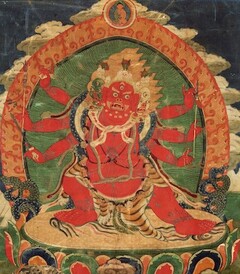
Hayagrīva (‘Horse-Necked’ or ‘Horse-Headed’, from haya, ‘horse’, and grīva, ‘neck’; Tib. rta mgrin) is one of the great wrathful herukas of Tibetan Buddhism. His thunderous neigh is said to shatter delusion and obstruction as effortlessly as a starved horse devours grass, and he is invoked across all schools of Tibetan Buddhism for protection, healing and the removal of obstacles.[1] In India this same name and form belonged to both a deva and an asura, whose myths turn on the revelation and guarding of sacred ritual knowledge—most famously the recovery of the Vedas.[2] Around the mid-seventh century this mingling of demonic and divine qualities eased Hayagrīva’s passage into the Buddhist pantheon as a wrathful vidyārāja, ‘king of spells’, and a manifestation of Avalokiteśvara’s mantra and dhāraṇī.[3] At first he was represented as an attendant at the bodhisattva’s side, appearing in the retinue of such Avalokiteśvara forms as Padmapāṇi, Lokeśvara and Amoghapāśa.[4] Before long, however, Hayagrīva merged with Avalokiteśvara and became a wrathful form of the bodhisattva, and a yidam (yi dam), or meditational deity, in his own right.[5] Where Avalokiteśvara embodies the compassion and enlightened mind of all buddhas, Hayagrīva, as his wrathful counterpart, is honoured accordingly as the heruka of the Lotus (Padma) family. Beyond this, he also plays an important role alongside other tantric deities, or appears within their respective maṇḍalas. He is for example closely linked, for instance, with Vajrapāṇi and Garuḍa; together the three form a wrathful triad whose combined sādhana practice is specified for removing obstacles and illness, particularly nāga-related afflictions.[6] Hayagrīva is counted among the ten wrathful wisdom deities of Vajrakīlaya’s own maṇḍala, where he presides over the western direction.[7]
Subjugation of Rudra
Hayagrīva’s wrathful character is explained above all through his role in the taming of Rudra, a once-devout prince who, corrupted across many lifetimes by pride and anger, rose to become the most powerful and depraved being in the universe, overpowering even the gods and making his palace atop Mount Malaya. When peaceful means failed to move him, the buddhas appeared in wrathful form as the horse-headed Hayagrīva and his consort the sow-headed Vajravārāhī. United in bliss, the pair entered Rudra’s body and made him burst. Rudra at last confessed his misdeeds and was liberated.[8]
Origins
While the teachings of Hayagrīva are believed to have manifested in numerous ways, the Nyingma school (rnying ma) of Tibetan Buddhism holds that their formal revelation in the human world occurred through Guru Padmasambhava and the eight vidyādharas (rig ’dzin), as part of the Kagyé (bka’ brgyad), the ‘Eight Sādhana Teachings’ that lie at the heart of Nyingma tantric practice. Of the eight Indian vidyādharas said to have first received these teachings at the charnel ground of Śītavana near Bodhgayā, it was to Nāgārjuna that the ḍākinī Karmendrāṇī entrusted the copper casket containing the Hayagrīva tantra, making him the teaching’s original recipient and custodian.[9] Each vidyādhara then transmitted his lineage to Guru Padmasambhava, making him the unified embodiment of the entire Kagyé cycle, who brought the teachings first to Tibet and established them there. Within the Kagyé Hayagrīva is revered chiefly as the embodiment of enlightened speech (gsung), and is known besides by such names as Wangchen (dbang chen, ‘Great Power’), Padma Sung (padma gsung, ‘Lotus Speech’) and Padma Heruka.[10]
Iconography
Hayagrīva is generally depicted as red in colour—reflecting his place at the head of Amitābha’s Lotus Family; black, associated with the Nyingma treasure traditions, is the second most frequent; while other body colours are rarer still. His physical forms range correspondingly from the simplest to the most elaborate: a single face and two arms, sometimes shown with his consort Vajravārāhī; three faces and four arms, as in the form transmitted by Atiśa Dīpaṃkaraśrījñāna (982–1055);[11] or three faces and six arms, as in Atiśa’s own longer sādhana, in which Hayagrīva’s central red face is flanked by white and dark blue.[12] In the most elaborate maṇḍala configurations his faces and arms multiply further still, to eight arms or, in the Longchen Nyingtik tradition, five faces and sixteen arms. Across nearly all these forms Hayagrīva is readily identifiable by the small horse’s head—usually dark green, maned in blazing red—that rises from his fiery crown. The loud neigh of this horse-head is interpreted as the roar of the Dharma borne upon the wind.
Hayagrīva in Tibet
Hayagrīva’s practice is believed to have first been brought to Tibet by Guru Padmasambhava. Later masters of the second diffusion (phyi dar), such as Atiśa Dīpaṃkara and Śākyaśrībhadra (1127–1225), also transmitted and further established the practice of Hayagrīva within Tibet.[13]
Guru Padmasambhava himself transmitted the Kagyé teachings primarily at the cave of Samye Chimpu (bsam yas mchims phu). During the empowerment, when throwing the flower to choose the karmically destined deity, Gyalwa Chokyang’s (rgyal ba mchog dbyangs) flower fell on the maṇḍala of Hayagrīva. Consequently, Guru Padmasambhava instructed him to remain in Wentsa (dben rtsa), close to the Chimpu main caves, and practice Hayagrīva. The cave where Gyalwa Chokyang engaged in his retreat became known as Tamdrin Phuk (rta mgrin phug; Hayagrīva Cave). Upon accomplishing Hayagrīva, Gyalwa Chokyang is said to have transformed into the deity, and the neigh of the horse on the crown of his head could be heard far and wide. Gyalwa Chokyang also attained the siddhi of “control over life” and thus could heal those on the brink of death.[14] Gyalwa Chokyang’s family descendants became the custodians of Samye Chimpu.[15] From the paternal side, Longchen Rabjam (klong chen rab ’byams, 1308–1364) was a descendant of Gyalwa Chokyang,[16] and his reincarnations include the Second Karmapa, Karma Pakshi (karma pakṣi, 1204–1283). Guru Padmasambhava alongside Gyalwa Chokyang and other disciples is said to have concealed the Hayagrīva teachings as treasures (gter ma) to be later revealed by treasure revealers (gter ston) such as Nyangral Nyima Özer. Practice of Hayagrīva also ran in particular families: Nyangral himself is said to have spent much of his youth in retreat near his family home in Lhodrak (lho brag), perfecting a tradition of Hayagrīva practice that was already something of a family speciality even before his own revelation of the Kagyé cycle.[17]
The texts gathered in this series belong to this long history of invocation and protection, in which Hayagrīva’s fierce neigh—shattering delusion and obstruction, and revealing the wisdom of Avalokiteśvara’s compassion—continues to be invoked by practitioners as a means to counter illness, obstacles and the poison of the afflictions.
Further Reading
Beer, Robert. The Encyclopedia of Tibetan Symbols and Motifs. Boston: Shambhala, 1999.
Buswell, Robert E., Jr., and Donald S. Lopez Jr. The Princeton Dictionary of Buddhism. Princeton: Princeton University Press, 2014.
Dalton, Jacob P. The Taming of the Demons: Violence and Liberation in Tibetan Buddhism. New Haven: Yale University Press, 2011.
Dudjom Rinpoche. The Nyingma School of Tibetan Buddhism: Its Fundamentals and History. Translated and edited by Gyurme Dorje and Matthew Kapstein. Boston: Wisdom Publications, 1991.
Hirshberg, Daniel A. Remembering the Lotus-Born: Padmasambhava in the History of Tibet’s Golden Age. Somerville, MA: Wisdom, 2016.
Jamgön Kongtrul. The Hundred Tertöns. Translated by Yeshe Gyamtso. Woodstock: KTD Publications, 2011.
Linrothe, Rob N. Ruthless Compassion: Wrathful Deities in Early Indo-Tibetan Esoteric Buddhist Art. Boston: Shambhala, 1999.
Lomi, Benedetta. “Hayagrīva.” In Brill’s Encyclopedia of Buddhism, vol. 2, Lives, edited by Jonathan A. Silk, 218–227. Leiden: Brill, 2019.
Mochizuki, Kaie. “On the Two Hayagrīvasādhanas of Dīpaṃkaraśrījñāna.” Journal of Indian and Buddhist Studies 70, no. 3 (2022): 135–142.
Nayar, Kamala Elizabeth. Hayagrīva in South India: Complexity and Selectivity of a Pan-Indian Hindu Deity. Leiden: Brill, 2004.
Nyoshul Khenpo. A Marvelous Garland of Rare Gems. Junction City: Padma Publishing, 2005.
Samye Translations. Following in Your Footsteps: The Lotus-Born Guru in India, vol. 2. Boudha, Kathmandu: Rangjung Yeshe Publications, 2021.
______. Following in Your Footsteps: The Lotus-Born Guru in Tibet, vol. 3. Boudha, Kathmandu: Rangjung Yeshe Publications, 2023.
Shahar, Meir. “The Tantric Origins of the Horse King: Hayagrīva and the Chinese Horse Cult.” In Chinese and Tibetan Esoteric Buddhism, edited by Yael Bentor and Meir Shahar, 147–190. Leiden: Brill, 2017.
Trautz, Nicholas. “On the bKa’ brgyad bde gshegs ’dus pa: Revelation, Ritual, and the Making of a Tantric Canon in Tibet.” PhD diss., University of California, Berkeley, 2021.
Watt, Jeff. “Buddhist Deity: Hayagriva Iconography.” Himalayan Art Resources. First published 2003; updated 2022. https://www.himalayanart.org/search/set.cfm?setID=5864.
Version: 2.4.2–20260915
Notes
-
Lomi 2019, 218–219. ↩
-
In the Mahābhārata and later Purāṇas, Hayagrīva appears both as a horse-headed form of Viṣṇu who recovers the stolen Vedas and as the demon who steals them; both accounts descend from the older Vedic legend of the sage Dadhyañc Ātharvaṇa, given a horse’s head so that he might teach the forbidden madhu-vidyā (‘doctrine of sweetness’) without incurring Indra’s wrath. Hayagrīva is still venerated in this form as the ‘Reciter of the Vedas’ and in South Asia as the ‘God of Learning.’ Lomi 2019, 218; Nayar 2004. ↩
-
His cult later spread as far as China, where he became the ancestor of the popular Horse King, and Japan, where he is still venerated as Batō Kannon. Lomi 2019. ↩
-
Lomi 2019, 218; Linrothe 1999, 86–88. ↩
-
Buswell and Lopez 2014, 347. ↩
-
Beer 1999, 66. ↩
-
Beer 1999, 247–249. ↩
-
The story of the subjugation of Rudra varies from tantra to tantra. Here, we are following the story as told in the Pema Kathang (padma bka’ thang, The Chronicles of Padma) and the Sertrengwa (gser phreng ba, The Golden Garland Chronicles) as summarized by Samye Translations (2021, 130–134). It is significantly similar to the account in the Anuyoga tantra Gongpa Düpé Do (dgongs pa ’dus pa’i mdo, The Sutra which Gathers All Intentions), which is possibly the most elaborate account of the subjugation of Rudra. For a translation of this story, see Dalton 2011, 159–206. ↩
-
Samye Translations 2021, 152–154. ↩
-
Trautz 2021, 27. ↩
-
Mochizuki 2022, 136. ↩
-
Mochizuki 2022, 137. ↩
-
Trautz 2021, 18; Mochizuki 2022, 135. ↩
-
For short biographies of Gyalwa Chokyang, see e.g. Jamgön Kongtrul 2011, 38–39. ↩
-
Nyoshul Khenpo 2005, 98. ↩
-
Jamgön Kongtrul 2011, 39. ↩
-
Trautz 2021, 14; and Hirshberg 2016, 50–53. ↩