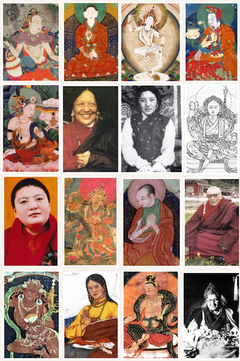
Published in Tibetan in 2017, the Ḍākinīs’ Great Dharma Treasury (mkha’ ’gro’i chos mdzod chen mo) is the largest anthology of writings by and about Buddhist women ever compiled in the Tibetan language, totaling 53 volumes. The creators of this treasure trove are a group of classically educated Tibetan nuns from the largest Buddhist monastic institution in the world, Larung Gar, in the Serta region of eastern Tibet. The Ḍākinīs’ Great Dharma Treasury is a product of the intense commitment of these female cleric-scholars to preserve and promote the teachings and life stories of their Buddhist foremothers. It is among the most exciting publications to come out of modern Tibet, because it contains a plethora of hitherto unknown and never-before-translated texts of myriad genres, enriching and expanding our knowledge about historical Buddhist women and female deities. The Ḍākinīs’ Great Dharma Treasury contains sources that span two thousand years, cross the full terrain of the Tibet plateau and, in a non-sectarian manner, feature women who practiced in varied lineages of Buddhism.
The 53-volume collection includes extracts from the Vinaya and Sūtra sections of the Kangyur, as well as accounts of the origin of major female deities, biographies of important female teachers, the collected writings of figures such as Machik Labdrön (1031–1129 or 1055–1149), Sera Khandro Kunzang Dekyong Wangmo (1892–1940), Do Dasal Wangmo (1928–2018), and Khandro Tāre Lhamo (1938–2003), as well as praises to various ḍākinīs and words of advice given to female practitioners.
Project History
The project took off in 2022 with the translation conference called “Celebrating Buddhist Women’s Voices in the Tibetan Tradition,” organized by Sarah Jacoby, Padma’tsho, Holly Gayley and Dominique Townsend and funded by the Tsadra Foundation and Luce/ACLS. This conference brought together over 70 accomplished and aspiring translators interested in writings by and about Tibetan women. The format for the four-day conference combined keynote lectures, panels, and break-out sessions in the mornings with afternoons dedicated to working on translations-in-progress from the Ḍākinīs’ Great Dharma Treasury in small groups.
For an overview of the conference, see Joshua Brallier’s “Conference Report: The Second Lotsawa Workshop, ‘Celebrating Buddhist Women’s Voices in the Tibetan Tradition,’” published in the Journal of Tibetan Literature. Full session recordings are available here on Tsadra Foundation’s website.
Goal
The ultimate goal of this translation project is twofold: (1) to make as many shorter works as possible from the collection freely available to the public in multiple languages here on Lotsawa House, and (2) to publish a ten-volume set of English translations, side-by-side with the Tibetan originals, through Shambhala Publications, working in collaboration with the Larung Gar nuns who served as compilers and editors of the Tibetan source materials.
Team
Project Co-Director
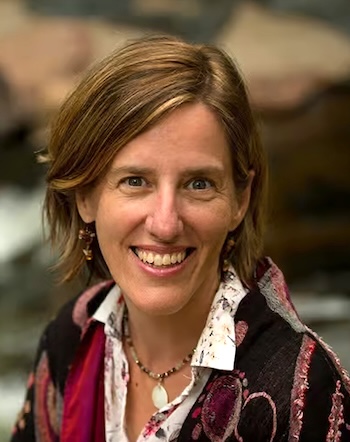
Holly Gayley is a scholar and translator of contemporary Buddhist literature in Tibet and associate professor of Buddhist Studies at the University of Colorado Boulder. Her research explores gender and sexuality in Buddhist tantra, literature by and about Tibetan and Himalayan women, ethical reform in contemporary Tibet, and theorizing translation, both literary and cultural, in the transmission of Buddhist teachings to North America. She is author of Love Letters from Golok: A Tantric Couple in Modern Tibet (2016); translator of Inseparable Across Lifetimes: The Lives and Love Letters of the Buddhist Visionaries Namtrul Rinpoche and Khandro Tāre Lhamo (2019); and editor of Voices from Larung Gar: Shaping Tibetan Buddhism for the Twenty-First Century (2021). Her most recent anthology of translations is Longing to Awaken: Buddhist Devotion in Tibetan Poetry and Song (2024), co-edited with Dominique Townsend.

Project Co-Director
Sarah H. Jacoby is a professor in the Religious Studies Department at Northwestern University in Evanston, Illinois. She specializes in Tibetan Buddhist studies, with research interests in Buddhist revelation (gter ma), religious auto/biography, Tibetan literature, gender and sexuality, translation studies, and the history of eastern Tibet. She is the author of Love and Liberation: Autobiographical Writings of the Tibetan Buddhist Visionary Sera Khandro (Columbia University Press, 2014), co-author of Buddhism: Introducing the Buddhist Experience (Oxford University Press, 2014; 2025), and co-editor of Buddhism Beyond the Monastery: Tantric Practices and their Performers in Tibet and the Himalayas (Brill, 2009). She has recently written articles on Buddhism and motherhood as well as the history of Vajrayāna sexuality. She has also recently sent her completed Tibetan-English translation of the autobiography of Sera Khandro Dewai Dorje (1892–1940) to press. At Northwestern she teaches a range of Buddhist Studies courses for both undergraduate and graduate students.
Project Co-Director
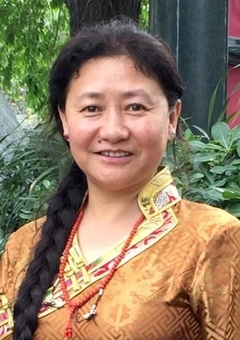
Padma 'tsho (Baimacuo) is Professor in the Philosophy Department of Southwest University for Nationalities (Southwest Minzu University) in Chengdu, China. She holds a Ph.D. from Sichuan University in Chengdu and M.A. from Central Nationalities University in Beijing. She has published about 50 articles and three books on her research. Her areas of research and teaching include Tibetan Buddhism, ritual, Tibetan monasteries as well as the education of Buddhist nuns in Tibetan areas. Her main research article is “How Tibetan Nuns Become Khenmos: The History and Evolution of the Khenmo Degree for Tibetan Nuns” (Religions, 2021). She has also translated a few Tibetan nuns’ writing into English, such as “In Praise of Jetsünma Mumtso (Introduced and Translated)” in Longing to Awaken: Buddhist Devotion in Tibetan Poetry and Song (Virginia, University of Virginia Press, 2024). Other articles have appeared in journals such as Contemporary Buddhism, China Tibetology, Journal of Ethnology, Sichuan Tibetan Studies, and Asian Highlands Perspective. Professor Padma 'tsho has spent time at several North American universities as a Visiting Research Scholar, including Harvard, Columbia, University of Virginia, and CU Boulder.
Highlights
Texts published so far as part of our Ḍākinī Treasury Series include:
Sera Khandro composed this verse autobiography, which is suitable for daily recitation, in 1929, two years after completing a longer, more detailed account of her life. As with many other biographical works in the Tibetan tradition, the story is itself a Dharma teaching, demonstrating the importance of following one’s heart, persevering in the face of difficulties, and cultivating complete trust and devotion. Translated by Christina Monson.
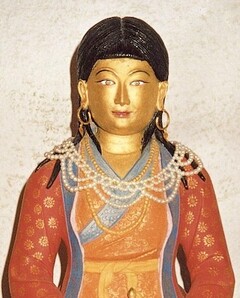
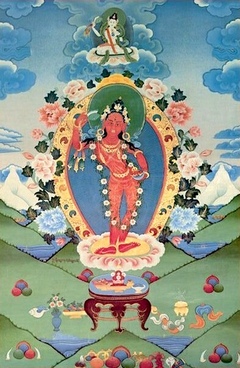
A short sādhana of the wisdom ḍākinī Yeshe Tsogyal in the form of Dechen Gyalmo (Great Bliss Queen) Vajravārāhī.
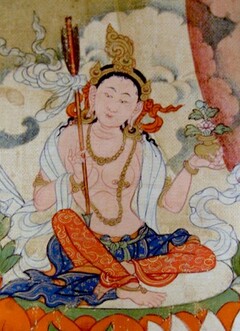
Verses in praise of the eighth-century princess and ḍākinī Mandāravā, one of the principal consorts of Guru Padmasambhava.
Support the Project
Please help by making a donation to support the commissioning of new translations and editorial work.
Donate