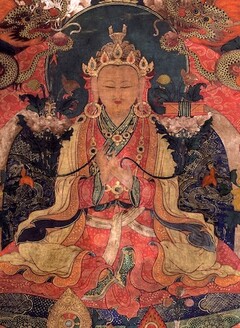
Introduction to the Ten Royal Sūtras
Introduction to the Ten Royal Sūtras
by Stefan Mang
The Ten Royal Sūtras (rgyal po’i mdo bcu), together with the smaller subset known as the Five Royal Sūtras (rgyal po’i mdo lnga), form an important compendium of Mahāyāna scriptures traditionally linked to the eighth-century establishment of Buddhism in Tibet. While the individual texts were already prominent well before their transmission to Tibet and later inclusion in the Tibetan Buddhist canon (bka’ ’gyur), their deliberate grouping as a “royal” collection represents a distinctly Tibetan development.
According to traditional accounts, this set was curated on the recommendation of Guru Padmasambhava for the Dharma King Tri Songdetsen (khri srong lde btsan, 742–c.800), with the aim of harmonizing the king’s spiritual realization, longevity, and the stability of the realm. Although seemingly closely associated with the Tibetan imperial court, these sūtras were not intended solely for royal use. Rather, their origin narrative underscores their elevated status, rendering them “royal” not only as objects of the king’s personal study and practice, but, more importantly, in recognition of their ritual efficacy within the wider corpus of canonical scriptures.
The emphasis on a small number of profound yet concise texts reflects an early Tibetan effort to systematize the vast Buddhist scriptural tradition into a practical framework suitable for daily application. Within this system, each sūtra fulfills a distinct functional role: articulating the philosophical view (lta), supporting meditation (sgom) and guiding conduct (spyod), encompassing the four enlightened activities (las bzhi), and addressing key ritual concerns such as protection, purification, prosperity, and longevity.
These highly revered texts have inspired a substantial body of commentarial literature, as well as the development of associated rituals, liturgies, sādhana practices, and recitation manuals (bklag thabs). They continue to be frequently recited by both monastic and lay practitioners to the present day.
Historical Narrative
The historical legitimacy of the Ten Royal Sūtras rests primarily on the biographical (bka’ thang) literature surrounding Guru Padmasambhava, especially the eighteenth chapter of The Copper Palace (zangs gling ma), revealed by Nyangral Nyima Özer (nyang ral nyi ma ’od zer, 1124/1136–1192/1204), with a brief reference also appearing in the seventieth chapter of The Chronicles of Padma (Padma bka’ thang), revealed by Orgyen Lingpa (o rgyan gling pa, b. 1323).[1] The Copper Palace situates the origin of the royal sūtras at a pivotal moment in the life of Dharma King Tri Songdetsen, at the sacred cave of Drakmar Yamalung (brag dmar g.ya’ ma lung). Recognizing the king’s extraordinary merit and indispensable role as a patron of the Dharma, Padmasambhava sought to bestow upon him a longevity empowerment to ensure the continuation of his enlightened rule.
To this end, the Guru manifested the maṇḍala of Buddha Amitāyus and prepared a ritual vase containing the nectar of immortality. The narrative, however, emphasizes the tension between the newly imported Buddhist tradition and the conservative elements of the Tibetan court. Suspicious of Padmasambhava’s influence, the king’s ministers accused the master of being a self-serving foreigner and alleged that the nectar was in fact poison intended to assassinate the king. Although Tri Songdetsen himself maintained unwavering trust in the Guru, ministerial opposition twice obstructed the bestowal of the longevity empowerment. In response, Guru Padmasambhava concealed a range of longevity sādhana texts and ritual vases as treasures (gter ma) at Yamalung and at numerous other sacred locations.[2]
As the direct ritual transmission was thus obstructed, an alternative supportive practice became necessary. Following Padmasambhava’s instructions, the King’s translators and Indian paṇḍitas identified ten specific sūtras, alongside additional ritual texts,[3] for the King to recite on a daily basis. According to the tradition, this practice proved highly effective: it is credited with extending the king’s life by thirteen years, allowing him to live until the age of sixty-nine, despite an astrological prediction that he would die at fifty-six.
Outline
Following Guru Padmasambhava’s biographies and the outline by Jamgön Mipham Rinpoche (jam mgon mi pham rin po che, 1846–1912), the following sūtras are listed with their specific purposes; the first five comprise the Five Royal Sūtras and, together with the remaining texts, form the Ten Royal Sūtras.
1. The Heart of Wisdom, the sūtra of profound view.
2. The Wisdom at the Hour of Death, the sūtra for meditating on the definitive meaning.
3. The Aspiration to Good Actions, the sūtra for vast prayers of aspiration.
4. The Bodhisattva’s Confession of Downfalls, the sūtra for confessing karmic obscurations.
5. Vajravidāraṇa, the sūtra of cleansing.
6. Sitātapatrā, Born from the Tathāgata’s Uṣṇīṣa, the sūtra of dispelling.
7. The Blue-Clad Lord of Secrets (Vajrapāṇi), the sūtra of protection.
8. The Stream of Wealth (Vasudhārā), the sūtra for increasing prosperity.
9. The One-Syllable Prajñāpāramitā, the sūtra of the essence.
10. The Sūtra of Lord Amitāyus (Boundless Life) the sūtra for longjevity.
Further Reading
Akester, Matthew. Jamyang Khyentsé Wangpo’s Guide to Central Tibet. Chicago: Serindia Publications, 2016.
Dudjom Rinpoche. The Nyingma School of Tibetan Buddhism: Its Fundamentals and History. Trans. and edited by Gyurme Dorje and Matthew Kapstein. Somerville, MA: Wisdom Publications, 1991.
Mipham Rinpoche. “Outline of the Ten Royal Sūtras.” Lotsawa House. Translated by Adam Pearcey, 2021.
Nyangrel Nyima Özer. The Lotus-Born: The Life History of Padmasambhava (Zanglingma). Translated by Erik Pema Kunsang. Boston: Shambala, 1999.
Orgyen Lingpa. The Life and Liberation of Padmasambhava (Vol. 1 & 2). Padma bKa’ thang. Translated into French by GC Toussaint, and into English by K. Douglas and G. Bays. Emeryville: Dharma Publishing, 1978.
Samye Translations. Following in Your Footsteps: The Lotus-Born Guru in Tibet (Vol. 3). Kathmandu: Rangjung Yeshe, 2023.
Version: 1.0–20260108
Notes
-
For the narrative as presented in The Copper Palace, see Nyangrel Nyima Özer 1999, 117–121. For the version preserved in The Chronicles of Padma, see Orgyen Lingpa 1978, 415–416. For a further summary and discussion, see Samye Translations 2023, 231–232. ↩
-
According to The Copper Palace (Nyangrel Nyima Özer 1999, 118), Guru Padmasambhava hid two such vases at Yarlung Sheldrak (yar klungs shel brag) and Drak Yangdzong (bsgrags yang rdzogs). Rigdzin Terdak Lingpa (rig ’dzin gter bdag gling pa, 1646–1714) subsequently discovered the longevity sādhana Union of All Innermost Longevity Practices (tshe sgrub yang snying kun ’dus), at Yamalung itself (Akester 2016, 301 and 302 fn. 4). The Third Karmapa Rangjung Dorje (karma pa rang byung rdo rje, 1284–1339) discovered two longevity treasures at Yamalung and Chimpu (mchims phu) (Dudjom Rinpoche 1991, 573 and Akester 2016, 301). Another longevity vase was borne by ḍākinīs to Pal Chuwori (dpal chub bo ri) and dissolved into the rock at the head of the Tsechu Köpa Labrang (tshes bcu bkod pa bla brang) spring (Akester 2016, 246 and 247 fn. 78). ↩
-
For a list of these additional ritual texts, see Nyangrel Nyima Özer 1999, 120–121. ↩